Last updated 2026-07-26
TL;DR
Baltimore City requires a rental license for nearly every rental unit, renewed every two years, with a pass/fail inspection tied to the Baltimore City housing code. Fees run roughly $50 to $135+ per unit depending on unit count, and operating without a license or letting a license lapse can bring civil citations. Confirm current fees with Baltimore's Department of Housing and Community Development before you file.
Does Baltimore require a rental license and inspection?
Yes. Baltimore City requires almost every residential rental unit to have a current rental license issued through the Department of Housing and Community Development (DHCD), and that license depends on passing a housing inspection. This comes from Baltimore City Code, Article 13, Subtitle 4 (Rental Dwellings), which sets out licensing and registration requirements for rental property owners [1]. The rule applies broadly: single rental rooms, apartments, rowhouses, and multi-unit buildings all fall under it, with a few narrow exemptions (owner-occupied homes with no more than one rented unit, for instance, may fall under a different registration track rather than full licensing, so check your specific property type with DHCD). If you own a rowhouse in Hampden that you rent out, or a triplex in Remington, you're very likely on the hook for a license. Baltimore's system has two related but different obligations that landlords sometimes confuse: rental registration (a lighter-touch requirement that applies to owner-occupied small properties in some cases) and full rental licensing (which requires the inspection). If you're not sure which bucket your property falls into, DHCD's rental licensing office can tell you based on your address and occupancy type. The practical stakes are real. A city that requires licensing can issue violation notices and civil penalties to landlords operating without a valid license, and lenders, title companies, and buyers increasingly check license status during Baltimore real estate transactions.
How often does Baltimore inspect rental units?
Baltimore rental licenses are not permanent. Under the city's licensing structure, licenses require renewal on a recurring cycle, and DHCD ties renewal to a passed inspection rather than just a fee payment [1]. In practice this has meant a two-year cycle for most rental licenses, though the exact renewal interval and inspection frequency can shift as the city updates its rules, so confirm your specific renewal date and inspection requirement directly with DHCD's Baltimore Rental Licensing program. New rental units (a property being rented for the first time, or a change in ownership) typically trigger an initial inspection before DHCD will issue the first license. After that, expect a follow-up inspection at each renewal cycle. If your unit fails, you don't just get flagged, you get a reinspection window (usually 30 days, but confirm the exact window on your notice) to fix the cited items before the license lapses or a fine attaches. One thing that trips up first-time landlords: the inspection clock doesn't pause because you have a good tenant living happily in the unit. If your license comes up for renewal and you skip scheduling the inspection, DHCD can move to lapse the license regardless of whether anyone has complained.
What does a Baltimore rental inspection check?
A Baltimore rental inspection checks the unit against the city's housing code, which covers structural safety, working systems, and basic livability, not cosmetic condition. Inspectors are enforcing Baltimore City Code Article 13, the Housing Code, which sets minimum standards for things like heating, plumbing, electrical, egress, and pest conditions [2]. Common items an inspector will look at: - Working smoke alarms and, where required, carbon monoxide alarms
- Functioning heating system able to maintain code-required minimum temperatures
- No exposed wiring, and outlets/switches in safe working condition
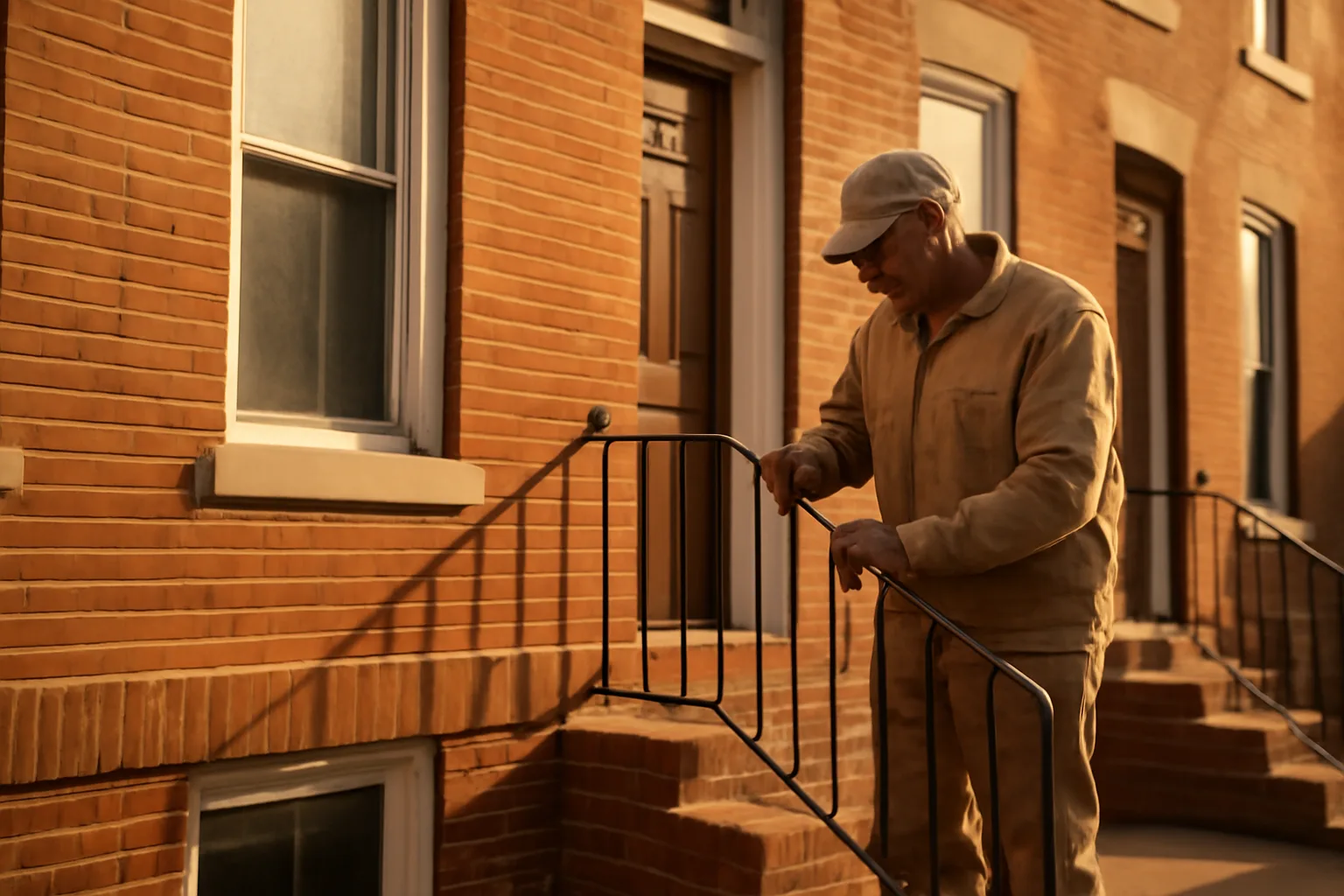
- Secure handrails and guardrails on stairs
- Windows that open, close, and lock, with no broken panes
- No active leaks, water damage, or mold growth from plumbing failures
- Adequate egress (a legal way out of every bedroom in case of fire)
- No evidence of active rodent or insect infestation
- Exterior conditions: peeling exterior paint (a lead paint concern in older Baltimore housing stock), trip hazards, trash accumulation This lines up with what most housing-code inspections look for nationally: general habitability and safety, not whether the paint color matches the trim. If you want a broader sense of what 'what can a landlord look at during an inspection' means in reverse (what inspectors check versus what a landlord can require of tenants during a walkthrough), those are two different inspection contexts and it's worth not conflating them; a city licensing inspection is about code compliance, while a landlord's own periodic property walkthrough is about lease compliance and property condition. Baltimore's older housing stock (a huge share of the city's rowhouses predate 1950) means lead paint risk is a real and specific compliance layer here, on top of the general housing code. Maryland's Reduction of Lead Risk in Housing law requires lead risk reduction certification for most pre-1978 rental properties, tracked through the Maryland Department of the Environment, and Baltimore inspectors will flag properties that lack current lead certification [3].
How much does a Baltimore rental license cost?
| Rental license fee (per unit) | ~$50 to $135+ | Confirm current fee with DHCD | |
|---|---|---|---|
| Smoke/CO alarm (materials) | $10 to $30 each | Hardware store price, not installation labor | |
| Lead risk reduction certificate | Varies widely | Required for most pre-1978 units [3] | |
| Reinspection fee (if applicable) | Confirm with DHCD | Some cities charge this, some don't | If you're trying to get organized before your first Baltimore inspection, a $79 one-time City Rental License & Inspection Prep Packet can save you the time of hunting down every checklist item yourself, though nothing beats calling DHCD directly if you have a property-specific question. |
Rental license fees in Baltimore are charged per unit and the fee schedule has changed more than once in recent years, so treat any number here as a starting point, not gospel. As a general range, landlords should budget somewhere between roughly $50 and $135 or more per unit for the license fee itself, with the exact figure depending on unit count in the building and the current fee schedule DHCD has on file. Confirm the current per-unit fee with Baltimore's Department of Housing and Community Development before you budget or file, because these schedules get updated by city ordinance. On top of the license fee, factor in the cost of actually getting the unit inspection-ready: a working smoke alarm runs $10 to $30 retail, a CO alarm similar, and if you're dealing with peeling exterior paint on an older rowhouse for lead compliance, that repair can run into the hundreds or low thousands depending on scope. If a unit fails and needs a reinspection, some cities charge a reinspection fee separate from the original license fee; ask DHCD whether Baltimore does. | Cost item | Typical range | Notes |
What happens if a rental unit fails inspection in Baltimore?
A failed inspection in Baltimore doesn't mean an automatic fine, but it does start a clock. The inspector documents each code violation on a written notice, and you typically get a defined reinspection window (commonly 30 days, though check your specific notice) to correct the items and request a follow-up visit [2]. If you don't fix the violations and don't get the reinspection scheduled, DHCD can move toward a lapsed or revoked license, and operating a rental unit in Baltimore without a valid license is itself a code violation that can carry civil penalties. Baltimore's code enforcement process allows for civil citations with fines that escalate for repeat or uncorrected violations; exact fine amounts vary by violation type and whether it's a first offense, so check current civil penalty amounts with Baltimore's Department of Housing and Community Development or the Baltimore City Code violations section directly [2]. The unglamorous truth: most failed inspections in Baltimore come down to a handful of repeat offenders. Smoke alarms that are missing or have dead batteries. Handrails that are loose. Exterior paint that's peeling on a pre-1978 property without lead certification on file. None of these are expensive to fix compared to the cost of a lapsed license, a stalled sale, or a tenant complaint escalating into a city inspection referral.
How do I become a landlord in Baltimore (or anywhere)?
Becoming a landlord starts well before you list a unit for rent. At minimum you need: a property you own or control, a legal entity or personal capacity to hold a lease, insurance coverage appropriate to a rental (more than a homeowner's policy), and compliance with your city's registration or licensing rules before you advertise the unit. A basic sequence that works in most licensing cities, Baltimore included: 1. Confirm the property is zoned and legally permitted for rental use. 2. Register or license the property with your city's rental housing office (in Baltimore, that's DHCD) before you sign a lease. 3. Get the unit inspection-ready: working alarms, functioning systems, no open code violations. 4. Line up landlord insurance (a dwelling fire policy or landlord package policy), which differs from a standard homeowner's policy because it covers loss of rental income and liability tied to tenant occupancy. 5. Screen tenants consistently under fair housing law, using the same criteria for every applicant. 6. Use a written lease that matches your state's landlord-tenant law. Baltimore's licensing step is not optional and not a formality. Because the license depends on a passed inspection, it forces you to do steps 2 and 3 in the right order: license first, tenant second. Landlords who skip this and rent first, license later, tend to end up scrambling for repairs with a tenant already living in the unit, which is both harder and more expensive.
What does landlording actually involve day to day?
Landlording is the ongoing work of owning and managing a rental property: collecting rent, maintaining the unit, responding to repair requests, handling turnover, and staying compliant with local law. It's a mix of property management and legal compliance, and in licensing cities like Baltimore, compliance work (license renewals, inspection prep, lead certification) is a bigger and more recurring part of the job than most new landlords expect. A landlord, put simply, is the person or entity that owns residential property and rents it to a tenant under a lease in exchange for rent, taking on responsibility for maintaining the property in habitable condition under state and local law. That habitability obligation is the legal backbone under most state landlord-tenant statutes, and it's also the substance behind what a Baltimore rental inspection is actually checking. Day to day, landlording in a city like Baltimore means: budgeting for the license renewal cycle two years out, keeping a maintenance log so you can show an inspector (or a court, if it comes to that) that you responded to repair requests promptly, and knowing your local eviction and notice rules well enough that you don't accidentally violate them when a tenant relationship goes bad. For city-specific tenant protections that intersect with your obligations as a landlord, see tenants rights and renters rights.
What rights do tenants have without a written lease?
A tenant without a written lease still has real legal protections; the lack of paper doesn't strip their rights. In most states, an oral or implied agreement to pay rent for occupancy creates a tenancy, typically treated as month-to-month, and the tenant retains protections against illegal lockout, retaliatory eviction, and the right to a habitable unit under the state's landlord-tenant law and local housing code. What changes without a lease is mostly the notice period and the specifics of what was agreed. Without written terms, courts generally fall back on the state's default rules for month-to-month tenancies, which usually require the landlord to give a set notice period (commonly 30 days, though this varies significantly by state and sometimes by how long the tenant has lived there) before ending the tenancy or raising rent. Maryland law, for context, treats an oral lease for residential property as valid but generally limits its enforceable term; longer-term oral leases can run into Maryland's Statute of Frauds issues, which is one more reason experienced Baltimore landlords use a written lease even for month-to-month arrangements. For the tenant-facing side of this question, see tenant rights and tenant and tenant disputes over verbal agreements.
How much notice does a landlord have to give a tenant?
Notice periods depend entirely on your state and the reason for the notice, and there's no single national number. Common patterns: 30 days' notice to end or change a month-to-month tenancy is typical in many states, but some require 60 or even 90 days depending on how long the tenant has lived there or local rent stabilization rules. Notice to enter for a non-emergency repair or inspection is often shorter, commonly 24 to 48 hours' advance notice, again set by state statute. For Baltimore specifically, Maryland's landlord-tenant statutes and any Baltimore City-specific tenant protections govern notice to enter and notice to terminate; because these rules can and do change, and because Baltimore City has at times layered additional local tenant protections on top of state minimums, confirm your current required notice period with the Maryland courts' landlord-tenant resources or a local tenant rights organization before you send any notice. The safest practice, regardless of the legal minimum: give more notice than required, and give it in writing, even for something as routine as scheduling the city inspection walkthrough. It cuts down on disputes and gives you a paper trail if a tenant later claims they weren't told.
What can a landlord look at during an inspection?
During a routine landlord inspection (as distinct from a city licensing inspection), a landlord can generally look at the general condition and safety of the unit: checking for damage beyond normal wear and tear, verifying smoke detectors work, confirming no unauthorized occupants or pets are present if the lease restricts them, and checking for maintenance issues like leaks or pest activity that need attention. What a landlord typically cannot do, in most states, is use an inspection as a pretext to search personal belongings, go through drawers or closets unrelated to a maintenance issue, or enter without the legally required advance notice except in a genuine emergency (fire, active flooding, gas leak). The inspection is about the property, not the tenant's possessions. This is a different animal from who's responsible for a walkthrough inspection in a state like California, where a landlord (or their agent) conducting a pre-move-out inspection has to provide the tenant a written itemized statement of deficiencies under California Civil Code Section 1950.5, giving the tenant a chance to fix issues before move-out charges are assessed against the security deposit [4]. Baltimore doesn't have an identical statute, but the underlying principle (notice, and a chance to remedy before money changes hands) shows up across most states' landlord-tenant frameworks in some form.
What can't a landlord do in Ohio (and how does that compare to Baltimore)?
Ohio landlord-tenant law, under Ohio Revised Code Chapter 5321, prohibits a landlord from several specific actions: entering the rental unit without reasonable notice (Ohio's standard is generally 24 hours except in an emergency), shutting off utilities to force a tenant out, removing a tenant's belongings or changing the locks without a court order (a 'self-help eviction'), and retaliating against a tenant for exercising a legal right like reporting a code violation [5]. Ohio's statute states landlords must give tenants 'reasonable notice of the landlord's intent to enter' and that entry must happen 'at reasonable times,' language echoed in some form in most states' entry statutes [5]. Baltimore and Maryland don't operate under Ohio's statute, obviously, but the same categories of prohibited conduct (no lockouts, no utility shutoffs, no retaliation, notice before entry) are common threads across almost every state's landlord-tenant code, including Maryland's. If you're comparing landlord obligations across states because you own property in more than one, the safest baseline assumption is: self-help eviction is illegal everywhere in the U.S., and every state requires some form of advance notice before non-emergency entry.
Why do landlords require renters insurance?
Landlords require renters insurance mainly to shift liability and personal property risk away from the landlord's own policy. A landlord's insurance covers the building and the landlord's liability as property owner, but it typically doesn't cover a tenant's personal belongings, and it may not fully cover a liability claim that originates from the tenant's own actions (a candle fire, a dog bite, a guest injury caused by the tenant's negligence). Requiring renters insurance, usually with a modest liability minimum ($100,000 is common), pushes that risk onto a policy the tenant pays for, often $15 to $30 a month depending on coverage and location. It also gives the landlord a practical backstop: if a tenant's negligence damages the unit or a neighboring unit, the tenant's renters insurance can be the first line of recovery instead of the landlord's own claim history taking the hit. Whether a Baltimore landlord can legally require renters insurance as a lease condition is generally yes, it's a standard and enforceable lease term in Maryland, but it has to be disclosed clearly in the lease and applied consistently to all tenants to avoid fair housing issues.
Frequently asked questions
How often does Baltimore inspect rental properties?
Baltimore rental licenses require a passed inspection tied to the renewal cycle, which has generally run every two years, though DHCD updates fee and renewal schedules periodically. Confirm your exact renewal date and inspection frequency directly with Baltimore's Department of Housing and Community Development, since the interval can change by ordinance.
How much does a Baltimore rental license cost per unit?
Expect roughly $50 to $135 or more per unit, depending on the current DHCD fee schedule and the number of units in the building. Fee schedules change by city ordinance, so confirm the exact current amount with Baltimore's Department of Housing and Community Development before budgeting.
What happens if I rent a unit in Baltimore without a license?
Operating an unlicensed rental in Baltimore is a code violation under Baltimore City Code Article 13, and DHCD can issue civil citations with escalating fines for continued noncompliance. It can also complicate refinancing or selling the property, since many title companies and lenders check license status.
Does Baltimore require lead paint certification for rentals?
Most Baltimore rental units built before 1978 need lead risk reduction certification under Maryland's Reduction of Lead Risk in Housing law, tracked through the Maryland Department of the Environment. Given Baltimore's older housing stock, inspectors commonly flag peeling exterior or interior paint tied to missing lead certification.
How to become a landlord?
Confirm your property can legally be rented, register or license it with your city's rental housing office, get landlord insurance (more than a homeowner's policy), make sure the unit meets local housing code, and use a written lease consistent with your state's landlord-tenant law. In licensing cities like Baltimore, do the licensing and inspection step before signing a lease, not after.
Who is responsible for a rental property walk-through inspection in California?
In California, the landlord (or their agent) is responsible for offering a pre-move-out inspection if requested, and must provide the tenant a written itemized statement of needed repairs or cleaning under California Civil Code Section 1950.5, giving the tenant a chance to address items before move-out deductions are made from the deposit.
What is landlording?
Landlording is the ongoing work of owning and managing rental property: collecting rent, handling maintenance and repairs, managing tenant turnover, and staying compliant with local registration, licensing, and habitability laws. In licensing cities, a meaningful share of landlording is administrative compliance, more than property upkeep.
What is a landlord, legally speaking?
A landlord is the person or entity that owns residential property and rents it to a tenant under a lease agreement, taking on a legal duty to maintain the property in habitable condition under state and local housing law. That habitability duty is the legal basis for most rental inspection programs, including Baltimore's.
What rights do tenants have without a lease?
A tenant without a written lease generally still has month-to-month tenancy protections under state law, including protection from illegal lockout and a right to habitable housing. What typically changes is the required notice period for ending the tenancy, which falls back to the state's statutory default, commonly 30 days but varying by state.
How much notice does a landlord have to give before entering a unit?
Most states require 24 to 48 hours' advance notice for non-emergency entry, though the exact figure is set by state statute and varies. Ohio, for example, requires 'reasonable notice' under Ohio Revised Code 5321.04, generally interpreted as 24 hours. Maryland and Baltimore-specific notice requirements should be confirmed directly since local rules can layer on top of state minimums.
What can a landlord look at during an inspection?
A landlord can generally check for property damage, working smoke detectors, unauthorized occupants or pets, and maintenance issues like leaks or pest activity. A landlord generally cannot use an inspection to search personal belongings unrelated to a maintenance concern or enter without legally required notice except in a genuine emergency.
What can't a landlord do in Ohio?
Under Ohio Revised Code Chapter 5321, a landlord cannot enter without reasonable notice, shut off utilities to force a tenant out, change locks or remove belongings without a court order, or retaliate against a tenant for reporting a code violation or exercising a legal right.
Why do landlords require renters insurance?
Renters insurance shifts liability for the tenant's belongings and tenant-caused incidents (like a kitchen fire or a guest injury) away from the landlord's own policy and claim history. It's a low-cost requirement, often $15 to $30 a month, that gives landlords a practical first line of financial recovery.
Sources
- Baltimore City Code, Article 13, Subtitle 4 (Rental Dwellings): Baltimore requires rental licensing for residential rental units, tied to inspection and renewal
- Baltimore City Code, Article 13, Subtitle 5 (Housing Standards): Baltimore housing code sets minimum property maintenance and safety standards enforced through inspection
- Maryland Department of the Environment, Reduction of Lead Risk in Housing: Maryland requires lead risk reduction certification for most pre-1978 rental housing
- California Civil Code Section 1950.5: California requires landlords to offer a pre-move-out inspection with a written itemized statement of deficiencies
- Ohio Revised Code Section 5321.04: Ohio law requires reasonable notice before landlord entry and defines landlord obligations and prohibitions