Last updated 2026-07-25
TL;DR
Becoming a landlord means more than buying a property and finding a tenant. Most cities require rental registration or licensing, some require an inspection before you can rent, and every state has rules on notice periods and tenant rights. Skipping these steps is the fastest way to a fine or a stalled lease-up.
What is a landlord, and what does landlording actually mean?
A landlord is the owner of a property (or their authorized agent) who rents that property to someone else, called a tenant, in exchange for regular payment. The relationship is defined by a lease or rental agreement, which can be written or, in many states, oral. "Landlording" is the informal industry term for the whole job: finding and screening tenants, collecting rent, handling repairs, following local and state law, and managing the property day to day. Most people picture landlording as just owning a rental unit and cashing checks. In practice it's closer to running a small regulated business. You're subject to fair housing law under the federal Fair Housing Act, which bans discrimination based on race, color, national origin, religion, sex, familial status, and disability [1]. You're also subject to your state's landlord-tenant code and, in a growing number of cities, a rental licensing or registration ordinance that requires you to register the unit, pay a fee, and sometimes pass an inspection before you can legally rent it out. If you own 1 to 10 units, you're the exact reader this whole industry of rental licensing rules was built around. Cities like Los Angeles, Baltimore, Minneapolis, and dozens of others require landlords with even a single rental unit to register or license that property annually [2]. Ignoring that requirement doesn't make it go away. It usually shows up later as a fine, a lien, or a blocked eviction filing.
How do you become a landlord, step by step?
Becoming a landlord has a real sequence, and skipping steps is how people end up with fines or unenforceable leases. Here's the order that actually works. 1. Confirm zoning allows rental use. Some single-family zones restrict short-term or even long-term rentals, especially in HOAs or co-ops. 2. Check your city's rental licensing or registration requirement. Search "[your city] rental license" or call your city's housing or code enforcement department directly. Requirements and fees vary enormously by city, so confirm the current fee and deadline with your city rental licensing office rather than relying on a number you saw online. 3. Get the property inspection-ready if your city requires one. Working smoke and carbon monoxide detectors, no exposed wiring, functioning heat, and no obvious code violations are common baseline items. 4. Get landlord insurance (more than a homeowner's policy) and decide your renters insurance policy for tenants. 5. Screen tenants consistently and legally. Run credit, background, and eviction history checks the same way for every applicant to avoid fair housing exposure. 6. Sign a lease that complies with your state's landlord-tenant statute (security deposit limits, disclosures, etc.). 7. Register with your city if required, and renew every year. Many licensing programs, like Minneapolis's rental license program, require renewal and reinspection on a set cycle rather than a one-time application [2]. A lot of new landlords do steps 5 and 6 first and treat licensing as an afterthought. That's backwards in a licensing city. If you sign a lease and take a security deposit before you're licensed, some cities (Los Angeles among them) allow tenants to raise your unlicensed status as a defense in an eviction case [3].
What is landlording as a business, and is it worth it for 1-10 units?
Landlording at small scale (1 to 10 units) is a part-time small business with real compliance obligations, not a passive income hack. You're managing three separate risk categories: legal (lease terms, fair housing, notice periods), physical (maintenance, code compliance, inspections), and financial (vacancy, nonpayment, capital repairs). The economics can work. The IRS allows depreciation of residential rental property over 27.5 years, which is a real tax benefit unavailable to most other small investments [4]. But the administrative load is heavier than most new landlords expect, especially once your city adds a rental registration or inspection requirement on top of your state's landlord-tenant code. If you're deciding whether to self-manage or hire a property manager, the honest answer depends on how far you live from the property and how much you value your weekends. A property manager typically costs 8% to 12% of monthly rent [5], which is worth it for many out-of-state or time-strapped owners, and a waste of money if you live five minutes away and don't mind fielding a call about a broken garbage disposal.
Who is responsible for the rental property walk-through inspection in California?
In California, the landlord is responsible for both the move-in and move-out walk-through inspections, and state law gives tenants specific rights around the move-out version. Under California Civil Code Section 1950.5, a landlord must, upon the tenant's request, conduct an initial inspection before the tenant moves out, give the tenant an itemized list of deficiencies, and allow a reasonable opportunity to fix them before the final deposit deduction [6]. The law is specific: "The landlord shall give the tenant reasonable notice of the date and time of the initial inspection... not less than 48 hours prior to the inspection, in the manner prescribed by Section 1962" (Cal. Civ. Code § 1950.5(f)(1)) [6]. If the tenant doesn't request the pre-move-out inspection, the landlord still does a final inspection after the tenant leaves to assess damage against the security deposit, but without the advance-notice-and-cure step. This is separate from any city-level rental inspection program. Some California cities (Los Angeles's Systematic Code Enforcement Program is a well-known example) require periodic habitability inspections of rental units regardless of tenant turnover, and those are run by city inspectors, not the landlord [7]. So you can have two different "inspections" going on: the landlord-tenant move-out inspection under state law, and a city code inspector's habitability check under a local ordinance.
What can a landlord look at during an inspection?
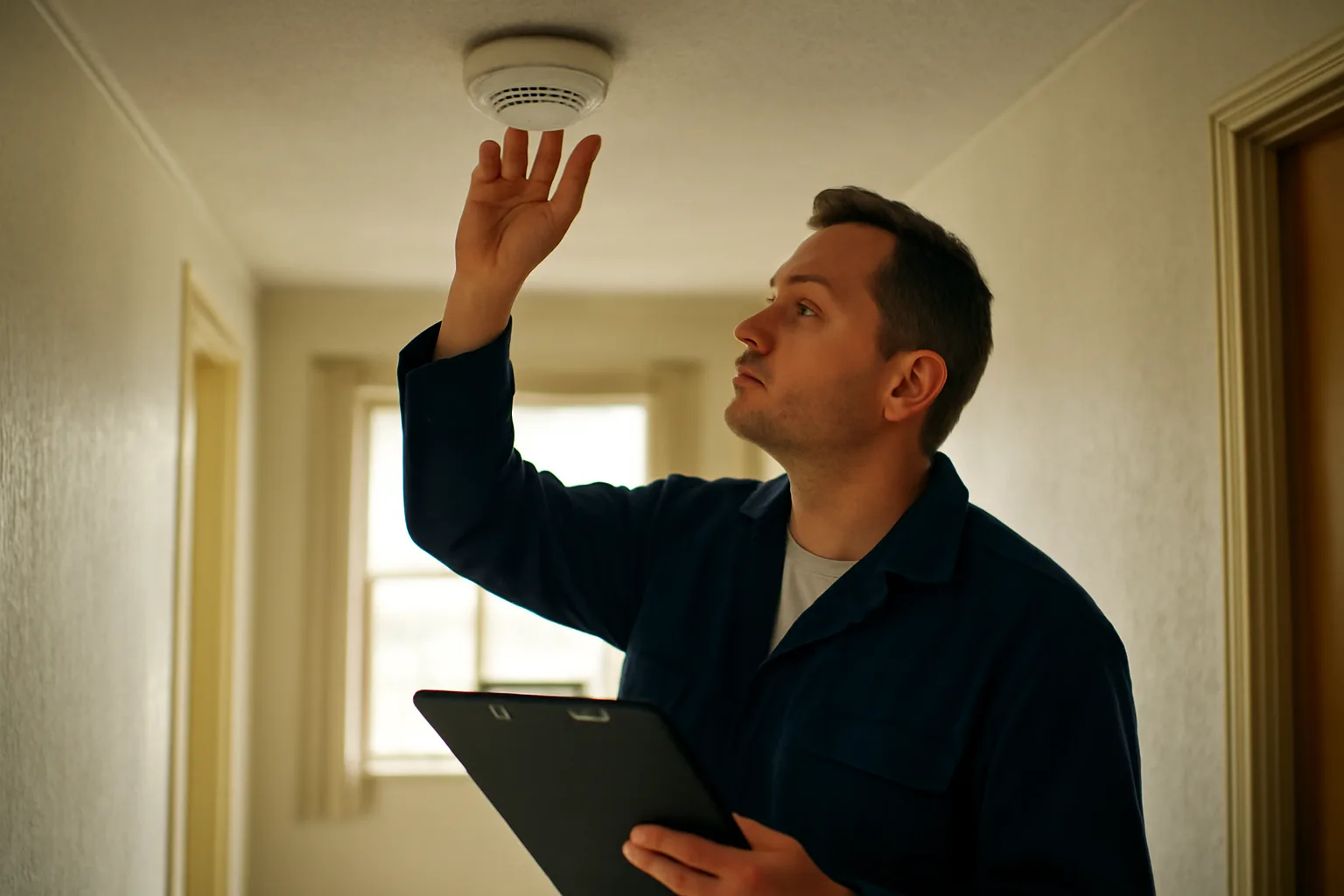
During a routine or move-in/move-out inspection, a landlord can generally check anything related to the physical condition of the unit and compliance with the lease. That means smoke and carbon monoxide detectors, plumbing and water damage, electrical outlets and fixtures, HVAC function, wall and floor condition, appliance condition, window and door locks, and signs of unauthorized pets or occupants or lease violations. What a landlord generally cannot do is treat an inspection as a general search. Most states require advance notice (commonly 24 to 48 hours) before entering an occupied unit for a non-emergency inspection, and the inspection has to be for a legitimate purpose like maintenance, safety, or a scheduled turnover check, not to harass a tenant or go through personal belongings unrelated to the property's condition. City rental inspection programs add another layer. A city code inspector checking for a rental license renewal typically looks at the items on that city's published checklist: smoke/CO detectors, egress windows in bedrooms, handrails, water heater strapping or pressure relief valves, and any visible code violations. They are not there to evaluate your tenant's housekeeping or personal property, only the structural and safety condition of the unit.
How much notice does a landlord have to give before entering or ending a tenancy?
Notice requirements split into two very different categories: notice to enter the unit, and notice to end the tenancy. Both vary by state, so treat any specific number as a starting point to verify against your own state's statute. For entry, many states require 24 hours' written or verbal notice before a landlord can enter an occupied unit for a non-emergency reason, though a few states specify 48 hours and some don't set a statutory minimum at all, defaulting instead to "reasonable notice." California, for example, presumes 24 hours is reasonable notice for entry under Civil Code Section 1954 [8]. For ending a month-to-month tenancy, notice periods commonly range from 30 to 60 days depending on the state and sometimes on how long the tenant has lived there. California requires 60 days' notice to terminate a month-to-month tenancy if the tenant has lived in the unit a year or more, and 30 days if less than a year (Cal. Civ. Code § 1946.1) [9]. For nonpayment of rent, notice periods are usually much shorter, often 3 to 14 days depending on the state, before a landlord can file for eviction. These numbers move constantly as state legislatures amend landlord-tenant codes, so confirm your state's current notice period rather than assuming last year's rule still applies.
What rights do tenants have without a lease?
A tenant without a written lease still has real legal rights. If a tenant is paying rent and the landlord is accepting it, most states treat this as an implied month-to-month tenancy governed by the state's landlord-tenant statute, even with nothing in writing. That means a tenant without a lease still generally has the right to: a habitable unit (working plumbing, heat, structural safety), advance notice before the landlord enters, advance notice before the tenancy is terminated (usually 30 days for month-to-month, though this varies by state), protection from retaliatory or discriminatory eviction, and, in many states, a required security deposit return timeline and itemized deduction list if a deposit was collected. What a tenant without a lease does not have is certainty around rent increases or the exact terms of the arrangement, which is exactly why oral or handshake arrangements create disputes. If you're a landlord operating without a written lease, you're not outside the law, you're just relying on your state's default statutory terms instead of terms you chose yourself. That's rarely in the landlord's interest.
Why do landlords require renters insurance?
Landlords require renters insurance mainly to shift liability for the tenant's personal property and to cover liability if the tenant's negligence causes damage or injury. A landlord's own property insurance covers the building and the landlord's fixtures and appliances. It does not cover the tenant's furniture, electronics, or clothing, and it typically doesn't cover a lawsuit if the tenant's actions (an unattended candle, an overflowing bathtub) damage someone else's unit or injure a guest. A typical renters insurance policy costs relatively little, commonly cited in the $15 to $30 per month range depending on coverage and location, and includes personal liability coverage, often $100,000 or more. Requiring it as a lease condition is legal in most states and increasingly standard practice, especially in multi-unit buildings where one unit's water damage can cascade into three others. From the landlord's side, requiring renters insurance reduces the odds that a tenant's uninsured loss turns into a demand that you cover it, or a legal fight over who was responsible for damage. It's a cheap risk transfer, and most landlord attorneys who work with small owners recommend it as standard lease language.
What can a landlord not do in Ohio?
Ohio's landlord-tenant law, codified mainly in Ohio Revised Code Chapter 5321, sets specific limits on landlord conduct. A landlord in Ohio cannot shut off utilities, change the locks, or remove a tenant's belongings to force them out, a practice generally known as "self-help eviction." Ohio law requires landlords to go through the court eviction process (forcible entry and detainer action) rather than acting unilaterally . A landlord in Ohio also cannot enter the rental unit without reasonable notice, generally interpreted as 24 hours, except in genuine emergencies. Ohio Revised Code 5321.04 requires landlords to maintain the premises in a fit and habitable condition, keep common areas safe, and maintain electrical, plumbing, and heating systems in good working order . Failing to do so, and then trying to evict a tenant who withholds rent over the disrepair, can backfire on the landlord if the tenant used Ohio's statutory rent escrow procedure correctly. Ohio also prohibits retaliatory conduct, meaning a landlord cannot raise rent, decrease services, or file eviction specifically because a tenant reported a code violation or joined a tenant union, within a protected window after that action. And like every state, Ohio landlords are bound by the federal Fair Housing Act's protections against discrimination in rental decisions [1].
How does rental licensing interact with all of this?
Everything above (inspections, notice periods, tenant rights, insurance) sits on top of a separate layer that a lot of new landlords miss entirely: city-level rental licensing and registration. These are local ordinances, completely separate from your state's landlord-tenant code, that require you to register your rental property with the city, often pay an annual fee, and sometimes pass a habitability inspection before you're legally allowed to rent it out. The number of cities doing this has grown steadily. Rental registration or licensing ordinances exist in cities across nearly every state, from small towns with a simple annual registration fee to large cities like Baltimore, which requires an annual rental license and periodic lead paint and habitability inspections for most rental units . The fee, the inspection checklist, and the renewal cycle are entirely city-specific. Some charge under $50 a year for a single-family rental, others charge several hundred dollars per unit, and inspection cycles range from every year to once every three years. There's no honest way to give you a national number, so confirm the current fee and inspection requirement with your city rental licensing office before you budget for it. If you've gotten a notice from your city, a scheduled inspection date, or a violation letter with a fine attached, that's usually your city's code enforcement or housing department telling you that you're now in their system, whether you registered voluntarily or not. Getting organized before that inspection (fixing detectors, checking egress windows, gathering your lease and registration paperwork) matters more than anything else at that point. Our $79 one-time City Rental License & Inspection Prep Packet is built for exactly that moment: a checklist and document set to get one rental unit inspection-ready and licensed without hiring an attorney for a routine registration.
What should you do if you got a rental license violation notice or fine?
First, read the notice carefully for the specific code section cited and the deadline to respond or cure the violation. Most cities give a cure period, often 10 to 30 days, before a fine escalates or a hearing is scheduled. Don't assume the fine is final just because it's printed on the letter. Second, call the office listed on the notice, not a generic city hall number. Ask directly: what exactly needs to be fixed, what's the reinspection process, and is there a payment plan or reduced fine for first-time violations. Many code enforcement offices will work with a landlord who responds quickly and in good faith, and escalate hard against one who ignores the notice. Third, document everything you fix, with dated photos, before the reinspection. If the violation involves a missing rental license entirely (more than a failed inspection item), get the registration application filed immediately, since some cities' fines are calculated per day of unlicensed operation, and that number grows every day you wait. If you're unsure whether a fine or process is being applied correctly, that's a question for a local landlord-tenant attorney, not a general guide like this one. This article is not legal advice, and specific violation disputes deserve a professional who knows your city's code.
Frequently asked questions
How do you become a landlord if you've never rented out a property before?
Confirm zoning allows rental use, check whether your city requires rental registration or licensing, get the unit inspection-ready (working smoke/CO detectors, no code violations), buy landlord insurance, screen tenants consistently, and sign a lease compliant with your state's landlord-tenant statute. Register with your city before you sign a lease if licensing is required there, not after.
Who is responsible for the rental property walk-through inspection in California?
The landlord is responsible for conducting both move-in and move-out inspections. Under California Civil Code Section 1950.5, if a tenant requests it, the landlord must do an initial inspection before move-out, give an itemized list of needed repairs, and allow the tenant a reasonable chance to fix them before deducting from the deposit.
What is landlording?
Landlording is the day-to-day job of owning and managing a rental property: finding and screening tenants, collecting rent, handling maintenance and repairs, following state landlord-tenant law and any city licensing rules, and managing the tenant relationship through move-in, the lease term, and move-out.
What is a landlord, legally speaking?
A landlord is the owner of real property, or their authorized agent, who rents that property to a tenant under a lease or rental agreement in exchange for rent. Landlords are bound by federal fair housing law and by their state's landlord-tenant code, and in licensing cities, by local rental registration ordinances too.
What rights do tenants have without a lease?
A tenant paying rent without a written lease is usually treated as a month-to-month tenant under state default law. They still generally have the right to a habitable unit, advance notice before entry, advance notice before termination (often 30 days), and protection from retaliatory or discriminatory eviction, even with nothing in writing.
Why do landlords require renters insurance?
Renters insurance covers the tenant's personal belongings and adds liability coverage if the tenant's negligence causes damage or injury, none of which the landlord's own property insurance covers. It's a cheap risk transfer, typically $15 to $30 a month for the tenant, that protects the landlord from disputes over uninsured tenant losses.
How much notice does a landlord have to give before entering the unit?
Most states require 24 to 48 hours' notice before a non-emergency entry. California presumes 24 hours is reasonable notice under Civil Code Section 1954. Check your specific state's statute, since some states set no fixed number and instead require only "reasonable" notice, which local courts interpret.
How much notice does a landlord have to give to end a month-to-month tenancy?
It commonly ranges from 30 to 60 days depending on the state and, in some states like California, on how long the tenant has lived there. California requires 60 days' notice if the tenant has been there a year or more, 30 days if less, under Civil Code Section 1946.1.
What can a landlord look at during an inspection?
A landlord can inspect smoke and CO detectors, plumbing, electrical, HVAC, appliance condition, and general lease compliance. They generally cannot search personal belongings unrelated to the unit's condition or use an inspection as a pretext to harass a tenant. City rental inspections focus specifically on safety and code items.
What can a landlord not do in Ohio?
Ohio landlords cannot shut off utilities, change locks, or remove belongings to force a tenant out (self-help eviction is illegal there); they must use the court eviction process. Ohio Revised Code 5321.04 also requires maintaining the unit in fit and habitable condition, and landlords cannot retaliate against tenants for reporting code violations.
Do all cities require a rental license, or just some?
Only some cities require it, but the list is long and growing, including major cities like Baltimore, Minneapolis, and Los Angeles. Requirements, fees, and inspection cycles are entirely local. Search your specific city's housing or code enforcement department, since there's no statewide or national rental licensing rule.
What happens if a landlord doesn't get the required rental license?
Consequences vary by city but commonly include daily accruing fines, inability to file an eviction until the property is licensed (an issue in cities like Los Angeles), and back-fees owed once the city discovers the unlicensed unit. Getting licensed before signing a lease avoids nearly all of this.
Sources
- U.S. Dept. of Housing and Urban Development, Fair Housing Act overview: Federal Fair Housing Act bans discrimination based on race, color, national origin, religion, sex, familial status, and disability
- City of Los Angeles Housing Department, Rent Registration: Los Angeles requires landlords to register rental units with the city
- IRS Publication 527, Residential Rental Property: IRS allows depreciation of residential rental property over 27.5 years
- U.S. Small Business Administration / industry property management fee ranges: Property managers typically charge 8% to 12% of monthly rent
- California Civil Code Section 1950.5: California requires landlords to give tenants at least 48 hours notice of an initial move-out inspection and a chance to cure deficiencies
- California Civil Code Section 1954: California presumes 24 hours notice is reasonable notice before landlord entry
- California Civil Code Section 1946.1: California requires 60 days notice to end a month-to-month tenancy of a year or more, 30 days if less
- Ohio Revised Code Chapter 5321, Landlords and Tenants: Ohio requires landlords to use the court eviction process rather than self-help eviction
- Ohio Revised Code Section 5321.04: Ohio landlords must keep the premises in a fit and habitable condition and maintain electrical, plumbing, and heating systems