Last updated 2026-07-25
TL;DR
Becoming a landlord means registering with your city or county where required, screening tenants legally, and following state notice and inspection rules. Tenants without a lease still have rights under state law (usually month-to-month protections). Landlords can inspect for safety and lease compliance but can't search personal belongings or show up unannounced in most states.
What is a landlord, exactly?
A landlord is anyone who owns residential property and rents it to someone else in exchange for payment, called rent. That's the whole legal definition at its core. You don't need a business license to be a landlord in most places, though plenty of cities require rental registration or licensing once you're renting out a unit, which is a separate requirement from just being a landlord in the general sense. The legal relationship is created by a lease or rental agreement, written or verbal, that gives the tenant the right to occupy the space (called "quiet enjoyment" in most state landlord-tenant statutes) in exchange for rent. Once that relationship exists, both sides have obligations. The landlord has to maintain habitability. The tenant has to pay rent and not damage the property. Some states define "landlord" formally in statute. California's Civil Code, for example, treats the landlord as the party with a legal or equitable ownership interest who has agreed to let another party possess the property [1]. Other states use similar language in their landlord-tenant acts. If you're renting out even one unit, one room, or a basement apartment, you're a landlord under these definitions, full stop.
What is landlording, and is it a full-time job?
"Landlording" is just the ongoing work of managing a rental: collecting rent, handling repairs, screening tenants, following local and state law, and dealing with turnover. For a single unit, it's a part-time job that eats maybe a few hours a month, more when something breaks or a tenant moves out. Most small landlords (1 to 10 units) do it alongside a regular job. The workload spikes around move-ins, move-outs, and anything involving the city rental inspection cycle if your municipality requires one. The actual day-to-day is mostly reactive: a maintenance call, a late rent notice, a lease renewal. What catches new landlords off guard isn't the tenant relationship, it's the paperwork. Rental registration deadlines, inspection scheduling, insurance renewal, and local ordinance changes pile up fast if you're not tracking them. That's genuinely where most first-year landlords lose time and money, not from bad tenants but from missing a city registration deadline or failing an inspection they didn't know was coming.
How do you become a landlord, step by step?
There's no license required to legally rent out property in most of the U.S., but there's a real sequence that protects you and keeps you compliant. 1. Confirm zoning allows rental use. Check with your city or county planning department, especially for a duplex conversion or accessory dwelling unit. 2. Check whether your city requires rental registration or licensing. Many cities with 50,000+ population, and a growing number of smaller ones, require landlords to register the property, pay an annual fee, and pass a habitability inspection before renting. Fees and rules vary widely by city, so confirm with your city rental licensing office directly rather than assuming a neighboring city's rules apply. 3. Get landlord insurance (a dwelling fire policy or landlord policy, different from a standard homeowner's policy). Standard homeowner's insurance typically excludes rental use, and most mortgage lenders and umbrella policies expect a proper landlord policy once the property is tenant-occupied. 4. Set your lease terms and rent price based on comparable local rentals. 5. Screen tenants using a consistent, written process (credit check, income verification, rental history, background check) applied the same way to every applicant. The Fair Housing Act prohibits discrimination based on race, color, national origin, religion, sex, familial status, or disability in this process [2]. 6. Collect a security deposit within your state's legal limit and hold it according to state rules (many states require a separate account and written notice of where it's held). 7. Sign the lease, document the unit's condition with photos, and hand over keys. If your city requires a rental license or inspection before you can legally rent, do that before you advertise the unit. Some cities won't let you sign a new lease, or will fine you, if the property isn't registered first.
What rights do tenants have without a written lease?
A tenant without a written lease still has full legal protection under state landlord-tenant law. No lease doesn't mean no rights. It usually means a month-to-month tenancy is created by default, governed entirely by state statute rather than by written terms. Under a verbal or implied month-to-month arrangement, tenants generally keep the right to habitable housing, protection from illegal lockouts or utility shutoffs, the right to proper notice before eviction, and the right to their security deposit back under the same rules as a written lease. The landlord still can't just change the locks or remove belongings without going through the legal eviction process in nearly every state. What a verbal lease usually lacks is clarity on things like who pays for what repairs, pet policies, or subletting rules, which makes disputes harder to resolve. Some states, like California, allow oral leases for terms under one year (California's Statute of Frauds requires leases longer than one year to be in writing) [3], but month-to-month oral agreements are common and enforceable almost everywhere. If you're the landlord and you never signed a lease with a current tenant, you're bound by whatever your state's default month-to-month rules say, including notice periods for ending the tenancy or raising rent, covered next.
How much notice does a landlord have to give a tenant?
| Entry for repairs/inspection | 24 to 48 hours | California requires 24 hours' written notice for entry in most cases [4] | |
|---|---|---|---|
| End month-to-month tenancy | 30 days | Common baseline in most states for tenancies under 1 year | |
| End month-to-month tenancy (longer tenancy) | 60 days | California requires 60 days if the tenant has lived there 1+ year [5] | |
| Rent increase | 30 to 90 days | Varies by state and by increase size; some rent-controlled cities require longer | |
| Non-payment of rent (before filing eviction) | 3 to 14 days | Varies heavily; Ohio requires a 3-day notice before filing [6] | California Civil Code Section 1954 says landlords must give "reasonable notice in writing," and defines 24 hours as presumptively reasonable for entry [4]. That's a good default to remember, but it's a floor, not a ceiling. Local ordinances and lease terms can require more notice than state law, never less. If you manage property in a state you're unfamiliar with, don't guess. Pull the actual statute or check your state attorney general's landlord-tenant guide before sending any notice, because a defective notice can force you to restart the entire process. |
Notice requirements depend on what you're doing (entering the unit, ending a tenancy, raising rent) and your state, so there's no single national number. Here's the general pattern most states follow. | Notice type | Typical range | Example |
Who is responsible for the rental property walk-through inspection in California?
In California, the landlord is responsible for offering and conducting the move-out inspection, but it happens at the tenant's request. California Civil Code Section 1950.5 gives tenants the right to request an "initial inspection" before move-out, done no earlier than two weeks before the tenancy ends [7]. The landlord has to give the tenant at least 48 hours' written notice of the date and time of that inspection unless the tenant waives that notice [7]. After the walk-through, the landlord must give the tenant an itemized statement of any deficiencies and a chance to fix them before move-out, specifically so the tenant can avoid deposit deductions for things they can still repair or clean themselves. This is separate from any city-mandated rental inspection for licensing purposes (some California cities, like Los Angeles under its Rent Escrow Account Program, or Oakland, run their own habitability inspection programs independent of the move-out walk-through). Those are usually handled by a city inspector, not the landlord, and are about code compliance, not deposit deductions. Confirm with your city rental licensing office whether a separate compliance inspection applies to your property before your tenant moves out.
What can a landlord look at during an inspection?
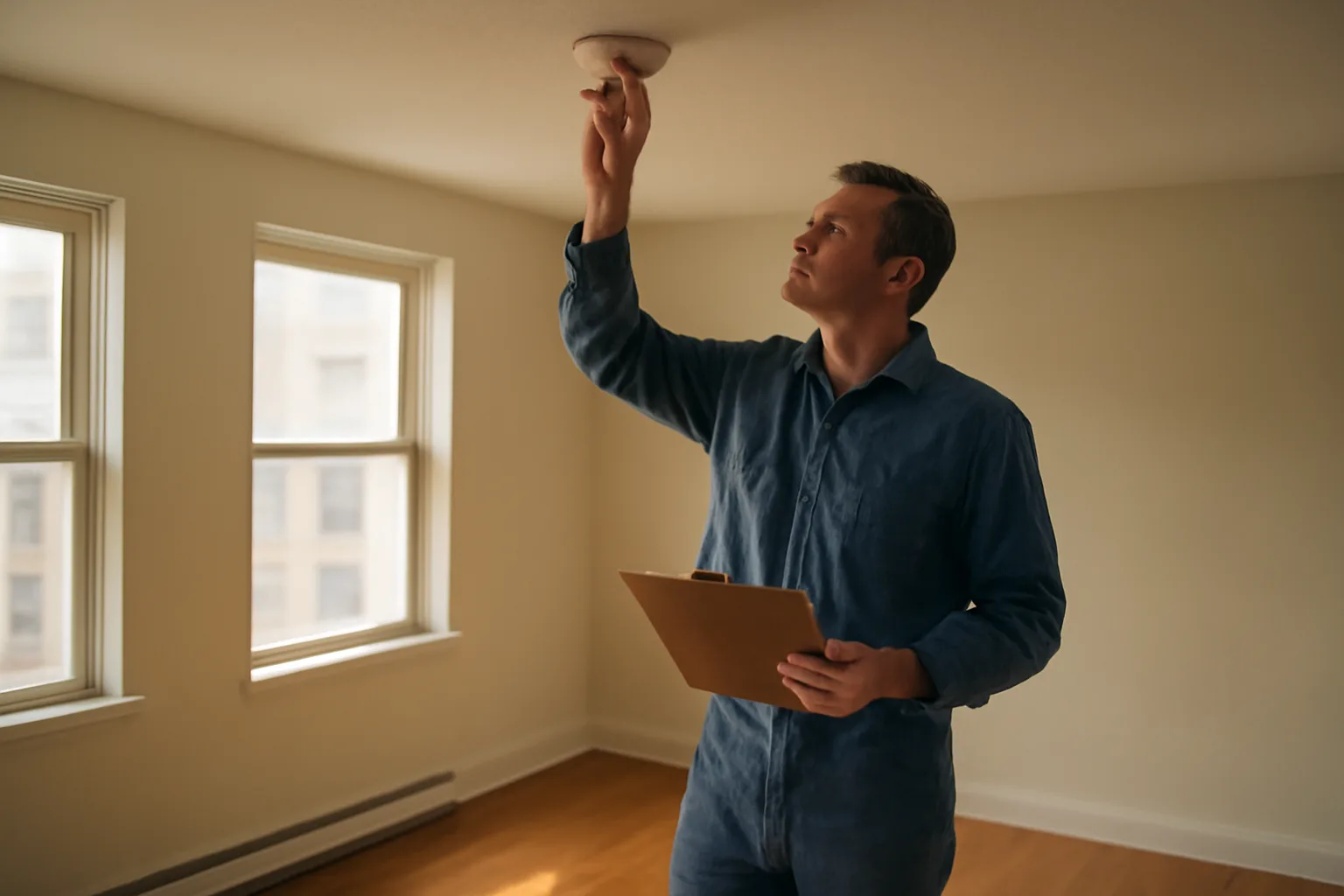
A landlord's inspection rights are generally limited to checking the condition of the property and confirming lease compliance, not searching through a tenant's belongings or personal areas. Standard, legal inspection scope includes: checking for damage beyond normal wear and tear, confirming smoke and carbon monoxide detectors work, checking for unauthorized occupants or pets, verifying no lease violations (illegal subletting, unauthorized alterations), and checking for safety hazards like mold, pest infestation, or plumbing issues. What's off-limits: opening drawers, closets, or containers that don't relate to a maintenance issue, searching for personal items, or using an inspection as a pretext to harass a tenant or retaliate for a complaint. Most states require the inspection purpose to be legitimate (repairs, safety, showing the unit to prospective tenants or buyers) and require advance written notice, not a surprise visit. City rental licensing inspections are narrower still. A city code inspector checking for a rental license renewal is generally only looking at safety items on their checklist (working smoke detectors, egress windows, electrical panel condition, no illegal occupancy, functioning heat) not general cleanliness or personal property. If you're prepping for one of these, knowing exactly what's on your city's checklist ahead of time saves you a failed inspection and a re-inspection fee. That's the exact gap our $79 City Rental License & Inspection Prep Packet is built to close: a checklist matched to what inspectors actually check, so you're not guessing.
Why do landlords require renters insurance?
Landlords require renters insurance mainly to cover the tenant's personal belongings and liability, protecting both sides if something goes wrong that the landlord's own policy won't cover. A landlord's dwelling policy typically covers the building structure and the landlord's own liability, but it does not cover a tenant's furniture, electronics, or clothing if there's a fire, burst pipe, or theft. Without renters insurance, a tenant who loses everything in a fire has no coverage, and often no way to pay, which sometimes leads to disputes or even claims against the landlord. Renters insurance also typically includes personal liability coverage, meaning if the tenant accidentally causes damage (an overflowing tub that damages the unit below, for example) their policy pays for it instead of the landlord's insurance taking the hit and raising the landlord's premiums. The National Association of Insurance Commissioners notes that renters insurance is generally inexpensive relative to the coverage it provides, commonly cited in the range of $15 to $30 a month depending on coverage limits and location [8]. Many landlords make renters insurance a lease requirement for exactly this reason: it shifts risk off the landlord's policy and reduces disputes over who pays for what after an incident.
What can't a landlord do in Ohio?
Ohio's landlord-tenant law (Ohio Revised Code Chapter 5321) sets specific things landlords are barred from doing, and violating them can expose a landlord to tenant lawsuits or defenses in an eviction case. Under ORC 5321.02 and 5321.03, an Ohio landlord cannot retaliate against a tenant for complaining to a government agency about a code violation, joining a tenant union, or asserting their legal rights, by raising rent, decreasing services, or threatening eviction because of that complaint [9]. A landlord also cannot use "self-help" eviction: changing the locks, shutting off utilities, or removing the tenant's belongings without a court-ordered eviction (ORC 5321.15 specifically bars this) [10]. Ohio law also requires landlords to maintain the unit in a habitable condition, including keeping it in compliance with building and housing codes, maintaining common areas, and keeping plumbing, heating, and electrical systems in working order (ORC 5321.04) . A landlord who ignores repair requests and then tries to evict a tenant for withholding rent over it may run into Ohio's rent escrow procedure, which lets tenants deposit rent with the court instead of the landlord when repairs are ignored. Ohio law requires the landlord give reasonable notice and enter only at reasonable times, generally interpreted with the same 24-hour norm most states use, though Ohio's statute doesn't specify an exact hour count the way California's does. When in doubt, 24 hours' written notice is the safest practice.
How do city rental licensing and inspection rules fit into all this?
Everything above is state landlord-tenant law: notice, entry, deposits, habitability. Separately, a growing number of cities layer on their own rental registration, licensing, or inspection requirements, and these are strictly local, meaning two cities twenty minutes apart can have completely different fees, deadlines, and inspection checklists. Common patterns across mandatory rental-licensing cities include an annual or biennial registration fee (often somewhere between $25 and $300 per unit, though this varies enormously and you should confirm with your city rental licensing office), a habitability inspection before the license is issued or renewed, and fines for operating an unregistered rental, which can run from a couple hundred dollars up to $1,000 or more per violation in some cities. If you own in one of these cities, the license and the lease are two separate compliance tracks. You can have a perfectly legal lease under state law and still be fined for operating without a valid rental license under your city's ordinance. Landlords new to this often assume signing a lease is the finish line; in a licensing city, it's really the starting point. For city-specific requirements, check your municipal code or call your city's housing or code enforcement department directly, since these rules change often and vary by unit count, building age, and whether the unit is owner-occupied.
Frequently asked questions
Do you need a license to be a landlord?
In most states, no state-level license is required to rent out property. But a growing number of cities and some counties require a rental registration or rental license, separate from state law, often tied to an inspection. Check with your specific city or county housing department, since requirements vary block by block in some regions.
What's the difference between a landlord and a property manager?
A landlord owns the property and holds the legal lease with the tenant. A property manager is hired (often for a fee around 8-12% of monthly rent) to handle day-to-day tasks like rent collection, maintenance, and tenant communication, but the landlord still holds ultimate legal responsibility and liability for the property.
Can a landlord enter without notice in an emergency?
Yes. Nearly every state, including California under Civil Code 1954, allows landlord entry without advance notice in a genuine emergency, such as a fire, flood, or gas leak. Outside emergencies, standard notice rules (commonly 24 hours) apply, and using 'emergency' as a routine excuse to skip notice can expose a landlord to a tenant complaint.
How much can a landlord raise rent without notice?
None. Rent increases always require advance written notice, typically 30 days for increases under 10% and up to 90 days for larger increases in some states, plus additional restrictions in rent-controlled cities. There's no scenario in standard landlord-tenant law where a rent increase takes effect without prior written notice to the tenant.
Is a verbal lease legally binding?
Yes, in most states, for tenancies of one year or less. Verbal leases create a real month-to-month tenancy governed by state default law. Some states' statute of frauds require leases longer than one year to be in writing to be enforceable, so a verbal agreement for a multi-year term may not hold up.
What happens if a landlord fails a city rental inspection?
Typically the city issues a list of required repairs with a re-inspection deadline, often 30 to 60 days depending on the city. Landlords usually pay a re-inspection fee if the first attempt fails, and continued non-compliance can lead to license denial, fines, or in serious code cases, a court order. Confirm the specific process with your city's rental licensing office.
Can a landlord refuse to rent to someone with a Section 8 voucher?
It depends on your state and city. Federal Fair Housing law doesn't ban source-of-income discrimination nationally, but a growing number of states and cities have passed their own laws requiring landlords to accept housing vouchers. Check your specific state and city law, since this varies significantly and enforcement differs by jurisdiction.
How long does a landlord have to return a security deposit?
It varies by state, commonly 14 to 30 days after move-out. California requires 21 days (Civil Code 1950.5), while other states range up to 45 days. Nearly all states require an itemized list of deductions if any of the deposit is withheld, and failing to meet the deadline can expose the landlord to penalty damages in many states.
What can't a landlord ask during tenant screening?
Under the federal Fair Housing Act, landlords cannot ask about or base decisions on race, color, national origin, religion, sex, familial status, or disability. Many states and cities add protected categories like sexual orientation, source of income, or age. Screening criteria (credit score, income minimum, rental history) should be applied identically to every applicant.
Does a landlord have to provide air conditioning?
Generally no, unless it's required by local building code or was included as an amenity in the lease. Habitability standards under most state law require working heat, but air conditioning is usually treated as an amenity, not a legal requirement, except in a few jurisdictions with extreme heat ordinances.
What's the first thing a new landlord should do before renting out a unit?
Confirm zoning and any local rental registration or licensing requirement before you advertise the unit. Skipping this step is the most common first-year mistake; some cities fine landlords for renting an unregistered unit even if the lease itself is otherwise legal. Check with your city or county first, then handle insurance and screening.
Can a tenant refuse a landlord's inspection?
A tenant can't unreasonably refuse a lawful inspection with proper notice, but they can push back on timing or ask to reschedule. If a landlord follows notice rules and the purpose is legitimate (repairs, safety check, code inspection), most states treat unreasonable tenant refusal as a lease violation.
Sources
- California Civil Code Section 1940: Defines the landlord-tenant hiring relationship under California law
- HUD, Fair Housing Act protected classes: Fair Housing Act prohibits discrimination based on race, color, national origin, religion, sex, familial status, or disability
- California Civil Code Section 1624 (Statute of Frauds): Leases longer than one year must be in writing in California
- California Civil Code Section 1954: 24 hours' written notice is presumptively reasonable for landlord entry in California
- California Civil Code Section 1946.1: 60 days' notice required to end a tenancy of one year or more in California
- Ohio Revised Code Section 1923.04: Ohio requires a notice period before filing an eviction action for nonpayment of rent
- California Civil Code Section 1950.5: Tenants can request a pre-move-out inspection with 48 hours' notice to the tenant of the inspection date
- Ohio Revised Code Section 5321.02: Ohio bars landlord retaliation against tenants who complain to authorities or assert legal rights
- Ohio Revised Code Section 5321.15: Ohio prohibits self-help eviction methods like lockouts or utility shutoffs
- Ohio Revised Code Section 5321.04: Ohio landlords must maintain the unit in compliance with building and housing codes