Last updated 2026-07-25
TL;DR
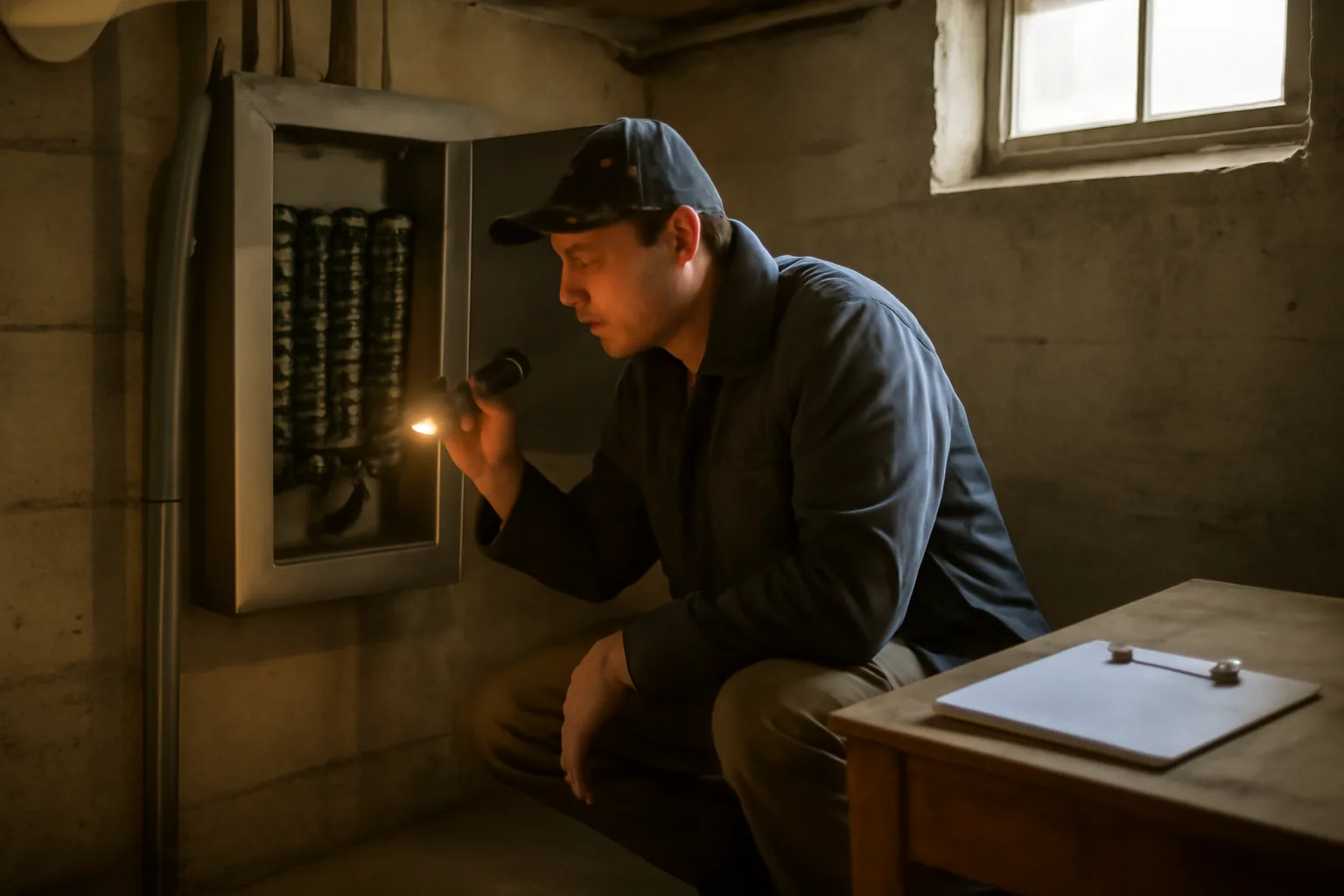
A solid house inspection checklist template covers exterior, roof, electrical, plumbing, HVAC, smoke/CO detectors, egress windows, and interior safety items room by room. Most city rental inspections check the same core list: working smoke and CO alarms, no exposed wiring, secure railings, functioning heat, and no active leaks. Use a checklist before your city inspector shows up, not after.
What should a house inspection checklist template actually include?
A usable checklist has to match how inspectors actually walk a property: exterior first, then structural systems, then unit-by-unit interior. Most municipal rental inspection checklists (Minneapolis, Rockford, Columbus, and dozens of others publish theirs online) group items into roughly the same eight categories: exterior/grounds, structure and roof, electrical, plumbing, HVAC, fire/life safety, egress, and interior condition per room. Here's a template you can adapt. It's not a substitute for your city's actual checklist (always pull that from your local rental licensing office), but it covers what shows up on nearly every one we've reviewed. Exterior
- Foundation: no visible cracks wider than 1/4 inch, no crumbling mortar
- Roof: no missing shingles, no sagging, gutters attached and draining away from foundation
- Siding/paint: no peeling paint on pre-1978 homes (lead paint rules apply, see EPA's Renovation, Repair and Painting Rule) [1]
- Steps, porches, railings: secure, no rot, railings required on stairs with 4+ risers in most model codes
- Address numbers visible from the street Structural and mechanical
- Foundation and framing: no active water intrusion
- Electrical panel: labeled circuits, no double-tapped breakers, no exposed wiring
- Plumbing: no active leaks under sinks, water heater has a functioning temperature-pressure relief valve with discharge pipe
- HVAC: furnace or heat source works, no visible gas leaks, ducts intact Fire and life safety
- Smoke alarms in every bedroom, outside each sleeping area, and on every level, per NFPA 72 and most local fire codes [2]
- Carbon monoxide alarms near sleeping areas if the home has fuel-burning appliances or an attached garage
- Fire extinguisher present and charged (required in many cities' rental codes, not universally)
- Two means of egress from each sleeping room (a window that opens is usually the second exit) Interior, room by room
- Windows open, close, and lock
- No broken glass
- Floors free of trip hazards
- Outlets grounded, no missing cover plates
- No visible mold or moisture staining Run this before you list a unit and again before every scheduled city inspection. It catches 90% of what actually generates violation notices.
How do I use this checklist to become a landlord in the first place?
Becoming a landlord isn't a licensed profession the way being a contractor or a realtor is. There's no national exam. But if you're renting out property in a city with a rental registration or licensing ordinance, you do have specific legal steps before you can legally collect rent. The general sequence: confirm the property is zoned for rental use, check whether your city requires a rental license or registration (many mid-size and large cities do), get any required pre-rental inspection done, obtain the license or certificate, then screen and place a tenant. Some cities also require a certificate of occupancy specific to rental use, separate from the one issued when the house was built. Budget real time for this. A first-time rental inspection scheduling window in cities like Minneapolis or Rockford often runs several weeks out, and if the property fails, you're looking at a re-inspection fee and another wait. Confirm your city's specific fee schedule, inspection cycle, and license renewal period with your local rental licensing office before you set a move-in date. If you already own the property and are just adding it to your rental portfolio, the same checklist above works as your pre-inspection prep. If you're buying a property specifically to rent, add a title search for open code violations. Some cities won't issue a rental license until prior violations tied to the property are cleared, even if you didn't cause them.
What is landlording, and what is a landlord, exactly?
Landlording is the ongoing work of owning and managing rental property: collecting rent, handling repairs, managing lease terms, screening tenants, and staying compliant with local housing and safety codes. A landlord is the legal term for the person or entity that owns a property and leases it to a tenant in exchange for rent, under a lease or rental agreement. Legally, a landlord has duties that go beyond just collecting a check. Nearly every state has an implied warranty of habitability built into landlord-tenant law, meaning the landlord is responsible for keeping the unit safe and livable regardless of what the lease says. HUD's Fair Housing Act also applies to landlords the moment they advertise or rent a unit, prohibiting discrimination based on race, color, religion, sex, national origin, familial status, or disability [3]. Practically, landlording day to day looks like: responding to maintenance requests within a reasonable time, keeping smoke detectors working, handling security deposits per state rules, and keeping the property in the condition your city's housing code requires. If you're managing 1 to 10 units yourself, you're doing all of this without a property management company's staff, which is exactly why a written checklist matters more, not less.
Who is responsible for a rental property walk-through inspection in California?
In California, the landlord is generally responsible for scheduling and conducting move-in and move-out walk-through inspections, though the tenant has a legal right to participate. California Civil Code Section 1950.5 gives tenants the right to request an initial inspection before move-out, done "no earlier than two weeks before the termination... of the tenancy," with the landlord required to give at least 48 hours written notice of the date and time [4]. The point of that initial inspection is to give the tenant a chance to fix any items themselves before the final move-out inspection, which is what actually determines security deposit deductions. The landlord must provide an itemized statement of deductions within 21 calendar days after the tenant moves out, per the same statute [4]. This is separate from a city's rental licensing inspection, which is done by a government inspector, not the landlord, and covers code compliance rather than damage or cleanliness. Don't confuse the two. A California landlord doing their own move-in/move-out walkthrough is documenting condition for deposit purposes; a municipal rental inspector checking for a license or permit is confirming code compliance under a completely different set of rules.
What can a landlord look at during a rental inspection?
A landlord (or their inspector) can generally look at anything related to habitability, safety, and lease compliance: smoke detectors, HVAC function, plumbing, electrical systems, signs of unauthorized pets or occupants, and property damage. They typically cannot search personal belongings, open closed drawers or containers, or use the inspection as a pretext to harass a tenant. Most state landlord-tenant statutes require the inspection to be for a legitimate purpose, things like verifying repairs are needed, checking for lease violations, or confirming smoke alarm function, and require advance notice except in emergencies. California Civil Code 1954, for example, lists specific reasons a landlord can enter: to make necessary repairs, show the unit to prospective tenants or buyers, or in case of emergency [5]. During a routine inspection, a landlord can reasonably check:
- Smoke and CO alarm function (test the button, check the battery)
- Signs of leaks, water damage, or mold
- HVAC filters and vents
- Evidence of unauthorized pets or additional occupants
- General condition of walls, floors, fixtures What's generally off-limits without a warrant, tenant consent, or specific legal cause: opening locked cabinets, going through personal papers, or searching for anything unrelated to the property's condition. Cities running licensing inspections (as opposed to a landlord's own walkthrough) usually limit their inspectors to visible, accessible areas and life-safety items, not personal belongings at all.
How much notice does a landlord have to give before entering or inspecting?
Notice requirements vary by state, typically 24 to 48 hours for non-emergency entry. California requires "reasonable notice," which the statute defines as 24 hours unless circumstances make that impracticable [5]. Many other states set 24 hours as the standard (Arizona, per A.R.S. 33-1343, requires at least two days notice for entry [6]); a few, like Delaware, specify 48 hours [7]. Check your specific state code rather than assuming a number, because the range genuinely runs from 24 to 48 hours depending on where you are, and some states don't set a statutory minimum at all, just requiring "reasonable" notice without defining it. When state law doesn't specify a number, courts have generally treated 24 hours as reasonable, but that's not guaranteed everywhere. Emergencies are the standard exception nearly everywhere: a burst pipe, fire, or gas leak lets a landlord enter without advance notice. Routine repairs, inspections, and showings almost always require the standard notice period, given in writing in most states (a text or verbal heads-up is legally shaky in a lot of jurisdictions, even if it's common practice). For city rental licensing inspections specifically, the notice comes from the municipal office, not the landlord, and the format and lead time depend entirely on your city's process. Confirm the specific notice period with your local rental licensing office, since it's set by ordinance, not state landlord-tenant law.
What rights do tenants have without a lease?
A tenant without a written lease still has legal protections under state landlord-tenant law, typically as a month-to-month tenant. They generally have the right to habitable housing, protection from illegal lockouts, advance notice before entry, and a required notice period before the tenancy can be ended. Most states treat an oral or unwritten rental arrangement, once rent has been accepted, as a month-to-month tenancy governed by the state's default landlord-tenant statute. That means the tenant still gets the implied warranty of habitability, protection from retaliatory eviction, and the standard notice period for termination, usually 30 days, though some states require more for longer-term tenants. What a tenant without a lease does NOT automatically get: a locked-in rent amount, a fixed term, or any lease-specific perk (parking spot, pet policy, included utilities) that was only ever a verbal promise and isn't part of the state's default rules. Disputes over verbal terms are hard to prove, which is exactly why even a one-page written agreement helps both sides. If you're managing a no-lease tenant in a city with rental licensing requirements, the license and inspection obligations still apply. A licensing ordinance doesn't care whether there's a signed lease. It applies to the unit and the fact that it's rented, period.
Why do landlords require renters insurance?
Landlords require renters insurance mainly to shift liability for a tenant's personal property loss and personal liability claims away from the landlord's own policy. A landlord's dwelling insurance covers the building; it does not cover a tenant's furniture, electronics, or clothing, and it generally doesn't cover a tenant being sued for something like their dog biting a visitor. Requiring renters insurance (commonly $15 to $30 a month for a basic policy, per Insurance Information Institute estimates [8]) also protects the landlord indirectly: if a tenant's negligence causes a fire or water damage, the tenant's liability coverage can pay for damage instead of it becoming a dispute with the landlord's insurer, or an uncollectible judgment against a tenant with no assets. Many landlords require proof of a policy naming the landlord as an "interested party" or additional insured before move-in, and require it to stay active for the lease term. This is a lease term, not a state or city legal mandate in most places, so it has to be written into the lease to be enforceable. It has nothing to do with rental licensing inspections themselves, those are about code compliance, not insurance, but a lot of landlords bundle the requirement into their move-in checklist anyway.
What can't a landlord do in Ohio?
Ohio landlords can't shut off utilities, change locks, or remove a tenant's belongings to force them out, a practice generally banned as "self-help eviction" under Ohio Revised Code Chapter 5321, the state's Landlords and Tenants law [9]. Only a court-ordered eviction through the proper legal process can remove a tenant. Ohio Revised Code 5321.04 lays out landlord obligations directly: keep the premises in compliance with health and safety codes, keep common areas safe, maintain electrical, plumbing, heating, and other facilities in good working order, and give reasonable notice before entering, except in emergencies [10]. A landlord who ignores these duties can face a tenant lawsuit for damages or a court order to fix the problem. Ohio law also prohibits retaliatory conduct: raising rent, cutting services, or starting an eviction specifically because a tenant complained to a housing authority or joined a tenant organization, per ORC 5321.02 [11]. And landlords can't require a tenant to waive their statutory rights under Chapter 5321 as a condition of the lease; those waiver clauses are unenforceable even if a tenant signs them. Practically, this means an Ohio landlord dealing with a difficult tenant still has to go through the courts, keep the unit compliant with local housing code the whole time, and can't retaliate against a tenant who reports a code violation to the city, even one that could cost the landlord a rental license.
How does a home inspection checklist differ from a city rental license inspection?
| Purpose | Assess overall condition, flag future repairs | Confirm minimum code compliance for occupancy | |
|---|---|---|---|
| Who orders it | Buyer (private) | City, as a licensing condition | |
| Typical cost | $300 to $500+ (varies by region and size) | Set by city ordinance, confirm with your local rental licensing office | |
| Scope | Roof, foundation, appliances, cosmetic issues sometimes included | Smoke/CO alarms, egress, electrical safety, structural hazards | |
| Result | Report for negotiation | Pass/fail; license issued, denied, or violations cited | |
| Frequency | One-time, at purchase | Recurring, often every 1 to 3 years depending on city | A buyer's inspector will note a 15-year-old water heater as "aging, monitor for replacement." A city rental inspector generally doesn't care about the water heater's age at all, only whether the temperature-pressure relief valve and discharge pipe are present and functional. The buyer's inspection is broader and less binary; the licensing inspection is narrower and pass/fail. If you're prepping for both (say, you just bought a rental property), do the buyer's-style checklist first for your own risk assessment, then run the narrower licensing checklist right before the city inspector arrives. |
A home inspection checklist (the kind a buyer's inspector uses) is about overall property condition and future maintenance risk. A city rental licensing inspection checklist is narrower: it exists to confirm the unit meets minimum health and safety code, nothing more, nothing less. | Feature | Buyer's home inspection | City rental license inspection |
What's the most efficient way to prep for a licensing inspection using a checklist?
Walk the property in the same order the inspector will: exterior first, then basement/mechanical, then each unit room by room, then common areas if it's a multi-unit building. Fix anything with a clear code citation first (missing smoke detectors, exposed wiring, broken railings); cosmetic issues rarely fail an inspection on their own. A few things that generate a disproportionate number of failed inspections and re-inspection fees, based on what most municipal codes flag most often: missing or non-functional smoke alarms, blocked egress windows (painted shut or blocked by an AC unit), exposed electrical wiring or missing outlet covers, and peeling paint on pre-1978 properties without proper lead-safe documentation. Keep a simple log: date, item, fixed yes/no, photo. If your city allows a self-certification affidavit for minor items (some do), this log is exactly what you'll need to fill it out honestly. If you manage multiple properties across different cities, the licensing requirements, fee schedules, and inspection cycles won't match from one city to the next, so a generic checklist only gets you partway there. This is the exact gap our $79 City Rental License & Inspection Prep Packet is built to close: a checklist and document set matched to your specific city's actual rental licensing requirements, not a generic national template. It won't guarantee you pass (no service can, since inspectors have discretion and codes get interpreted locally), but it saves the hours of digging through your city's ordinance pages to figure out what's actually required. For state-level context on tenant notice and entry rules that affect how you schedule your own pre-inspection walkthroughs, see our guides on tenants rights and tenant rights by state.
How do I be a landlord without getting blindsided by ordinance changes?
Check your city's rental licensing office page at least once a year, since ordinances change more often than people expect. Some cities have added mandatory registration or inspection requirements in the last five years without much publicity beyond a mailed notice. Set a calendar reminder tied to your license renewal date, more than the inspection date. Missing a renewal deadline in some cities triggers a separate late fee stacked on top of the license fee itself, confirm the exact structure with your local rental licensing office since it varies significantly city to city. Join your local landlord association if one exists. Cities usually notify these groups before rolling out ordinance changes, giving members a few months' lead time that non-members don't get until the official notice hits their mailbox. Ohio, California, and dozens of individual cities each have their own layered rules; there's no substitute for checking the specific one that applies to your property. For general landlord obligations that apply regardless of city, our guides on landlord and landlord landlords responsibilities cover the baseline duties most state codes share.
Frequently asked questions
What should I put on a house inspection checklist template before a rental license inspection?
Cover exterior condition, roof, foundation, electrical panel, plumbing, HVAC function, smoke and CO alarms in every required location, egress windows that open, and no exposed wiring or trip hazards. Match your checklist to your specific city's published rental inspection checklist when one exists, since categories and pass/fail thresholds vary by jurisdiction.
How do I become a landlord for the first time?
Confirm the property is zoned for rental use, check whether your city requires a rental license or registration, complete any required pre-rental inspection, obtain the license, then screen and place a tenant under a written lease. Budget several weeks for first-time licensing in cities with backlogged inspection schedules.
Who is responsible for the rental property walk-through inspection in California?
The landlord schedules and conducts move-in and move-out walk-through inspections, but California Civil Code 1950.5 gives tenants the right to request an initial inspection two weeks before move-out, with 48 hours written notice, so they can fix issues before final deductions are assessed.
What is landlording?
Landlording is the ongoing work of owning and managing rental property, including collecting rent, handling repairs, screening tenants, maintaining habitability, and staying compliant with local housing codes and licensing ordinances. It's the day-to-day operational side of being a landlord, more than the legal title.
What is a landlord, legally speaking?
A landlord is the person or entity that owns real property and leases it to a tenant in exchange for rent under a lease or rental agreement. Legally, landlords carry duties under state law, including an implied warranty of habitability and compliance with fair housing law under the federal Fair Housing Act.
What rights do tenants have without a signed lease?
A tenant without a lease, once rent is accepted, is generally treated as a month-to-month tenant under state law and keeps rights to habitable housing, advance notice before entry, protection from illegal lockout, and a standard notice period (often 30 days) before the tenancy can be ended.
Why do landlords require renters insurance?
Renters insurance shifts liability for a tenant's personal property loss and personal injury claims onto the tenant's own policy instead of the landlord's. It also covers tenant-caused damage liability, like a kitchen fire, protecting the landlord from becoming the only party left to cover the cost.
How much notice does a landlord have to give before entering a unit?
Most states require 24 to 48 hours notice for non-emergency entry. California requires reasonable notice, generally interpreted as 24 hours; Arizona requires at least two days under A.R.S. 33-1343; Delaware requires 48 hours. Emergencies (fire, flooding, gas leak) are exceptions nearly everywhere.
What can a landlord look at during a routine inspection?
A landlord can generally check smoke and CO alarms, plumbing and electrical condition, HVAC function, signs of unauthorized occupants or pets, and general property condition. They typically cannot search personal belongings, open locked drawers, or use an inspection as a pretext unrelated to habitability or lease compliance.
What can't a landlord do in Ohio?
Ohio landlords can't perform a self-help eviction (changing locks, shutting off utilities, or removing belongings) under Ohio Revised Code Chapter 5321. They also can't retaliate against a tenant for reporting code violations, and can't force a tenant to waive their statutory rights under the lease.
How is a city rental license inspection different from a home inspection?
A city rental license inspection checks minimum health and safety code compliance for occupancy, is pass/fail, and recurs on a set cycle. A buyer's home inspection assesses overall property condition and future repair risk, is one-time, and produces a detailed report rather than a binary result.
How often do rental license inspections happen?
It depends entirely on the city; cycles commonly run every 1 to 3 years, though some cities inspect only at initial licensing or upon complaint. Confirm the exact inspection cycle, renewal deadline, and fee schedule with your specific city's rental licensing office, since there's no national standard.
Sources
- EPA, Renovation, Repair and Painting Rule: Lead-safe work practice rules apply to pre-1978 housing during renovation and repair, including peeling paint remediation
- NFPA 72, National Fire Alarm and Signaling Code (summary): Smoke alarm placement standards requiring alarms in every bedroom, outside sleeping areas, and on every level
- HUD, Fair Housing Act overview: Federal Fair Housing Act prohibits discrimination in rental housing based on protected classes
- California Civil Code Section 1950.5: Tenant right to request initial move-out inspection with 48 hours notice; 21-day deadline for itemized deduction statement
- California Civil Code Section 1954: Landlord entry notice requirements and permitted reasons for entry in California
- Arizona Revised Statutes Section 33-1343: Arizona requires at least two days notice before landlord entry
- Delaware Code Title 25, Section 5509: Delaware landlord-tenant law entry notice provisions
- Insurance Information Institute, renters insurance facts and statistics: Typical renters insurance policy cost range
- Ohio Revised Code Chapter 5321: Ohio landlord-tenant law prohibiting self-help eviction and setting landlord obligations
- Ohio Revised Code Section 5321.04: Ohio landlord obligations to maintain habitability, safety, and give reasonable entry notice
- Ohio Revised Code Section 5321.02: Ohio prohibition on retaliatory landlord conduct against tenants who report violations