Last updated 2026-07-25
TL;DR
There's no federal or universal state law requiring landlords to replace carpet on a fixed schedule. Most disputes get resolved using a "useful life" depreciation standard, commonly 5 to 10 years, applied when calculating normal wear and tear against a security deposit. Some cities layer on their own habitability or inspection rules through rental licensing programs.
How often are landlords required to replace carpet?
There's no federal statute and, in almost every state, no state statute that says "replace the carpet every X years." What exists instead is a body of case law and security deposit guidance built around the idea of useful life and normal wear and tear. The most commonly cited framework comes from a 1980s-era analysis used in landlord-tenant training materials and adopted informally by many state and local housing agencies: carpet has a useful life of about 5 to 10 years, depending on quality and installation. Once carpet has outlived its expected life, a landlord generally can't charge a departing tenant the full replacement cost, because normal wear and tear over time is considered the landlord's cost of doing business, not the tenant's. Some states have written this concept into actual guidance. California's Department of Consumer Affairs guide on security deposits explains that a landlord can deduct for damage beyond normal wear and tear, but must account for depreciation: "the landlord may not charge the tenant for the cost of replacing the entire carpet if the carpet was already near the end of its useful life" is the general idea reflected in that guidance [1]. The exact useful-life number isn't set in the statute itself (Civil Code 1950.5), it's the accounting method landlords and courts use to apply the statute's "normal wear and tear" language [2]. So the honest answer is: no law forces a replacement schedule. What you actually have is a deposit-deduction rule that assumes carpet depreciates fully somewhere around year 7 to 10, which functions like a soft replacement clock for practical, financial purposes.
Is there a law that sets a specific carpet replacement schedule?
No. Search all you want, you won't find a statute in any state that says carpet must be replaced every 5 years or every 7 years. That number gets repeated so often in landlord forums and property management blogs that people assume it's codified somewhere. It isn't. What is codified, in most states, is a landlord's general duty to maintain a habitable unit. Under the Uniform Residential Landlord and Tenant Act framework, adopted in some form by many states, landlords must maintain premises in a "fit and habitable condition" [3]. Carpet that's torn, moldy, or a genuine trip hazard can trigger a habitability complaint even without a specific replacement law, because it falls under general maintenance obligations, not a flooring-specific rule. The 5-to-10-year figure functions as a depreciation schedule for security deposit math, not a legal deadline. A landlord isn't in violation of anything just because carpet is 12 years old. But if that same tenant moves out and the landlord tries to bill them for a full replacement, small claims courts routinely reduce the charge based on the carpet's age, using something close to that useful-life logic.
What is the useful life standard for carpet in security deposit disputes?
| 1 year | 90% remaining | Up to ~90% of replacement or repair cost | |
|---|---|---|---|
| 5 years | 50% remaining | Up to ~50% of replacement or repair cost | |
| 8 years | 20% remaining | Up to ~20% of replacement or repair cost | |
| 10+ years | Fully depreciated | Generally $0, ordinary wear and tear only | This table is illustrative, not a legal formula every court uses identically. Some states use a shorter useful life assumption (5 to 7 years) for lower-grade carpet, others stretch it closer to 10 to 15 years for commercial-grade carpet. If you're billing a deposit deduction, keep the original invoice showing the carpet's install date and cost. Without that paper trail, you have no way to prove depreciation and a tenant's dispute letter (or small claims filing) will likely win. |
The useful life standard treats carpet like a depreciating asset. If a carpet is expected to last 10 years and a tenant moves out after 8 years of normal use, a landlord generally can only charge for roughly 20% of the replacement cost, if there's damage beyond normal wear and tear at all. This isn't unique to carpet. Courts and state consumer guidance apply the same logic to paint, appliances, and other components that degrade with ordinary use. California's Department of Consumer Affairs security deposit guide walks through this exact depreciation approach for flooring and paint when landlords itemize deductions [1]. Here's a simple table showing how the math typically plays out, using a common 10-year useful life assumption: | Carpet age at move-out | Remaining useful life | Landlord's chargeable share for damage beyond wear and tear |
What counts as normal wear and tear versus tenant damage on carpet?
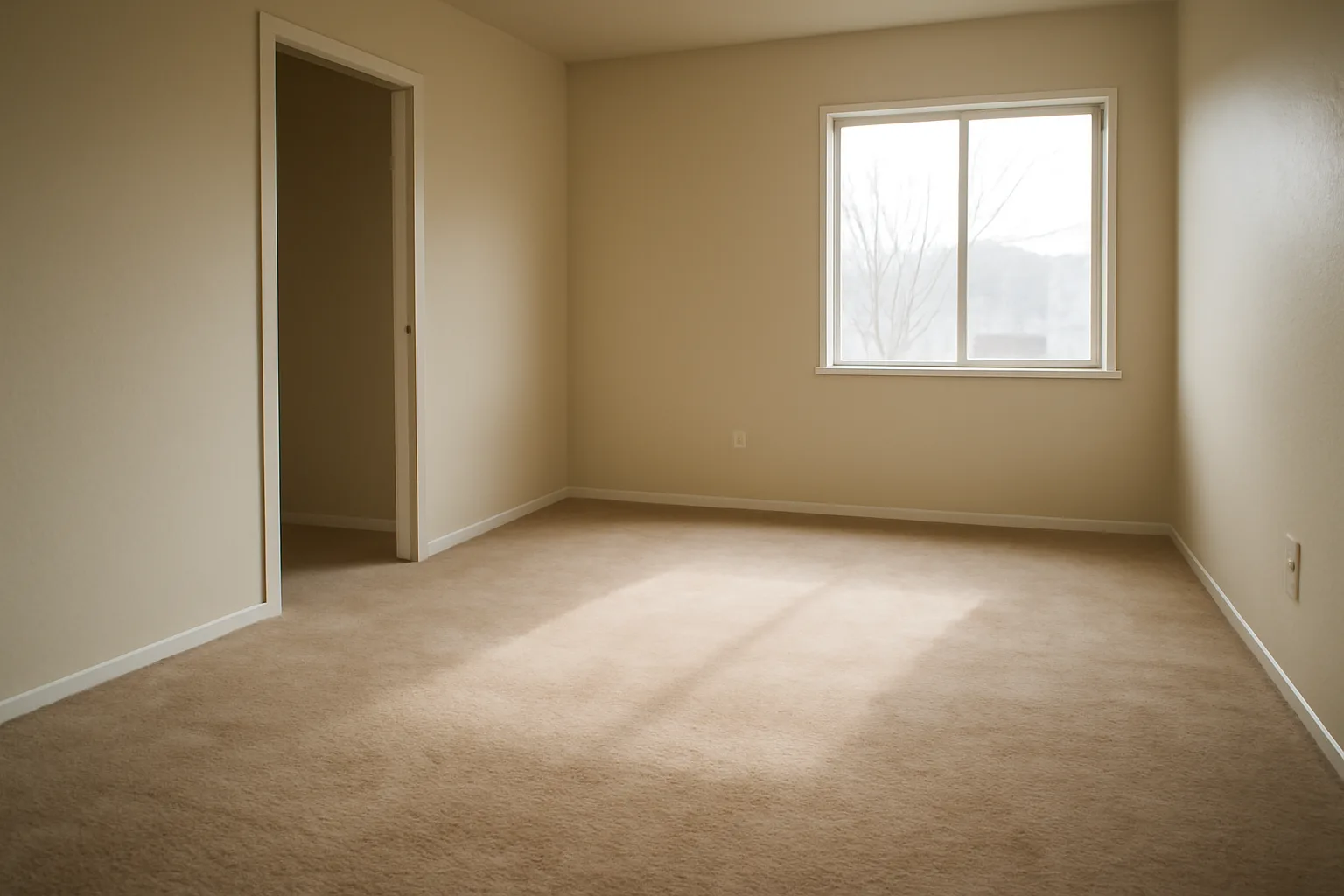
Normal wear and tear is the gradual deterioration that happens from ordinary living: foot traffic paths, minor fading from sunlight, and light flattening near doorways and furniture. Tenant damage is something a tenant caused through negligence or misuse: pet urine stains, cigarette burns, large rips, or mold from failing to report a leak. The distinction matters because normal wear and tear can never be charged to a tenant's deposit, regardless of carpet age. Damage can be charged, but only after applying depreciation for the carpet's remaining useful life. Common examples that lean toward normal wear and tear: light traffic-pattern wear, minor color fading, small indentations from furniture legs. Common examples that lean toward chargeable damage: pet stains and odor that require replacement rather than cleaning, burn holes, large tears, or water damage from tenant negligence (like an overflowed bathtub the tenant never reported). A lot of disputes land in a gray zone. If you're unsure, get a written estimate from a flooring company that itemizes what's cleaning versus what's replacement, and photograph the carpet at move-in and move-out. That documentation is what actually protects you if a tenant challenges a deduction, not the useful-life number itself.
Do rental licensing or inspection programs require carpet condition checks?
Some cities with rental registration, licensing, or systematic inspection programs do check flooring condition as part of a general habitability review, but they're checking for hazards, not for carpet age. An inspector isn't going to cite you because carpet is 9 years old. They will cite you if carpet is torn in a way that creates a trip hazard, saturated with mold from a chronic leak, or so deteriorated it violates the local housing code's general maintenance standard. City-specific rental inspection checklists vary a lot. Some focus almost entirely on life-safety items (smoke detectors, egress, electrical), and flooring only comes up if it's actively unsafe. Others use a broader property maintenance code that references "floor coverings in good repair" as part of overall unit condition. Because every city's ordinance and inspection checklist is different, confirm the exact standard with your city rental licensing office before assuming carpet condition will or won't come up. If you're prepping for a first inspection under a new mandatory rental licensing ordinance, it helps to walk the unit yourself using the same lens an inspector would use, room by room, checking floors alongside smoke detectors, egress windows, and electrical outlets. That's the kind of prep our $79 City Rental License & Inspection Prep Packet is built around, a room-by-room checklist format so you're not guessing what an inspector will flag.
What can a landlord look at during an inspection?
During a routine or move-in/move-out inspection, a landlord can generally document the condition of anything that affects the unit's habitability or the tenant's security deposit: flooring, walls, ceilings, appliances, plumbing fixtures, smoke and carbon monoxide detectors, windows, doors, and general cleanliness. This is different from a search, landlords aren't inspecting personal belongings, just the condition of the rental unit itself. Most states require advance notice before entry for a non-emergency inspection, typically 24 to 48 hours depending on the state (see the notice section below). During the inspection, a landlord can take photos or video of the unit's condition, note existing damage, and check that systems like heat and smoke detectors are functioning. What a landlord generally cannot do is search through drawers, closets, or personal items beyond what's needed to assess property condition, and cannot use inspection access as a pretext for harassment or retaliation. For city-mandated rental inspections tied to a licensing program, the scope is usually defined by the local housing code and covers structural and safety items: egress, electrical, plumbing, pest evidence, smoke/CO detectors, and general maintenance including flooring hazards. The inspector, not the landlord, controls what gets checked in that context, and the checklist is typically public if you ask your city's rental licensing office for it.
Who is responsible for a rental property walk-through inspection in California?
In California, the landlord is responsible for offering an initial move-out inspection if the tenant requests one, under Civil Code Section 1950.5(f). This pre-move-out walkthrough happens before the tenant vacates, giving them a chance to fix any issues that might otherwise result in a deposit deduction. California law states the landlord must notify the tenant of the right to this inspection and, if requested, perform it "no earlier than two weeks before the expiration or termination of the tenancy" [2]. The landlord then must give the tenant an itemized statement of deficiencies noted during that walkthrough, so the tenant has a chance to correct them before the final move-out. After the tenant actually vacates, the landlord (or their agent, like a property manager) conducts the final move-out inspection alone, documents the unit's condition, and has 21 days to return the deposit along with an itemized statement of any deductions, per the same Civil Code section [2]. Tenants aren't required to attend either inspection, but they're allowed to be present for the final one if they choose. For licensed rental units in cities with their own registration or inspection ordinance (several California cities require this on top of state deposit law), a separate city inspector, not the landlord, handles the compliance inspection. Confirm which type of inspection applies to your situation with your city rental licensing office, since state deposit-related walkthroughs and city habitability inspections are two different things with different rules.
How much notice does a landlord have to give before entering or inspecting a unit?
Notice requirements vary by state, but 24 hours is the most common standard for non-emergency entry, including routine inspections. California requires "reasonable notice," which state law presumes to be 24 hours in most circumstances, under Civil Code Section 1954 [4]. Some states use 48 hours, and a handful don't specify an exact number, just "reasonable" notice, which courts interpret case by case. Emergency situations (fire, flooding, a burst pipe) are the standard exception, allowing landlords to enter without advance notice because of the immediate risk to the property or occupants. City rental licensing inspections typically require their own separate notice, often by mail or posted notice, scheduled days or weeks in advance rather than the 24-hour standard used for routine landlord entry. That's a different notice requirement from the day-to-day entry rules under state landlord-tenant law, so don't assume your city's licensing inspection notice period matches your state's general entry notice rule. Always confirm the specific notice period with your city rental licensing office, since these vary widely and change over time.
What is landlording and what does it mean to be a landlord?
Landlording is the ongoing work of owning and managing a rental property: collecting rent, maintaining habitability, handling repairs, screening tenants, following state and local landlord-tenant law, and (in many cities now) complying with rental registration or licensing ordinances. A landlord, legally, is anyone who leases real property to a tenant in exchange for rent, whether that's one accidental rental unit or a portfolio of fifty. Most small landlords don't think of themselves as running a business, but legally, that's exactly the role. You're bound by the same habitability duties (Uniform Residential Landlord and Tenant Act, adopted with modifications in many states, sets baseline maintenance obligations) [3] whether you own one duplex or a hundred units. The job breaks into a few real buckets: legal compliance (leases, notices, deposit handling, fair housing law), maintenance (repairs, code compliance, habitability), financial management (rent collection, expense tracking, taxes), and increasingly, municipal compliance (rental registration, licensing renewals, scheduled inspections in cities that require them). That last bucket has grown a lot over the past decade as more cities adopt proactive rental inspection ordinances rather than relying only on tenant complaints.
How do you become a landlord and what should a first-time landlord know?
Becoming a landlord starts with acquiring a property you intend to rent out, then meeting the legal requirements to lease it: getting proper insurance (landlord/dwelling insurance, not a standard homeowner's policy), complying with your state's landlord-tenant law, and, in mandatory rental-licensing cities, registering the property and possibly passing an initial inspection before you can legally rent it. A reasonable first-time checklist looks like this: confirm your city or county requires rental registration or licensing (a growing number do, often triggered simply by renting out any unit, even a single room), get a landlord insurance policy, understand your state's security deposit limits and return deadlines, learn your state's required notice periods for entry and lease termination, and set up a system for handling maintenance requests and habitability complaints promptly. The biggest first-time mistake isn't usually about the lease, it's skipping the local licensing step entirely. Many first-time landlords don't realize their city requires a rental license or registration until they get a violation notice or a neighbor complaint triggers a code enforcement visit. If you're renting out a unit for the first time, check with your city's rental licensing office (sometimes called code enforcement, sometimes a separate rental housing division) before you sign a lease, not after.
What rights do tenants have without a written lease?
Tenants without a written lease still have full legal protection under state landlord-tenant law. Verbal agreements create a legally recognized tenancy, usually treated as a month-to-month tenancy, and tenants retain the same habitability rights, deposit protections, and notice requirements as tenants with a written lease. What changes without a written lease is proof. Rent amount, due date, and any special terms become harder to establish if there's a dispute, since there's no document to point to. Courts generally look at behavior (what rent has actually been paid and accepted) and any texts, emails, or other records referencing the agreement to reconstruct the terms. Landlords still owe the same statutory duties regardless of lease format: habitability maintenance, proper notice before entry, and compliant handling of any security deposit collected. A verbal agreement doesn't reduce a landlord's obligations, it just makes the terms of that agreement riskier to prove later. For that reason alone, a written lease, even a short one, protects both sides better than a handshake deal.
Why do landlords require renters insurance?
Landlords require renters insurance mainly to shift liability risk away from their own landlord policy. A landlord's dwelling insurance covers the building and the landlord's own property, but it generally doesn't cover a tenant's personal belongings or a tenant's liability if they cause damage (a kitchen fire, a bathtub overflow that damages the unit below). Renters insurance is typically cheap, often in the range of $15 to $30 a month depending on coverage and location, though exact pricing varies by insurer and market and isn't something we can cite a single national figure for with confidence. Requiring it as a lease condition is legal in most states and increasingly common, especially in multi-unit buildings where one tenant's negligence can damage neighboring units. For the landlord, requiring renters insurance reduces the odds of an uninsured tenant suing (or simply being unable to pay) after a loss they caused, and reduces disputes over whose insurance should cover what. It's a low-cost risk transfer tool, not a money-maker for landlords, since landlords don't typically profit from a tenant's policy, they just avoid absorbing losses that should belong to the tenant's own negligence or belongings.
What can a landlord not do in Ohio?
Under Ohio's landlord-tenant law (Ohio Revised Code Chapter 5321), a landlord cannot shut off utilities, change locks, or remove a tenant's belongings to force them out, this is generally referred to as a "self-help eviction" and it's illegal in Ohio as in nearly every state. Ohio law requires landlords to go through the formal eviction process in court (forcible entry and detainer action) rather than taking matters into their own hands [5]. Ohio law also prohibits retaliatory conduct, a landlord cannot raise rent, decrease services, or attempt to evict a tenant specifically because that tenant complained to a government authority about a code violation or exercised a legal right under the landlord-tenant statute, under Ohio Revised Code 5321.02 [6]. A landlord also cannot ignore the statutory duty to maintain the premises in a fit and habitable condition, keep common areas safe, and keep plumbing, heating, and electrical systems in good working order, as required under Ohio Revised Code 5321.04 [7]. Ohio also caps a landlord's ability to enter without notice: entry generally requires "reasonable notice" (Ohio courts and practice generally treat 24 hours as reasonable, though the statute itself says "reasonable notice" rather than a fixed number) and must occur at reasonable times, except in genuine emergencies . Landlords in Ohio cities with their own rental registration or inspection ordinances also need to check local requirements separately from state law, since Ohio Revised Code 5321 sets a statewide floor, not a ceiling, and cities can add licensing or inspection layers on top.
How does carpet replacement interact with a city rental license or inspection requirement?
In cities with mandatory rental licensing, an inspector reviewing your unit for a license renewal typically isn't checking carpet age at all. They're checking for hazards: trip hazards from torn or buckled carpet, mold or odor suggesting a hidden moisture problem, and general cleanliness tied to habitability standards in the local housing code. That means a 15-year-old carpet in good, clean, flat condition will usually pass a licensing inspection just fine, while a 2-year-old carpet with a large unrepaired tear or pet damage could get flagged. Age isn't the standard cities use, condition and safety are. Where this gets confusing for landlords is that two separate systems are running at once: your state's security deposit depreciation rules (useful life, normal wear and tear) apply when a tenant moves out and you're calculating deductions, while your city's licensing or inspection ordinance applies a completely different habitability-based standard when checking whether your unit qualifies for a rental license or passes a required inspection. Don't assume passing one means you're covered on the other, they're answering different questions. If you're heading into a first-time or renewal rental license inspection and want a structured way to walk your own unit room by room before the city does, that's exactly the gap our $79 City Rental License & Inspection Prep Packet is designed to fill, though it's a prep tool, not a guarantee of passing any specific city's inspection. Related reading: tenant rights, tenants rights, and renters rights cover the tenant side of habitability and deposit disputes in more depth.
Frequently asked questions
Is there a federal law requiring landlords to replace carpet every few years?
No. There's no federal statute setting a carpet replacement schedule for rental units. Landlord-tenant law, including deposit deduction rules and habitability standards, is set at the state level, with additional requirements sometimes added by city rental licensing or housing codes.
What is the average useful life of carpet for security deposit purposes?
Most state guidance and court practice treats carpet as having a useful life of roughly 5 to 10 years, though this figure comes from depreciation practice rather than a specific statute. California's consumer guidance on security deposits reflects this kind of depreciation approach when landlords itemize deductions [1].
Can a landlord charge a full security deposit deduction for old, worn carpet?
Generally no. If carpet has reached or exceeded its expected useful life (commonly assumed around 7 to 10 years), a landlord typically can't charge the tenant for full replacement, since ordinary wear and tear from aging is the landlord's cost, not the tenant's, under standard deposit-deduction principles.
How to become a landlord for the first time?
Buy or designate a property to rent, check whether your city requires rental registration or licensing, get landlord insurance, learn your state's security deposit and notice-period rules, and set up a system for handling maintenance requests. Many first-timers skip the local licensing step and get an ordinance violation notice later.
Who is responsible for a rental property walk-through inspection in California?
The landlord is responsible for offering a pre-move-out walkthrough if the tenant requests one, per California Civil Code Section 1950.5(f), and for conducting the final move-out inspection and returning the deposit with an itemized statement within 21 days [2].
What is landlording?
Landlording is the day-to-day work of owning and managing rental property: collecting rent, maintaining habitability, handling repairs, following state and local landlord-tenant law, and complying with any rental registration or licensing ordinance your city has adopted.
What is a landlord?
A landlord is anyone who leases real property to a tenant in exchange for rent. Legally, the size of the operation doesn't matter, an owner with one rented room is bound by the same core landlord-tenant statutes as an owner with a large portfolio.
What rights do tenants have without a lease?
Tenants without a written lease still have full protection under state landlord-tenant law, usually treated as a month-to-month tenancy. They keep habitability rights, deposit protections, and required entry notice, the lack of a written lease just makes the specific terms harder to prove in a dispute.
Why do landlords require renters insurance?
Renters insurance shifts liability for a tenant's belongings and tenant-caused damage away from the landlord's own policy. It reduces the landlord's risk of absorbing losses caused by tenant negligence, like a kitchen fire or an overflowed tub that damages the unit.
How much notice does a landlord have to give before entering a unit?
Most states require 24 hours notice for non-emergency entry, including inspections, though some require 48 hours or simply "reasonable" notice without a fixed number. California presumes 24 hours is reasonable under Civil Code Section 1954 [4]. Confirm your specific state's rule, since it varies.
What can a landlord look at during an inspection?
A landlord can document the condition of flooring, walls, appliances, plumbing, smoke and CO detectors, windows, and general habitability items. They generally cannot search personal belongings beyond what's needed to assess the unit's condition, and cannot use inspection access as a pretext for harassment.
What can a landlord not do in Ohio?
Ohio landlords cannot perform self-help evictions (shutting off utilities, changing locks, removing belongings), cannot retaliate against tenants who report code violations, and must maintain the unit in a fit and habitable condition under Ohio Revised Code Chapter 5321 [5][6][7].
Does a rental license inspection check carpet condition?
It depends on the city, but inspectors generally check for hazards like trip risks, mold, or odor rather than carpet age itself. A local housing code's general maintenance standard usually governs this, not a flooring-specific rule, so confirm what your city's checklist actually covers.
Sources
- California Legislative Information, Civil Code Section 1950.5: Sets California's security deposit rules, the pre-move-out inspection right, and the 21-day itemized deduction deadline
- Uniform Law Commission, Uniform Residential Landlord and Tenant Act: Establishes the baseline landlord duty to maintain premises in a fit and habitable condition, adopted with modification in many states
- California Legislative Information, Civil Code Section 1954: Establishes that 24 hours notice is presumed reasonable for landlord entry in California
- Ohio Legislative Service Commission, Ohio Revised Code Chapter 5321: Ohio landlord-tenant law prohibits self-help evictions and requires formal court eviction process
- Ohio Legislative Service Commission, Ohio Revised Code Section 5321.02: Prohibits landlord retaliation against tenants who report code violations or exercise legal rights
- Ohio Legislative Service Commission, Ohio Revised Code Section 5321.04: Requires Ohio landlords to maintain premises in a fit and habitable condition including working plumbing, heating, and electrical systems
- Ohio Legislative Service Commission, Ohio Revised Code Section 5321.05: Requires reasonable notice and reasonable timing for landlord entry into a rental unit in Ohio