Last updated 2026-07-26
TL;DR
There's no single national "rental car license" for landlords; what most cities require is a rental registration or rental license plus a habitability inspection before you can legally rent out a unit. Requirements, fees, and inspection scope vary by city, so you confirm specifics with your local rental licensing office before you sign a new lease.
What is landlording, exactly?
Landlording is the ongoing job of owning residential property and renting it to someone else in exchange for money. It's more than collecting a check. It's screening applicants, keeping the unit habitable, handling repairs, following state and local landlord-tenant law, and dealing with the paperwork side: leases, security deposit accounting, notices, and (in a lot of cities now) rental registration or licensing. Some people back into landlording by renting out a house they couldn't sell, or a unit in a duplex they bought to live in half of. Others buy specifically to rent. Either way, once you take rent money from a tenant, you're subject to the same landlord-tenant statutes as someone with 500 units. Scale doesn't exempt you from the law, and in a growing number of cities, it doesn't exempt you from a license either. The U.S. Census Bureau's Rental Housing Finance Survey found that a large share of rental properties are owned by individual investors rather than companies, meaning most "landlords" in America are exactly the reader of this article: a person with one, two, or a handful of units, doing this alongside a regular job. [1]
What is a landlord, legally speaking?
A landlord is the party who owns or controls a rental property and grants a tenant the right to occupy it under a lease or rental agreement, usually for money. Most state landlord-tenant statutes define "landlord" broadly enough to include an owner, a property manager acting for the owner, or anyone else who has the legal right to rent out the unit. The Uniform Residential Landlord and Tenant Act, which many states have adopted in some form, defines "landlord" as the owner, lessor, or sublessor of a dwelling unit. [2] That legal definition matters for two reasons. First, it determines who's on the hook when something goes wrong: code violations, injuries, deposit disputes. Second, it determines who has to hold the rental license. In cities with mandatory rental licensing, the license is usually tied to the property and the owner of record, not to a management company you hire. If you fire your property manager mid-lease, the license obligation doesn't go with them; it stays with you. If you're just getting oriented on how city licensing programs work in general, it helps to look at a specific city's ordinance rather than guessing. Programs range from a simple annual registration fee with no inspection, to full licensing with a mandatory interior walk-through every one to three years.
How do you become a landlord?
Becoming a landlord is mostly a sequence of compliance steps layered on top of buying or converting a property. There's no national landlord license or certification exam. What you need depends on your state and, increasingly, your city. Here's the realistic sequence: 1. Confirm zoning allows the rental use (single-family rental, duplex, ADU, short-term rental, etc.) with your local planning or zoning office. 2. Check whether your city requires rental registration or a rental license before you can advertise or lease the unit. Many mandatory-licensing cities require this before occupancy, not after. 3. Get the property inspection-ready: working smoke and carbon monoxide alarms, no exposed wiring, functioning plumbing and heat, egress windows in bedrooms, no active pest infestations. 4. Pull any required inspection and pay the license or registration fee. Fees commonly run somewhere between $25 and a few hundred dollars per unit per year depending on the city, and some places charge extra for reinspections after a failed first visit. Confirm the exact fee with your city rental licensing office; ordinances change these numbers often enough that any number older than a year or two should be double-checked. 5. Set up compliant paperwork: a written lease, security deposit handling that matches your state's rules, and disclosures required by state or federal law (lead paint disclosure for pre-1978 housing is a federal requirement under 24 CFR Part 35, for example). [3] 6. Get landlord insurance (sometimes called a dwelling fire policy or DP-3 policy), not a standard homeowner's policy, since most homeowner policies exclude tenant-occupied property. 7. Screen tenants under the Fair Housing Act and your state's screening laws, sign the lease, collect the deposit, and move them in. A lot of new landlords skip step 2 because they don't know their city requires it, and that's usually where the first fine shows up. If you're prepping a property for a first license or the first inspection under a new ordinance, our rental packet builder at $79 is a one-time flat cost to organize the paperwork and pre-inspection checklist most cities ask for, instead of hiring someone by the hour to sort it out.
Who is responsible for the rental property walk-through inspection in California?
In California, the landlord is responsible for making the unit available and safe for a walk-through inspection, but the specific inspection type determines who actually conducts it. There are two different "walk-throughs" that come up in California rentals, and people often mix them up. The first is the move-in/move-out inspection under California Civil Code Section 1950.5, which covers security deposit documentation. This one is a joint process: the landlord (or their agent) and the tenant walk the unit together, and if the tenant requests it, the landlord must give at least 48 hours' written notice before the initial move-out inspection and let the tenant attend. [4] This inspection protects both sides on deposit deductions. Skipping it is legal but risky, since it removes your evidence trail if a deposit dispute ends up in small claims court. The second is a municipal rental housing inspection, which exists in cities like Los Angeles under its Systematic Code Enforcement Program (SCEP). That inspection is conducted by a city housing inspector, not the tenant, and the landlord is responsible for scheduling it, paying the associated fee, and fixing anything cited. [5] Los Angeles charges an annual SCEP fee per unit that funds inspections roughly every four years per property, with the exact current fee and cycle listed on the Los Angeles Housing Department's fee schedule. If your property is outside Los Angeles, check with your specific city's rental licensing or code enforcement office, since California doesn't have one statewide rental inspection law. Requirements are set city by city.
What can a landlord look at during an inspection?
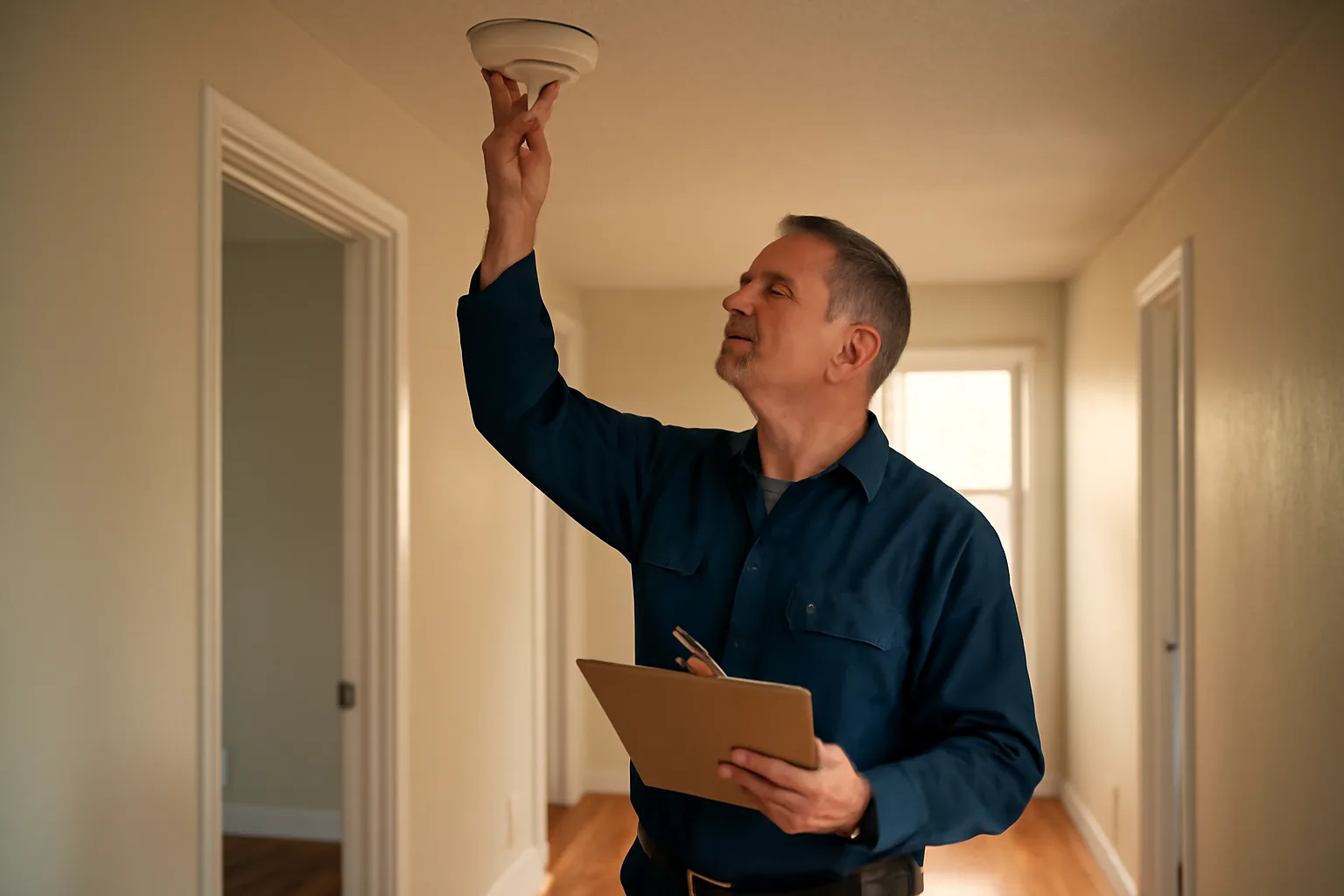
During a habitability or code inspection, a landlord (or the city inspector who does the walk-through under a rental licensing ordinance) can generally check that smoke detectors work, that there's no unpermitted electrical or plumbing work, that egress windows aren't blocked or painted shut, that there's no active mold or pest infestation, and that the unit meets basic health and safety code. This is a life-safety check, not a home-decor inspection. What inspectors typically look at:
- Working smoke alarms and carbon monoxide detectors (required in every state to some degree; check your state fire code for placement rules)
- Functioning heat, hot water, and plumbing with no active leaks
- Electrical panels and outlets that aren't overloaded, exposed, or improperly modified
- Clear egress paths and windows that open (critical in bedrooms)
- No structural hazards: rotting floors, unsafe stairs, broken railings
- Pest and rodent evidence
- Proper occupancy limits are not exceeded What a routine habitability or licensing inspection is not supposed to be is a general search of a tenant's belongings or a pretext to harass a tenant. Most states require advance notice before a landlord enters a unit outside of an emergency, commonly 24 to 48 hours, and inspections tied to city licensing programs are usually scheduled with the tenant in advance too. If you're a landlord scheduling your own pre-inspection walk-through before the official city visit, stick to the same life-safety checklist above. Going through drawers or closets that have nothing to do with code compliance is a good way to generate a fair housing or privacy complaint. For city-specific inspection checklists, our landlord landlords resource walks through what different cities actually put on their inspection forms.
How much notice does a landlord have to give before entering a unit?
| California | 24 hours (presumed reasonable) | Cal. Civ. Code Sec. 1954 [6] | |
|---|---|---|---|
| Florida | 12 hours (for repairs, under reasonable notice standard) | Fla. Stat. Sec. 83.53 [7] | |
| Texas | No statewide statute; governed by lease terms and reasonableness | N/A | |
| Ohio | "Reasonable notice," presumed to be 24 hours | Ohio Rev. Code Sec. 5321.04 [8] | Emergencies are the standard exception everywhere: a burst pipe, a gas leak, a fire, anything threatening life or property lets a landlord enter without advance notice. But for a routine inspection, whether it's your own pre-inspection walk-through or a scheduled visit tied to a city rental license renewal, you give notice under your state's rule and put it in writing so there's a record. Verbal notice is legal in most places but harder to prove later if a tenant disputes it. |
Most states require landlords to give tenants advance written or verbal notice before entering an occupied rental for a non-emergency reason, and the most common window is 24 hours, though it ranges by state. California requires "reasonable notice," which the law presumes to be 24 hours in writing for non-emergency entry under Civil Code Section 1954. [6] Some states specify 48 hours, and a few don't set a specific number at all, just requiring "reasonable" notice, which courts interpret case by case. Here's a comparison of a few commonly cited notice periods: | State | Standard notice for non-emergency entry | Statute |
Why do landlords require renters insurance?
Landlords require renters insurance mainly to shift liability for the tenant's personal belongings and for injuries or damage the tenant causes, off the landlord's own policy and onto the tenant's coverage. A landlord's dwelling policy typically covers the structure itself, not a tenant's furniture, electronics, or clothes, and it may not fully cover liability if the tenant's negligence (a stovetop fire, an overflowing tub) causes damage. Renters insurance is cheap relative to what it covers. The average cost nationally runs somewhere in the range of $15 to $30 a month depending on coverage limits and location, according to industry rate surveys from insurers like the Insurance Information Institute, though exact pricing varies a lot by state and by how much personal property coverage a tenant chooses. [9] Requiring it is legal in most states as long as it's applied consistently to all tenants and disclosed in the lease. A handful of jurisdictions have specific rules about how landlords can require or facilitate it, so check state and local law before making it a blanket lease term. Beyond covering the tenant's stuff, renters insurance policies typically include liability coverage, meaning if the tenant's dog bites a visitor, or their unattended candle starts a fire, their policy is the first line of defense instead of the landlord's. That's the real reason most landlords who've been burned once (sometimes literally) add it to every lease going forward.
What rights do tenants have without a lease?
A tenant without a written lease still has legal rights, because occupying a unit and paying rent creates a landlord-tenant relationship under state law regardless of whether anything is on paper. This is usually called a tenancy at will or a month-to-month tenancy by default, and it comes with real protections. Even with no written lease, a tenant generally has the right to:
- A habitable unit (working plumbing, heat, structural safety) under the implied warranty of habitability that most states recognize by statute or case law
- Advance notice before the landlord terminates the tenancy, typically matching the rent payment interval (commonly 30 days for month-to-month), governed by state statute
- Advance notice before the landlord enters, following the same rules as tenants with a written lease
- Return of any security deposit paid, under whatever timeline and rules the state sets for deposit return
- Protection from retaliatory or discriminatory eviction under the Fair Housing Act and, often, a parallel state fair housing law What a tenant without a lease usually doesn't get is the certainty a lease provides, like a locked-in rent amount for a fixed term. Without a lease, a landlord can generally raise rent or end a month-to-month tenancy with proper notice, whereas a signed lease term protects the rent and the tenancy until the lease expires. If you're a tenant reading this without a lease, our tenants rights and tenant rights resources cover state-specific defaults in more depth.
What can a landlord not do in Ohio?
Ohio landlord-tenant law, codified in Ohio Revised Code Chapter 5321, restricts several things landlords are tempted to do when a tenant relationship goes sideways. A landlord in Ohio cannot shut off utilities, change the locks, or remove the tenant's belongings to force them out; that's a self-help eviction, and Ohio law requires landlords to go through the court eviction process (forcible entry and detainer action) instead. [8] Specifically, under Ohio Revised Code Section 5321.04, a landlord must maintain the premises in a fit and habitable condition, keep common areas safe, maintain electrical, plumbing, and heating systems, and supply running water and reasonable heat. A landlord who fails these duties can face a tenant lawsuit for damages or a rent escrow deposit through the local municipal court. [8] Ohio law also restricts retaliation: under Section 5321.02, a landlord cannot raise rent, decrease services, or attempt to evict a tenant specifically because the tenant complained to a health or safety authority, joined a tenant union, or asserted a legal right under the lease. And under the entry notice rule already mentioned, a landlord cannot enter without reasonable notice (presumed 24 hours) except in a genuine emergency. Other things off-limits everywhere, more than Ohio: discriminating based on a protected class under the federal Fair Housing Act (race, color, religion, sex, national origin, familial status, disability), and charging a security deposit or fee structure that violates state caps where they exist.
How do rental licensing and inspection requirements vary by city?
Every mandatory-licensing city writes its own ordinance, so there's no single federal or state standard covering rental license fees, inspection frequency, or renewal cycles. Some cities require annual registration with no physical inspection at all, just a fee and a form. Others require a full interior inspection before the first tenant moves in, then again every one to four years. A few patterns show up across cities with these programs, based on published municipal fee schedules and code sections: - Annual or biennial renewal is the most common cycle; some cities go longer between full inspections (Los Angeles's SCEP program runs roughly every four years per property under the Rent Stabilization Ordinance framework). [5]
- Fees are usually charged per unit, not per building, so a triplex costs more to license than a single-family rental.
- Failing an initial inspection almost always triggers a reinspection fee and a compliance deadline, commonly 30 to 60 days, though this varies.
- Some cities exempt owner-occupied duplexes or small buildings under a certain unit count; others don't exempt anything.
- Penalties for operating without a required license can include daily fines, an inability to file an eviction in court until the property is licensed, or both, depending on the city's ordinance. Because these numbers change and differ by city, this is the one area where you should never rely on a generic guide, including this one, for the exact fee or deadline. Confirm the current figures directly with your city rental licensing office before you budget or schedule anything.
Frequently asked questions
Is there such a thing as a national rental license for landlords?
No. There's no federal or national rental license. Rental licensing, registration, and inspection requirements are set entirely at the city or county level (rarely at the state level), so requirements in one city tell you nothing about the next city over. Always check your specific municipality's rental licensing or code enforcement office.
How much does a rental license typically cost?
Costs vary widely by city, commonly somewhere between $25 and a few hundred dollars per unit per year, with some cities adding separate inspection or reinspection fees. There's no reliable national average because so few cities publish comparable data; confirm the exact current fee with your city rental licensing office before budgeting.
What happens if I rent out a unit without the required license?
Consequences vary by city but commonly include daily fines, back-fees once discovered, and in many cities an inability to file an eviction lawsuit until the unit is properly licensed. Some cities also require you to pay penalty fees on top of the standard license fee once you're caught operating unlicensed.
Do I need a rental license if I only rent out one unit?
Possibly. Many mandatory-licensing cities apply the requirement to any rental unit regardless of how many units the owner has, though some exempt owner-occupied duplexes or very small buildings. Check your specific city's ordinance; owning just one rental unit doesn't automatically exempt you.
What's the difference between rental registration and rental licensing?
Registration usually just means telling the city you have a rental unit and paying a fee, with no inspection required. Licensing usually adds a mandatory inspection requirement before the city issues or renews the license. Cities use these terms inconsistently, so read your specific ordinance rather than assuming based on the label.
Can a landlord refuse to rent to someone who doesn't have renters insurance?
In most states, yes, a landlord can require renters insurance as a lease condition as long as it's applied to all applicants consistently and disclosed upfront, since this isn't a protected class issue. A few jurisdictions restrict how landlords can require or bundle renters insurance, so check state and local rules first.
What's the implied warranty of habitability?
It's a legal doctrine, recognized by statute or court decision in most states, that says a landlord must keep a rental unit fit to live in (working plumbing, heat, structural safety) even if the lease doesn't say so explicitly. Tenants generally can't waive this right, and courts have used it to void lease clauses that try to.
How far in advance must a landlord notify a tenant of a scheduled inspection?
This follows the same rule as normal entry notice in most states, commonly 24 hours, sometimes 48. California presumes 24 hours in writing reasonable under Civil Code Section 1954; Ohio presumes the same under Revised Code Section 5321.04. Check your specific state's landlord-tenant statute for the exact standard.
Can a landlord do a walk-through inspection without the tenant present?
Generally yes, as long as proper advance notice was given and the entry isn't for an improper purpose, but many landlords choose to schedule it when the tenant can attend to avoid disputes over what was found. For move-out deposit inspections in states like California, the tenant has a right to request being present.
What documents does a new landlord need before renting out a unit?
At minimum: a written lease, proof of any required rental license or registration, a certificate of occupancy if your city requires one, required disclosures (like federal lead paint disclosure for pre-1978 housing), and proof of landlord insurance. Requirements expand from there depending on your city and state.
Do all cities require an interior inspection before issuing a rental license?
No. Some cities require a full interior inspection before first occupancy and periodically after; others only require registration and a fee with no physical inspection at all. This varies enormously by city, so don't assume your city's process based on what a friend in another city describes.
What can void a rental license once it's issued?
Common triggers include failing a follow-up or complaint-driven inspection, letting the license lapse without renewal, exceeding the permitted occupancy, or operating in violation of local zoning. Specific revocation triggers are set in each city's ordinance, so check yours directly.
Sources
- U.S. Census Bureau, Rental Housing Finance Survey: individual investors own a large share of U.S. rental properties
- Uniform Law Commission, Uniform Residential Landlord and Tenant Act: definition of landlord used across many state statutes
- HUD, 24 CFR Part 35 - Lead-Based Paint Disclosure: federal requirement to disclose lead paint risk in pre-1978 housing
- California Legislature, Civil Code Section 1950.5: move-out inspection notice and deposit itemization rules in California
- California Legislature, Civil Code Section 1954: 24 hours is presumed reasonable notice for landlord entry in California
- Ohio Legislature, Revised Code Section 5321.04: Ohio landlord duties for habitability and reasonable entry notice
- Insurance Information Institute, Renters Insurance Facts + Statistics: typical monthly cost range for renters insurance
- Ohio Legislature, Revised Code Section 5321.02: Ohio's protection against retaliatory landlord conduct
- U.S. Department of Justice, Fair Housing Act overview: federal protected classes under the Fair Housing Act