Last updated 2026-07-26
TL;DR
There's no such thing as a 'rental car license' for landlords. If you're renting out a house or apartment, you need a rental property license from your city, not a car rental credential. This guide covers registering as a landlord, passing inspections, tenant rights basics, and how mandatory rental licensing actually works.
wait, do you mean a rental license for a car, or for a property you're renting out?
If you typed "how to get rental car license" because you want to rent out your own car (like on Turo or a peer-to-peer car sharing app), that's a totally different animal from what this site covers. Honestly, it depends more on your state's insurance and business licensing rules than anything a landlord deals with. Some states require a business license or specific insurance rider before you can legally rent out a personal vehicle for money, and that's worth checking with your state's Department of Motor Vehicles or Secretary of State business licensing office directly. But if you own a house, condo, or a few apartment units and you're renting them out to tenants, and your city sent you a notice about a rental registration, rental license, or inspection deadline, you're in the right place. This confusion is common because "rental license" gets used loosely online for both cars and real estate, and search engines don't always sort that out well. The rest of this article is written for that second reader: the landlord with 1 to 10 units who just got a letter from their city's rental licensing office, or who's trying to figure out how to become a landlord the right way from scratch. If that's you, keep reading.
how do you become a landlord in the first place?
Becoming a landlord legally means three things at minimum: you own or control a property you intend to rent out, you comply with your state's landlord-tenant law, and you register or license that property with your city if your municipality requires it. There's no national landlord license. It's handled state by state and often city by city on top of that. Step one is figuring out whether your city has a rental registration or licensing ordinance at all. Not every city does. Places like Los Angeles, Minneapolis, Baltimore, and hundreds of smaller cities require landlords to register every rental unit, pay an annual or biennial fee, and in many cases pass a habitability inspection before or after renting. Others have no registration requirement at all beyond normal business licensing. Step two is getting your property compliant with basic safety codes: smoke detectors, working locks, no major code violations, functioning heat and plumbing. Step three is understanding your state's landlord-tenant statute, since that governs security deposits, notice periods, eviction procedure, and habitability standards regardless of whether your city also has a licensing program. If you're brand new to this, the U.S. Department of Housing and Urban Development publishes state-by-state links to landlord-tenant law and fair housing resources, and that's a decent starting point before you sign your first lease.
what is landlording, exactly, and what is a landlord?
A landlord is the legal owner (or an authorized agent of the owner) who rents real property to another person, called a tenant, in exchange for rent. "Landlording" is just the informal term for the ongoing job of being that owner: collecting rent, handling repairs, screening tenants, keeping the property compliant with code, and managing the legal relationship defined by your lease and state law. It's not a licensed profession the way being a real estate agent or a contractor is. In most states you don't need a special credential to become a landlord. What you do need, if your city has one, is a rental registration or rental license specific to that property, which is a local government requirement, not a personal professional license. Some states require landlords who manage properties for other owners (property management companies) to hold a real estate broker's license, since that activity counts as brokering under most state real estate licensing laws. But if you own the property yourself and rent it out, you generally don't need a broker's license just to be a landlord.
how do you actually get a rental license or registration from your city?
Most mandatory rental licensing cities follow a similar process, even though the specific forms and fees differ by city. Here's the general sequence: 1. Find your city's rental licensing office (sometimes housing department, sometimes code enforcement, sometimes a separate rental registration division). 2. Fill out a registration or license application listing the property address, unit count, owner and manager contact info, and sometimes tenant names. 3. Pay the fee, which typically ranges depending on the city, per unit or per property, often billed annually. Confirm the exact number with your city rental licensing office. 4. Schedule and pass a habitability or safety inspection if your city requires one before issuing or renewing the license. 5. Post the license or provide it to tenants if your ordinance requires disclosure. 6. Renew on your city's cycle, which is often annual or every two years, and watch for late fees if you miss the deadline. Cities that skip mandatory inspections but still require registration (a lighter-touch model) usually just want a working contact for code enforcement and emergency purposes. Cities with full licensing programs, like Minneapolis's rental licensing ordinance, combine registration with mandatory periodic inspections and can suspend or revoke a license for repeated violations [1]. If you own units across multiple cities, this gets complicated fast, since every city sets its own fee schedule, inspection interval, and application form. That's the exact mess our $79 City Rental License & Inspection Prep Packet is built to sort through: it walks you through what to gather before you apply, checklist-style, so you're not guessing what your specific city wants.
who is responsible for the rental property walk-through inspection in california?
In California, the landlord is generally responsible for arranging and allowing habitability inspections, but the specific rules differ depending on whether it's a move-in/move-out inspection or a city-mandated rental housing inspection program. For move-in and move-out condition inspections, California Civil Code Section 1950.5 gives tenants the right to request an initial inspection before move-out specifically tied to their security deposit, and the landlord must give at least 48 hours' written notice before entering to conduct that inspection unless the tenant waives the notice [2]. The landlord (or their agent) does the actual walk-through, and the tenant has the right to be present. For city-level rental housing inspection programs, which exist in cities like Los Angeles under its Systematic Code Enforcement Program (SCEP), the city's building and safety inspectors conduct the inspection, not the landlord, though the landlord is responsible for scheduling access and fixing what's flagged. The Los Angeles Housing Department administers SCEP inspections roughly every four years for most rental properties in the city [3]. So the short answer: for security deposit related walk-throughs, the landlord conducts it (with tenant's right to be present). For municipal code compliance inspections, a city inspector conducts it and the landlord is responsible for compliance and access.
what can a landlord look at during an inspection?
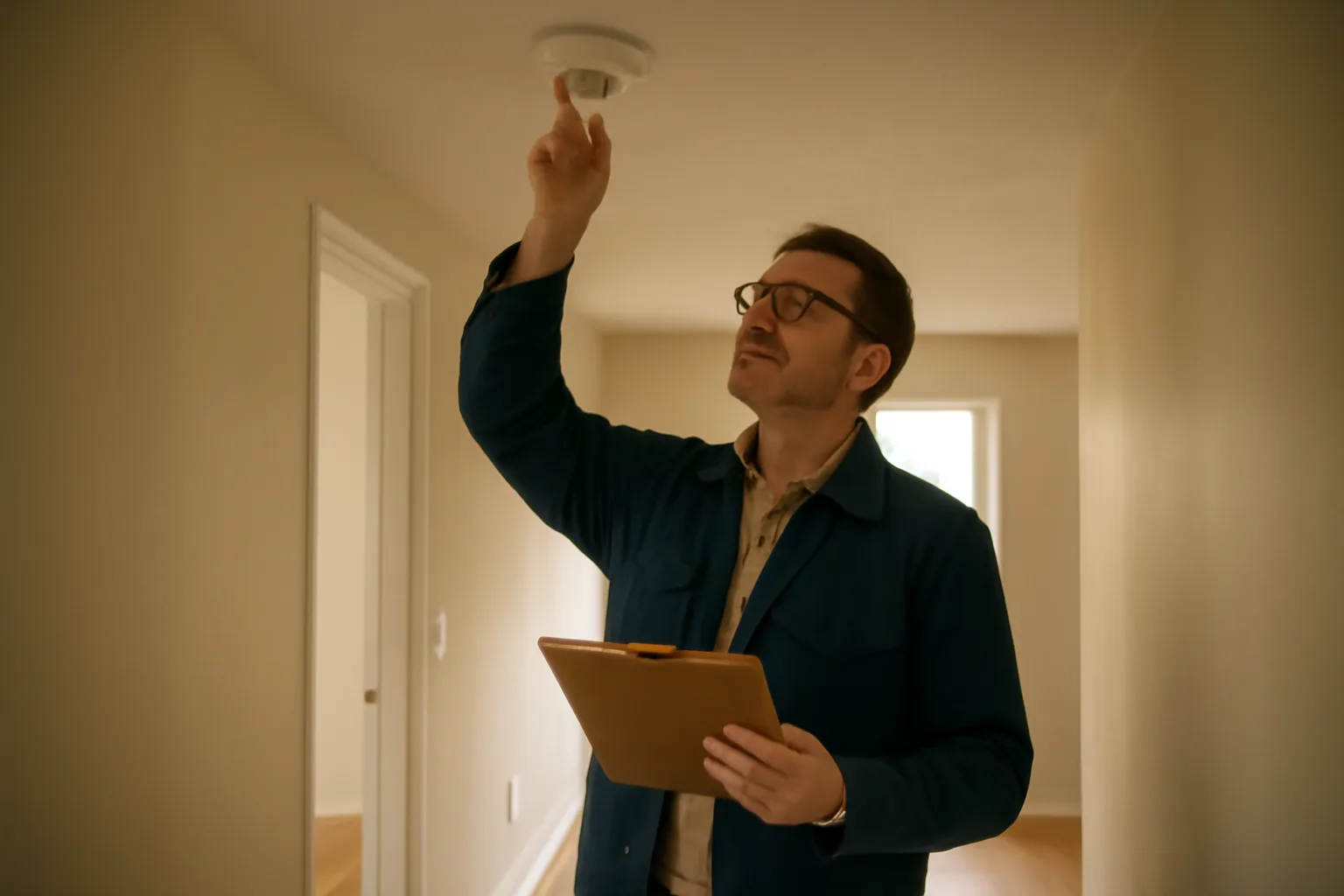
During a routine or code-compliance inspection, an inspector or landlord can generally look at anything related to habitability and safety: smoke and carbon monoxide detectors, electrical outlets and panels, plumbing fixtures, heating systems, window and door locks, evidence of pest infestation, mold, structural damage, and compliance with occupancy limits. They are not there to inspect your personal belongings or go through drawers and closets beyond what's needed to check a fixture or system. For a landlord conducting their own entry (not a city inspection), most states require the visit to be for a legitimate purpose, like repairs, showing the unit to prospective tenants or buyers, or a periodic inspection allowed under the lease, and require advance notice, commonly 24 to 48 hours depending on the state. California's standard is 24 hours' notice for routine entry under Civil Code 1954, with the 48-hour rule applying specifically to the pre-move-out inspection [2]. A landlord generally cannot use an inspection as a pretext to harass a tenant, search for personal items unrelated to the property condition, or enter without proper notice except in a genuine emergency. If your lease or city ordinance requires periodic interior inspections tied to your rental license, that's usually limited to checking the same safety items code enforcement would check: detectors, egress windows, no illegal occupancy, no obvious hazards.
how much notice does a landlord have to give before entering or inspecting?
| California | 24 hours (48 hours for move-out inspection) | Civil Code 1954, 1950.5 [2] | |
|---|---|---|---|
| Florida | 12 hours | Fla. Stat. 83.53 [4] | |
| Texas | No statutory minimum; lease governs | Texas Property Code Chapter 92 [5] | If your city has its own rental licensing inspection, that inspection notice requirement is usually set separately in the local ordinance, so check your specific city's rules alongside your state's general landlord-tenant law. Some cities require inspectors to give 7 to 10 days' notice for a scheduled licensing inspection, which is longer than the day-to-day entry notice under state law. |
Most states require landlords to give tenants advance written or verbal notice before entering the unit for a non-emergency reason, and the common standard is 24 hours, though it varies. California requires "reasonable notice," which the statute presumes to be 24 hours in writing, except for the pre-move-out inspection, which requires 48 hours [2]. Some states, like Florida, specify 12 hours' notice for non-emergency entry under Florida Statutes Section 83.53 [4]. Here's a quick comparison of a few states' baseline notice requirements for non-emergency landlord entry: | State | Standard notice for entry | Source |
why do landlords require renters insurance?
Landlords require renters insurance mainly to shift liability for the tenant's personal property and personal liability away from the landlord's own insurance policy. A landlord's property insurance covers the building and the landlord's own liability, but it does not cover a tenant's furniture, electronics, or clothing if there's a fire, burst pipe, or theft, and it typically doesn't cover a tenant's liability if they cause damage or someone gets hurt in the unit. Requiring renters insurance, often with a minimum liability coverage amount like $100,000 or $300,000 named in the lease, protects the landlord from being the only deep pocket if a tenant's actions cause a fire, a dog bite, or a slip-and-fall claim from a guest. The Insurance Information Institute notes that the average cost of a renters insurance policy nationally runs in the range of $15 to $30 a month, which is a small ask compared to the liability exposure it removes from the landlord's side [6]. It also protects the tenant, honestly, which is worth mentioning to renters who push back on the requirement. Without it, a tenant whose apartment burns down loses everything with zero coverage unless the landlord's negligence caused it (which is hard to prove and doesn't cover their personal items anyway).
what rights do tenants have without a lease?
Tenants without a written lease, often called month-to-month tenants or tenants-at-will, still have real legal rights under state law. They just don't have the specific terms a written lease would spell out. In most states, an oral or implied rental agreement still creates a landlord-tenant relationship covered by state landlord-tenant statutes, meaning the tenant still has a right to habitable conditions, protection from illegal lockouts, and a required notice period before the landlord can end the tenancy. Without a lease specifying a term, the tenancy is generally treated as month-to-month, and ending it requires the notice period set by state law, commonly 30 days, though some states require more for longer-term tenants. California, for instance, requires 60 days' notice to terminate a month-to-month tenancy if the tenant has lived there a year or more, and 30 days if less than a year, under Civil Code Section 1946.1 [7]. Tenants without a lease still cannot be evicted without proper legal process. A landlord can't just change the locks or shut off utilities to force someone out, a practice called "self-help eviction" that's illegal in nearly every state. They also retain fair housing protections under the federal Fair Housing Act regardless of whether there's a written lease [8].
what can a landlord not do in ohio?
Ohio landlord-tenant law, codified mainly in Ohio Revised Code Chapter 5321, spells out several things a landlord cannot do. A landlord cannot shut off utilities, remove doors or windows, or change the locks to force a tenant out without going through the formal eviction process in court, a practice sometimes called self-help eviction, which is illegal under Ohio law . A landlord in Ohio also cannot retaliate against a tenant for exercising a legal right, like reporting a code violation or joining a tenants' union. Ohio Revised Code 5321.02 specifically prohibits retaliatory conduct including raising rent, decreasing services, or threatening eviction because a tenant made a legitimate complaint . A landlord cannot enter the rental unit without reasonable notice except in an emergency; Ohio law generally expects landlords to give reasonable notice, and many Ohio courts and local ordinances treat 24 hours as reasonable, similar to other states. Ohio landlords also cannot ignore their duty to maintain the unit in a habitable condition. Ohio Revised Code 5321.04 requires landlords to keep the premises in compliance with health and safety codes, keep common areas safe, and maintain electrical, plumbing, heating, and sanitary systems in good working order . Failing to do so can expose the landlord to a rent escrow action or other tenant remedies under the same chapter.
what's the real difference between rental registration, rental licensing, and rental inspection programs?
These three terms get used interchangeably but they're not the same thing, and knowing the difference matters when you're reading your city's ordinance. Rental registration is the lightest version: the city just wants to know a property is a rental, who owns it, and how to reach the owner or a local agent. There's often a small fee and no inspection requirement attached. Rental licensing goes a step further. The city requires an active license to legally operate the unit as a rental, usually renewed annually or every two years, and operating without one can trigger fines or even bar you from collecting rent or evicting a tenant in some jurisdictions until you're licensed. Rental inspection programs add a physical compliance check, either on a fixed cycle (every 2 to 4 years is common) or triggered by a tenant complaint or a change in occupancy. Some cities bundle all three into one ordinance; some only require one or two of them. If you're not sure which applies to you, your city's housing department or code enforcement office is the place to ask, since ordinance language varies enormously and the wrong assumption can cost you a fine you didn't see coming.
what happens if you skip registration or licensing and just rent out the unit anyway?
Cities with mandatory rental licensing programs generally treat unregistered or unlicensed rentals as a code violation, and penalties escalate the longer it goes unaddressed. Common consequences include daily or monthly fines (confirm with your city rental licensing office for the exact schedule, since these range widely, from double-digit fines in smaller towns to hundreds of dollars a day in larger cities with aggressive enforcement), a hold on your ability to file an eviction in court until you're compliant, and in some cities, a lien placed on the property for unpaid fines. Some cities also require proof of a valid rental license before a tenant can even be legally required to pay rent, which means an unlicensed landlord can end up unable to enforce a lease in court at all until they fix the paperwork. This isn't universal, but it's common enough in cities with teeth in their ordinances that it's worth checking before you assume a late registration is just a minor paperwork issue. The fix, if you're behind, is usually straightforward: contact your city's rental licensing office, ask what's needed to come into compliance, and expect to pay a late fee on top of the normal registration or license fee. Waiting rarely helps and often just adds to the fine total.
Frequently asked questions
How do I become a landlord if I've never rented out property before?
Start by confirming whether your city requires rental registration or licensing, then get familiar with your state's landlord-tenant statute for security deposits, notice periods, and habitability duties. After that, prep the unit for safety compliance (smoke detectors, working locks, no major code issues), screen tenants under fair housing rules, and use a written lease.
Is there an actual license required to be a landlord?
No, there's no personal professional license required just to be a landlord in most states. What you may need is a local rental registration or rental license tied to the specific property, issued by your city, plus compliance with your state's landlord-tenant law. Property managers handling units for other owners may need a real estate broker's license depending on the state.
Who does the rental property walk-through inspection in California?
For security deposit related move-out inspections, the landlord or their agent conducts the walk-through, with the tenant having a right to be present under California Civil Code 1950.5. For city rental housing inspection programs, a municipal code inspector does the walk-through, and the landlord is responsible for scheduling access.
What is landlording?
Landlording is the everyday work of owning and renting out property: collecting rent, handling maintenance, screening tenants, staying compliant with local licensing rules, and following state landlord-tenant law. It's not a licensed profession itself, though the property you rent out may need a city rental license.
What is a landlord, legally speaking?
A landlord is the property owner, or an authorized agent acting for the owner, who rents real property to a tenant in exchange for rent under a lease or rental agreement. The relationship is governed primarily by state landlord-tenant law and, in many cities, a local rental registration or licensing ordinance.
What rights does a tenant have if there's no written lease?
A tenant without a written lease still has rights under state landlord-tenant law, usually as a month-to-month tenant. That includes a right to habitable conditions, protection from illegal lockouts or utility shutoffs, and a state-required notice period (often 30 days, sometimes 60) before the tenancy can be ended.
Why do landlords require tenants to carry renters insurance?
Renters insurance shifts liability for a tenant's personal belongings and personal liability claims away from the landlord's own policy. It typically costs $15 to $30 a month per the Insurance Information Institute, and protects both sides if there's a fire, injury, or other covered loss in the unit.
How much notice does a landlord have to give before entering the unit?
It depends on the state. California requires 24 hours for routine entry and 48 hours for a pre-move-out inspection under Civil Code 1954 and 1950.5. Florida requires 12 hours under Florida Statutes 83.53. Some states, like Texas, leave it to the lease with no statutory minimum.
What can a landlord not do in Ohio?
Under Ohio Revised Code Chapter 5321, a landlord cannot shut off utilities or change locks to force a tenant out without a court eviction, cannot retaliate against a tenant for a legitimate complaint, and cannot ignore the duty to maintain the unit in habitable, code-compliant condition.
What can a landlord or inspector actually look at during a rental inspection?
Inspectors and landlords can check safety and habitability items: smoke and CO detectors, electrical panels and outlets, plumbing, heating, locks, pest or mold evidence, and occupancy limits. They generally cannot search personal belongings unrelated to the property's condition or use an inspection as a pretext for harassment.
Does 'how to get a rental car license' mean something different from a rental property license?
Yes. There's no formal 'rental car license' for individual landlords; renting out a personal vehicle involves state DMV and insurance rules, not property licensing. If you're renting out a house or apartment, the correct term is rental registration or rental license through your city's housing or code enforcement office.
How do I find out if my city requires a rental license at all?
Search your city name plus "rental registration" or "rental license" and look for a .gov result from the housing department, code enforcement office, or building department. Not every city has a program; it's common in larger cities and increasingly common in mid-size cities, but plenty of small towns have no requirement at all.
Sources
- California Civil Code Section 1950.5 and 1954: Tenant's right to a pre-move-out inspection with 48 hours' notice; 24-hour notice standard for routine entry
- Florida Statutes Section 83.53: Florida requires 12 hours' notice for landlord entry
- Texas Property Code Chapter 92: Texas has no statutory minimum notice period for landlord entry, governed by lease terms
- California Civil Code Section 1946.1: California requires 60 days' notice to end a month-to-month tenancy of a year or more, 30 days otherwise
- U.S. Department of Justice, Fair Housing Act Overview: Fair housing protections apply to tenants regardless of whether a written lease exists
- Ohio Revised Code Section 5321.03: Illegal lockouts and utility shutoffs by landlords are prohibited without formal eviction process
- Ohio Revised Code Section 5321.02: Ohio prohibits landlord retaliation against tenants for legitimate complaints
- Ohio Revised Code Section 5321.04: Ohio requires landlords to maintain habitable, code-compliant premises