Last updated 2026-07-26
TL;DR
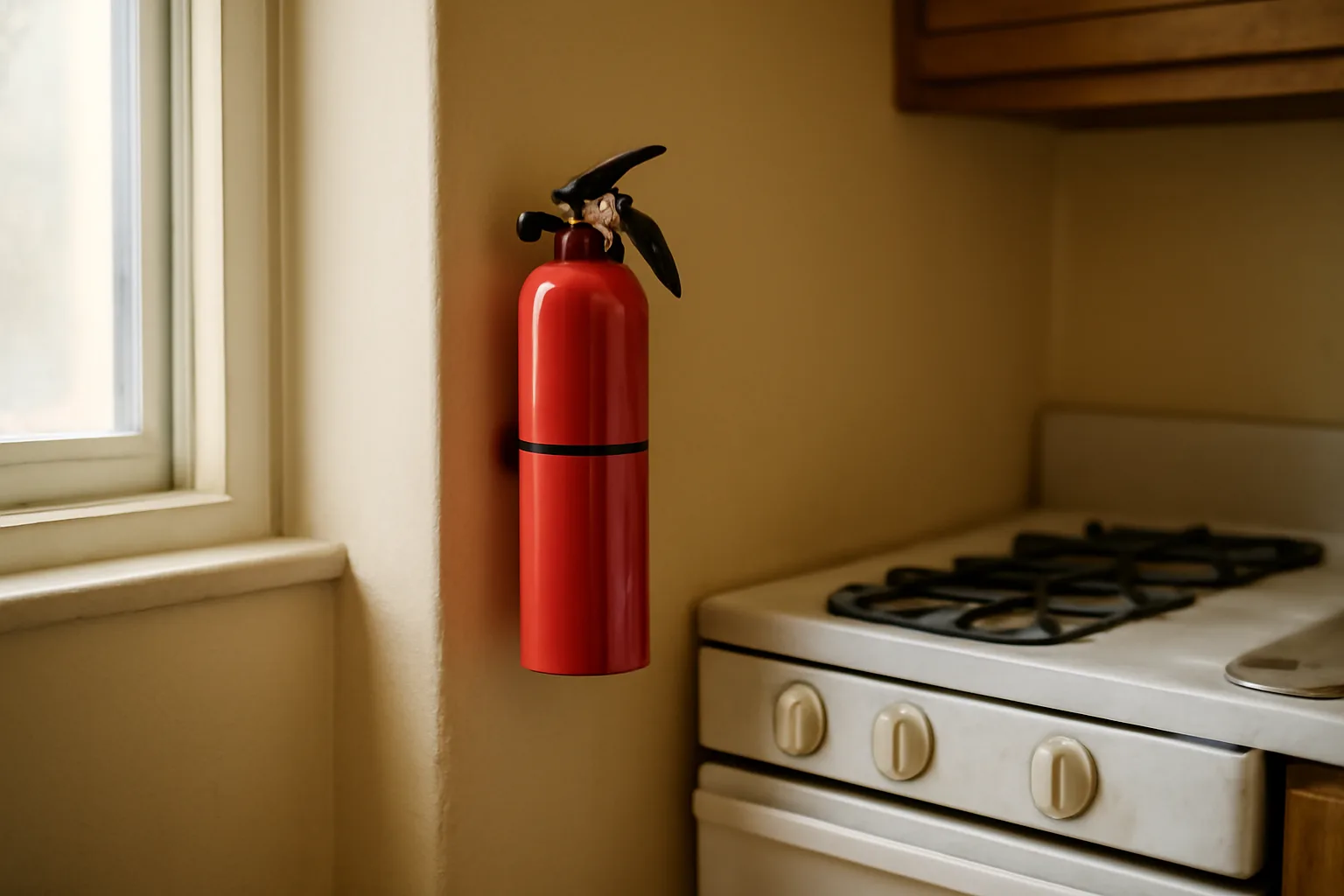
No statewide California law requires landlords to put a fire extinguisher inside every rental unit. State law (Health & Safety Code) requires working smoke alarms and carbon monoxide detectors, and many cities layer on fire extinguisher, sprinkler, or common-area equipment rules through local fire codes. Always confirm with your city rental licensing office and fire marshal.
Is a landlord required to provide a fire extinguisher in California?
Short answer: not by state statute, in most cases. California's Health and Safety Code spells out detailed landlord duties around smoke alarms and carbon monoxide detectors, but it does not contain a blanket requirement that every rental unit have its own portable fire extinguisher [1][2]. That said, "no state law" doesn't mean "no law anywhere." California cities and counties adopt the California Fire Code (based on the International Fire Code) with local amendments, and plenty of jurisdictions require fire extinguishers in common areas of multi-unit buildings, in commercial spaces, or in specific unit types like those with fuel-burning appliances [3]. Some local rental inspection programs check for extinguishers as part of a habitability sweep even when the state code doesn't name them directly. So the honest answer is: check two places. First, your city or county fire code and rental inspection checklist. Second, your lease. A lot of landlords who don't legally have to provide an extinguisher do it anyway, because it's cheap insurance against a small kitchen fire turning into a total loss.
What does California state law actually require for fire safety in rentals?
California Health and Safety Code Section 13113.7 requires an owner of a residential unit to install and maintain smoke alarms in each unit sold or newly built and, since amendments effective January 1, 2016, to have working smoke alarms in the number and locations set by the State Fire Marshal's regulations, generally at least one in each sleeping room, one outside each sleeping area, and one on each level [1]. California Health and Safety Code Section 13113.8 sets a similar mandate for carbon monoxide detectors in dwelling units, tied to Section 17926, which requires CO alarms in any dwelling unit with a fossil fuel burning heater, appliance, fireplace, or an attached garage [2]. Neither statute mentions portable fire extinguishers as a required in-unit item. The state's fire safety framework leans on early detection (smoke and CO alarms) plus the building and fire code's structural requirements (fire-rated walls, sprinklers in certain new construction, exit signage) rather than mandating a handheld extinguisher in every kitchen. If you want the state-law backbone for your habitability file, this is it: smoke alarms, CO alarms, and general habitability duties under Civil Code Section 1941.1, which lists effective waterproofing, working plumbing, heating, and electrical systems, and safe floors, stairways, and railings as the baseline for a habitable unit [4].
Do any California cities require fire extinguishers in rental units?
Yes, some do, and this is where a lot of landlords get caught off guard. Local fire departments in California can adopt amendments to the California Fire Code that add requirements the state code doesn't cover statewide, including extinguishers in specific occupancy types [3]. Common local patterns include: a portable fire extinguisher required in or near the kitchen of each unit in older wood-frame buildings, extinguishers mounted in common hallways and stairwells of apartment buildings above a certain unit count, and extinguisher requirements tied to a certificate of occupancy or rental inspection program rather than the fire code alone. Because these rules live at the city or county level and change as fire departments update their local amendments, there's no single list you can trust for every California city. If you own in Los Angeles, San Francisco, San Jose, Sacramento, or any other city with a rental registration or inspection program, the right move is to confirm with your city rental licensing office or local fire marshal's office before your next inspection, not to assume the state default applies.
What size and type of fire extinguisher does a rental unit need if one is required?
Where a local jurisdiction does require an extinguisher, it typically follows NFPA 10, the National Fire Protection Association's standard for portable fire extinguishers, which most California fire code amendments incorporate by reference [5]. For a typical residential kitchen or living area, that generally means a minimum 2-A:10-B:C rated multipurpose dry chemical extinguisher, mounted so the top is no more than 5 feet from the floor (for units weighing 40 lbs. or less) and travel distance to reach one doesn't exceed 75 feet in most occupancies [5]. A rough real-world buying guide: a basic 5-lb ABC dry chemical extinguisher rated 3-A:40-B:C, sold at most hardware stores, typically runs $25 to $50 per unit as of 2024-2025, though prices swing with brand and retailer. Landlords with several units usually buy in bulk from a restaurant supply or safety equipment distributor for a lower per-unit price. Extinguishers also need periodic maintenance. NFPA 10 calls for a monthly visual inspection (gauge in the green, no visible damage, pin and tamper seal intact) and an annual maintenance check, often by a licensed fire equipment servicer, plus hydrostatic testing on a longer cycle depending on the extinguisher type [5]. If your city requires extinguishers as part of its rental inspection program, expect the inspector to check the gauge and the inspection tag date, more than whether one is physically present.
How does an extinguisher requirement fit into a city rental inspection?
If your city runs a mandatory rental inspection or licensing program, the inspector is generally working off two different rulebooks at once: the state and local housing/building code for basic habitability, and the local fire code for fire safety items. What can a landlord look at during an inspection usually mirrors what the inspector looks at: smoke alarms in every required location, CO alarms where fuel-burning appliances or attached garages exist, clear and unobstructed egress paths, working locks on exterior doors, and, in cities with a fire extinguisher requirement, a properly mounted, currently tagged extinguisher in the required spot. Most inspection programs give you a checklist or pre-inspection notice in advance. Read it literally. If "fire extinguisher present and serviced within the last 12 months" is on your city's checklist, that's your answer regardless of what state law says, and no amount of arguing state law will get you out of a local citation.
Who is responsible for a rental property walk-through inspection in California?
For city licensing and habitability inspections, the property owner (or an authorized property manager) is responsible for scheduling access, being present or providing entry, and fixing anything flagged before the compliance deadline. The inspector, typically a city building or fire inspector, does the actual walk-through and writes up findings. For move-in and move-out walk-throughs between landlord and tenant, California Civil Code Section 1950.5 governs the security deposit process and gives tenants the right to request an initial inspection before move-out, with the landlord required to give at least 48 hours' written notice before that initial inspection and to provide an itemized statement of deductions within 21 days after the tenant moves out [6]. So there are really two different "walk-through inspection" questions people search for: the government compliance inspection (owner's job to prep for and pass) and the tenant move-out inspection (owner's job to conduct properly under the deposit statute). Confuse the two and you'll miss deadlines that matter for different reasons: one triggers a fire code citation, the other triggers a deposit dispute.
How much notice does a landlord have to give before entering a rental unit?
California Civil Code Section 1954 requires a landlord to give "reasonable notice in writing" before entering an occupied unit for repairs, inspections, or showings, and the statute treats 24 hours as presumptively reasonable notice unless circumstances suggest otherwise [7]. Entry has to happen during normal business hours unless the tenant agrees otherwise, and emergencies are the one situation where no advance notice is required at all [7]. For the security deposit move-out inspection specifically, Civil Code Section 1950.5(f) requires at least 48 hours' written notice before that initial pre-move-out walk-through, a longer window than the general 24-hour entry rule [6]. If your city rental inspection program needs interior access to check smoke alarms, CO alarms, or an extinguisher, you still owe your tenant the same 24-hour written notice under Section 1954 before you or the city inspector comes in, unless your lease or a local ordinance sets a longer window.
How to become a landlord in California, step by step
There's no state license required just to rent out a house or a duplex you own in California, but there are real steps that separate a landlord who avoids fines from one who doesn't. First, check your city and county for rental registration or licensing requirements. A growing number of California cities (particularly ones with rent control or just-cause eviction ordinances) require landlords to register each rental unit annually and pay a per-unit fee, sometimes tied to a habitability inspection cycle. Second, get the unit itself compliant: working smoke alarms per Health & Safety Code 13113.7, CO alarms where required under Section 13113.8, and any local fire code items like extinguishers or address numbering [1][2][3]. Third, understand your habitability duties under Civil Code 1941.1, and your notice-to-enter duties under Civil Code 1954 [4][7]. Fourth, screen tenants consistently and lawfully under the federal Fair Housing Act. Fifth, use a written lease that spells out rent, deposit terms tied to Civil Code 1950.5, and maintenance responsibilities. A lot of new landlords skip step one and find out about their city's registration requirement from a violation notice instead of a welcome packet. If you're staring at that kind of notice right now, a focused packet that walks through your specific city's rental license and inspection prep saves real time versus piecing it together from a dozen city PDFs. That's the whole idea behind our $79 City Rental License & Inspection Prep Packet, built for landlords reacting to exactly this kind of deadline.
What is landlording, and what is a landlord, exactly?
A landlord is the owner (or authorized agent of the owner) of real property who rents that property to another person, the tenant, in exchange for rent, under either a written lease or an oral/month-to-month rental agreement. "Landlording" is the informal, widely used term for the ongoing work of owning and managing that rental relationship: collecting rent, maintaining the property, handling repairs, screening new tenants, complying with local and state law, and handling move-outs. California law doesn't use the word "landlording" in any statute. It's a practitioner and industry term, not a legal one, but it's a useful shorthand for the full bundle of duties, which in California includes habitability maintenance under Civil Code 1941.1, deposit handling under Civil Code 1950.5, and notice-to-enter rules under Civil Code 1954 [4][6][7]. Being a landlord in California with even one unit means you're subject to state landlord-tenant law regardless of whether you think of yourself as a "real" landlord or just someone renting out a spare unit. The law doesn't distinguish based on portfolio size, only some local registration ordinances do, often exempting owner-occupied duplexes or very small operations. Confirm your city's exemption rules with your city rental licensing office rather than assuming you're too small to need to register.
What rights do tenants have without a written lease in California?
A tenant without a written lease in California still has full legal protection as a tenant under state law. An oral rental agreement creates a month-to-month tenancy, and California's core landlord-tenant statutes, habitability under Civil Code 1941.1, the deposit rules under Civil Code 1950.5, the notice-to-enter rules under Civil Code 1954, and the just-cause eviction protections under Civil Code 1946.2 (for tenancies of 12 months or more in covered properties) all apply regardless of whether the agreement is written [4][6][7][8]. Without a written lease, the terms default to what's actually been agreed and practiced (rent amount, due date, who pays which utilities) plus whatever state and local law fills in. Rent increase notice requirements still apply: generally 30 days' written notice for increases of 10% or less in a 12-month period and 90 days' written notice for larger increases, under Civil Code 1946.2 in combination with the statewide Tenant Protection Act (Civil Code 1947.12) [8][9]. Termination of a month-to-month tenancy without a written lease still requires proper written notice, 30 or 60 days depending on how long the tenant has lived there, unless just-cause protections under the Tenant Protection Act apply and require an even more specific process [8][9]. The absence of a written lease is a real risk for landlords too: it makes proving your side of any dispute harder. It doesn't strip the tenant of any statutory right.
Why do landlords require renters insurance, and can they in California?
Yes, a California landlord can require tenants to carry renters insurance as a lease condition, and a lot do. There's no statute that mandates renters insurance statewide, but nothing prohibits a landlord from making it a lease term either, the same way landlords can require a security deposit within the statutory cap. Landlords require it for a practical reason: it shifts liability. If a tenant's negligence causes a fire, water damage, or a guest injury, renters insurance (with its liability coverage, typically $100,000 to $300,000 in a standard policy) covers the tenant's exposure instead of leaving the landlord's own insurer to fight over who pays. It also covers the tenant's personal belongings, which the landlord's property insurance policy generally does not cover at all. If you require it, put the minimum coverage amount and the requirement to name you as an "interested party" or provide proof of coverage annually directly in your lease terms, and keep a copy of the tenant's declarations page in your file. This is a lease drafting decision, so loop in a local attorney or your property manager rather than relying on a generic clause pulled off the internet.
What can a landlord look at during an inspection?
During a routine habitability or licensing inspection, a landlord (or the government inspector) can generally check: smoke alarm and CO alarm presence and function, visible signs of pest infestation, mold, or water damage, functioning of heating and plumbing systems, the condition of railings, stairs, and flooring, working locks and window latches, and, where locally required, fire extinguisher presence and service tags [4]. What an inspection is not for is going through a tenant's personal belongings, closets, drawers, or private papers beyond what's needed to check the condition of the unit itself. California's notice-to-enter statute, Civil Code Section 1954, limits entry to specific stated purposes, repairs, improvements, showing to prospective tenants or buyers, or an agreed inspection, and requires that entry happen only during normal business hours absent tenant consent otherwise [7]. For city compliance inspections tied to a rental license or registration program, the scope is usually defined by that city's ordinance and inspection checklist, which the inspector should hand you (or make available) before the visit. If a city inspector wants to look at something outside that stated scope, you're allowed to ask what code section authorizes it.
What a landlord cannot do in Ohio (and how California compares)
This question comes up a lot from people comparing state landlord-tenant rules, so it's worth a straight answer even though this article is about California. Ohio's landlord-tenant law, codified at Ohio Revised Code Chapter 5321, prohibits a landlord from using "self-help" eviction, meaning a landlord in Ohio cannot lock a tenant out, shut off utilities, or remove a tenant's belongings without going through the court eviction process [10]. Ohio law also requires landlords to maintain the premises in a fit and habitable condition, comply with building and housing codes, and keep common areas safe, under ORC 5321.04 [10]. California has the same basic prohibition on self-help eviction. Civil Code Section 789.3 makes it unlawful for a landlord to willfully cause the interruption of utility service, remove outside doors or windows, or remove a tenant's personal property in order to force them out, and gives tenants a statutory penalty for violations [11]. So while the two states have different code numbering and different specific procedural rules (California's just-cause and rent-cap rules under the statewide Tenant Protection Act have no Ohio equivalent), the underlying "you can't just lock the tenant out yourself" rule holds in both states. If you're operating in Ohio and landed here by mistake, the Ohio Revised Code Chapter 5321 landlord-tenant statute is your actual starting point, not California's Civil Code.
What happens if a city cites you for a missing fire extinguisher or smoke alarm?
If a city rental inspection flags a missing or non-functioning smoke alarm, CO alarm, or (where locally required) fire extinguisher, you'll typically get a written notice of violation with a correction deadline, often 15 to 30 days depending on the city's ordinance, before any fine attaches. Fines for repeat or unaddressed violations vary enormously by city, from double-digit dollar amounts for a first offense in some smaller cities to several hundred dollars per unit per violation in larger cities with aggressive rental inspection enforcement. There's no single statewide fine schedule because these penalties come from local ordinances, not state law. The fastest fix, almost always, is the cheapest one: buy the alarm or extinguisher, mount it correctly, photograph it with a timestamp, and submit proof of correction before the deadline rather than waiting for a re-inspection to catch it. Cities generally waive or reduce fines for a documented, timely correction versus a landlord who ignores the notice entirely. If you manage more than one unit or more than one city, keeping a standing checklist per property (by city, by inspection cycle) beats trying to remember each jurisdiction's fire code amendments from memory. That's the specific gap our $79 City Rental License & Inspection Prep Packet is built to close: a structured way to track what your specific city actually requires before the inspector shows up, not a generic national checklist.
Frequently asked questions
Is a landlord required to provide a fire extinguisher in California?
Not under state law. California's Health and Safety Code requires smoke alarms and, where applicable, carbon monoxide alarms, but has no statewide fire extinguisher mandate for rental units [1][2]. Some cities add their own fire code requirement for extinguishers in common areas or specific occupancies, so confirm with your city rental licensing office or fire marshal before assuming either way.
Does California require smoke detectors in every bedroom of a rental?
Yes. Under Health and Safety Code Section 13113.7 and the State Fire Marshal's regulations, rental units generally need a smoke alarm in each bedroom, one outside each sleeping area, and one on each level of the unit [1]. Battery-only alarms are allowed in existing construction in most cases; hardwired alarms are typically required when a unit undergoes covered remodeling.
How much notice does a landlord have to give before entering a rental unit in California?
California Civil Code Section 1954 requires written notice before entry for non-emergency reasons like repairs or inspections, and treats 24 hours as presumptively reasonable [7]. For the pre-move-out deposit inspection specifically, Civil Code Section 1950.5 requires at least 48 hours' written notice [6]. Emergencies are the only exception where no advance notice is legally required.
Who is responsible for a rental property walk-through inspection in California?
The property owner or manager is responsible for scheduling and preparing for a city compliance inspection and for fixing flagged issues by the deadline. For tenant move-out walk-throughs, the landlord must give at least 48 hours' written notice under Civil Code 1950.5 and provide an itemized deposit deduction statement within 21 days after move-out [6].
What can a landlord look at during an inspection?
A landlord or city inspector can generally check smoke and CO alarms, plumbing, heating, electrical systems, stairs and railings, locks, and, where locally required, fire extinguishers. Civil Code Section 1954 limits entry purposes to repairs, showings, or agreed inspections, and inspections shouldn't extend to a tenant's personal belongings beyond what's needed to assess the unit's condition [4][7].
How do I become a landlord in California?
There's no state license requirement to rent out property, but check your city for rental registration or licensing rules, install required smoke and CO alarms, comply with habitability duties under Civil Code 1941.1, use a written lease, and screen tenants under fair housing law. Many California cities layer on their own registration fees and inspection cycles, so confirm locally.
What is landlording?
Landlording is the everyday term for the ongoing work of owning and managing rental property: collecting rent, handling maintenance and repairs, screening tenants, complying with habitability and notice laws, and managing move-ins and move-outs. It's not a legal term; California statutes just refer to "landlord" and "tenant" or "owner" and "occupant."
What rights do tenants have without a lease in California?
An oral agreement still creates a full month-to-month tenancy with all statutory protections: habitability rights under Civil Code 1941.1, deposit rules under Civil Code 1950.5, notice-to-enter rules under Civil Code 1954, and, where applicable, just-cause eviction and rent-increase notice protections under the statewide Tenant Protection Act [4][6][7][8][9].
Why do landlords require renters insurance in California?
Landlords require renters insurance mainly to shift liability: if a tenant's negligence causes fire or water damage, the tenant's policy (often with $100,000+ in liability coverage) pays instead of the landlord's insurer. It also covers the tenant's belongings, which a landlord's own property policy never covers.
What a landlord cannot do in Ohio?
Under Ohio Revised Code Chapter 5321, a landlord cannot use self-help eviction: no lockouts, no utility shutoffs, and no removing a tenant's belongings without a court order [10]. Ohio landlords also must keep the property in fit condition and comply with local housing codes under ORC 5321.04.
Does a fire extinguisher requirement show up on a city rental inspection checklist in California?
It can, but only where the local fire code requires one. Cities amend the California Fire Code independently, so some require extinguishers in kitchens or common hallways and check for a current service tag during inspection, while others don't mention extinguishers at all [3][5]. Ask your city's rental licensing office for its specific checklist.
What size fire extinguisher should I buy for a rental unit if my city requires one?
Most local fire code amendments follow NFPA 10, which for residential kitchens typically calls for a minimum 2-A:10-B:C rated multipurpose dry chemical extinguisher [5]. A common 5-lb ABC extinguisher usually costs $25 to $50 per unit as of 2024-2025, plus periodic servicing.
Can a California landlord be fined for not having required fire safety equipment?
Yes, if the city's local ordinance or fire code requires it and the landlord doesn't correct a flagged violation within the notice period. Fine amounts vary widely by city since there's no statewide fine schedule; typically a written notice with a correction deadline comes before any fine attaches.
Sources
- California Health and Safety Code Section 13113.7: Landlords must install and maintain smoke alarms in required numbers and locations in dwelling units
- California Health and Safety Code Section 13113.8: Carbon monoxide detector requirements for dwelling units with fossil fuel appliances or attached garages
- California Building Standards Commission, California Fire Code adoption: California cities adopt and locally amend the California Fire Code, which can add fire extinguisher requirements beyond state minimums
- California Civil Code Section 1941.1: Statutory habitability requirements for California rental units including plumbing, heating, electrical, and safe stairs/railings
- National Fire Protection Association, NFPA 10 Standard for Portable Fire Extinguishers: Portable fire extinguisher rating, placement, mounting height, and maintenance/inspection requirements referenced by local fire codes
- California Civil Code Section 1950.5: 48-hour written notice requirement before pre-move-out inspection and 21-day deadline for itemized deposit statement
- California Civil Code Section 1954: 24-hour written notice presumed reasonable before landlord entry for repairs or inspection, with emergency exception
- California Civil Code Section 1946.2: Just-cause eviction protections for tenancies of 12 months or more under California's statewide Tenant Protection Act
- California Civil Code Section 1947.12: Statewide rent increase caps and notice requirements (30 or 90 days depending on increase size) under the Tenant Protection Act
- Ohio Revised Code Chapter 5321, Landlord and Tenant: Ohio prohibits landlord self-help eviction (lockouts, utility shutoffs, removal of belongings) and requires habitability compliance
- California Civil Code Section 789.3: California prohibition on landlord self-help eviction including utility shutoffs and removal of tenant property