Last updated 2026-07-25
TL;DR
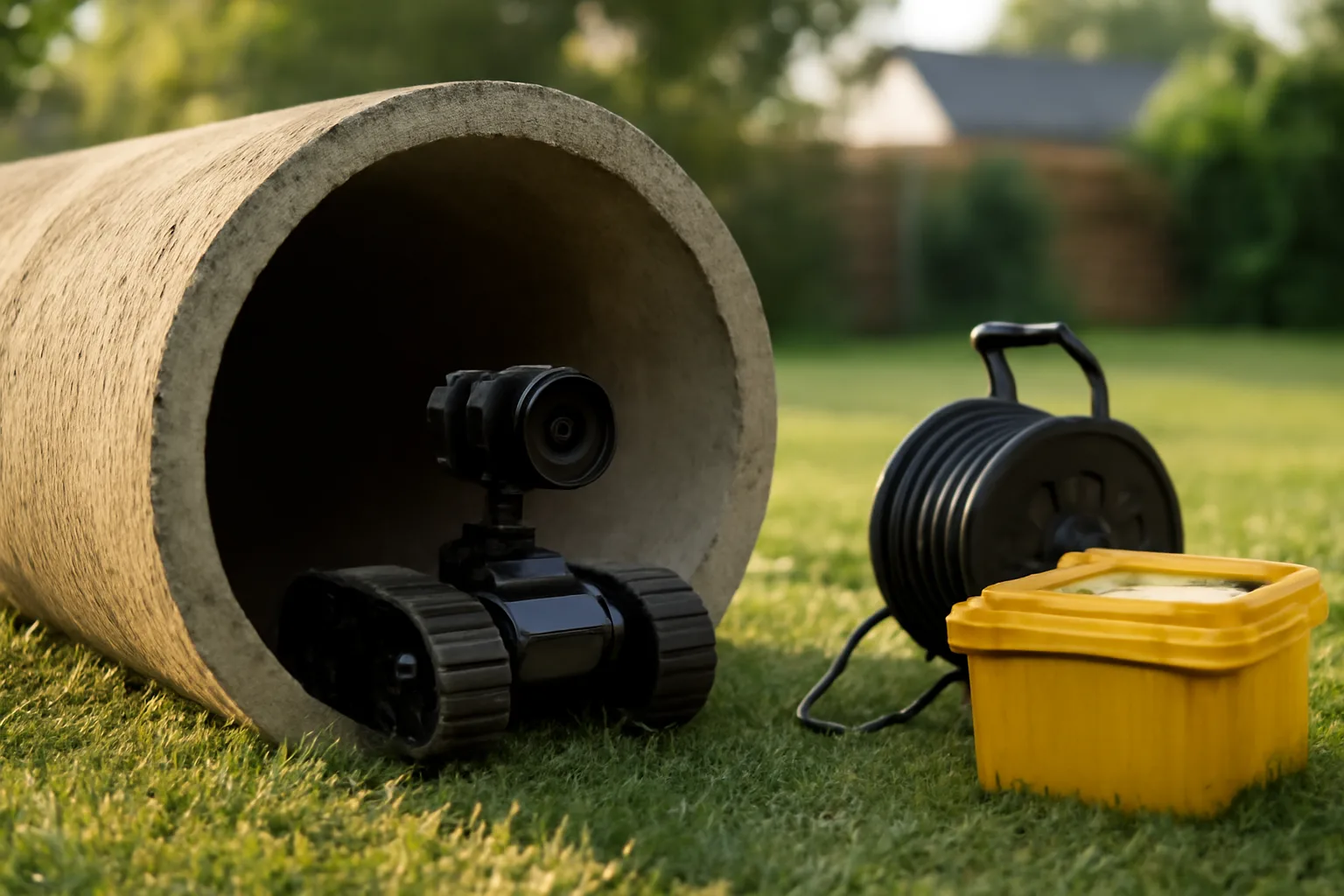
Some cities require sewer lateral camera inspections as part of rental licensing, often using a pipe crawler robot with pan-and-tilt camera, LED lighting, and distance counter. Renting one runs roughly $100 to $300 a day, or you can hire a plumber to run the scope for $200 to $600. Most landlords with 1-2 rentals should just hire it out.
what is a pipe crawler and why would a rental inspection need one
A pipe crawler is a small wheeled or tracked robot that carries a camera through a sewer line or drain pipe so you can see the inside of the pipe without digging it up. Plumbers and municipal inspectors use them to check for cracks, root intrusion, bellies (sags that trap water), offset joints, and collapsed sections. The footage gets recorded, and in a lot of cities that require sewer lateral inspections, that recorded video (or a written report based on it) becomes part of your rental license or point-of-sale compliance file. Not every city requires this. It's mostly cities with older clay or cast iron sewer infrastructure, where lateral failures (the private pipe connecting a house to the municipal main) cause backups and inflow/infiltration problems for the whole system. Cities like this often fold a sewer lateral certificate into the rental licensing or point-of-sale inspection package. Confirm with your city rental licensing office or public works department whether a lateral scope is required, and if so, whether they accept a plumber's report or require a specific format. If your city does require it, you'll usually see the requirement listed alongside other rental inspection items like smoke detectors, egress windows, and electrical panel condition. It is a distinct system from those, though, and it needs a different tool and usually a different contractor visit.
what features actually matter in a pipe crawler used for sewer inspections
If you're the one hiring a service or considering renting equipment yourself, here's what separates a usable inspection from a wasted trip. Pan-and-tilt camera head. A fixed forward-facing camera misses the sidewalls of the pipe where root intrusion and cracks usually show up first. Pan-and-tilt heads rotate 360 degrees and tilt up/down, so the operator can look directly at a joint or crack instead of just driving past it. Self-leveling image. Pipes aren't always laid perfectly level, and the crawler itself can tip on debris. A self-leveling camera keeps the picture right-side-up so the footage is actually readable, instead of a stream that rotates every time the unit hits a bump. Footage counter / distance meter. This tells you and the inspector exactly how far into the line a defect sits, measured in feet from the cleanout or access point. Without it, a report saying "crack found near the middle of the run" is nearly useless if someone later needs to locate it for excavation. LED lighting with adjustable brightness. Sewer pipe is dark and often has standing water or condensation on the lens housing. Bright, adjustable LEDs cut glare bounce-back in wet pipe and improve visibility on light-colored PVC versus dark cast iron. Locatable transmitter (sonde). A lot of crawler and push-camera systems include a sonde, a small transmitter in the camera head that a separate locator wand can trace from the surface. This lets the operator mark exactly where a defect is on the ground above, which matters if repair work follows. Wheel or track drive suited to pipe diameter. Crawlers come in size classes generally matched to 6-inch, 8-inch, 10-inch, and larger pipe. A crawler sized for municipal main lines (8 inches and up) usually won't fit or track well inside a typical 4-inch residential lateral. For a single-family rental lateral, you generally want a push-camera or small crawler rated for 3 to 6 inch pipe, not oversized municipal equipment. Many city sewer or public works departments publish their own inspection standards. Cincinnati's Metropolitan Sewer District, for instance, publishes specifications for CCTV sewer inspection reporting that call out pan-tilt-zoom capability and standardized defect coding under the PACP system used industry-wide. If your city references PACP (Pipeline Assessment and Certification Program) in its rental or point-of-sale ordinance, that's a strong signal they expect a professional-grade inspection, not a $40 borescope from a hardware store.
should you rent a pipe crawler yourself or hire it out
For almost every landlord with 1 to 10 units, hiring a licensed plumber or sewer inspection company to run the scope is the better call. Here's the honest math. Renting sewer inspection camera equipment (crawler or push-camera with monitor and reel) from an equipment rental company typically runs somewhere in the $100 to $300 per day range depending on region and unit size, based on general equipment rental industry pricing patterns. That sounds cheap until you factor in what you actually need beyond the machine itself. You need to locate and access the cleanout, which on an older property might mean digging one first. You need to interpret what you're seeing on screen, distinguishing a normal pipe joint from an actual defect. You need the footage in a format your city accepts, sometimes a specific file type or a written PACP-coded report, more than a phone video of a monitor. And you need liability coverage if the crawler gets stuck in the line, which happens. A plumber or sewer camera specialist running the same job typically charges in the $200 to $600 range for a single-family lateral inspection with a written report, though this varies widely by market and whether access requires excavation. That's often close to or less than a day's equipment rental once you add your own time and the risk of a stuck camera or misread footage. The exception: if you own more than a handful of properties in the same sewer-lateral-mandate city and expect to need this every few years across multiple addresses, buying or renting equipment might pencil out. For one or two rentals reacting to a single inspection deadline, hire it out.
what can a landlord look at during an inspection
A rental inspection, whether it's a city compliance inspection or your own periodic walk-through, generally covers life-safety and habitability items: smoke and carbon monoxide detectors, egress windows in bedrooms, electrical panel condition, plumbing leaks, water heater venting and temperature/pressure relief valve, heating system function, and structural issues like foundation cracks or unsafe stairs. Many municipal rental licensing ordinances spell these out specifically; you can usually find the checklist on your city's rental licensing or code enforcement page. What a landlord can look at during a routine tenant walk-through (separate from a city inspection) is generally limited to the condition of the unit itself: checking for damage, verifying smoke detectors work, confirming no unauthorized occupants or pets, and looking for lease violations like unpermitted alterations. Landlords generally cannot search personal belongings, open closed drawers or containers, or use the inspection as pretext to harass a tenant. Most states require advance written notice before entry for a non-emergency inspection. Sewer lateral scoping is different from a typical unit walk-through because it targets the underground pipe, not the interior living space, so it usually happens with the tenant's knowledge but doesn't require them to be present. Still give notice under your state's entry rules, since a plumber often needs interior access to a cleanout in a basement or crawlspace. If you want a structured way to track what your specific city requires before an inspection date, our landlord basics guide walks through building a documentation packet city inspectors actually expect to see.
how much notice does a landlord have to give before an inspection
This is set by state law, not city rental ordinances, and it varies. California requires "reasonable notice," which the Civil Code presumes to be 24 hours unless circumstances indicate otherwise, and notice must state the exact date, approximate time, and purpose of entry (Cal. Civ. Code Section 1954) [1]. Many other states also use 24 hours as the standard, though a few, like Florida, allow entry with as little as 12 hours' notice for the purpose of repairs, under Florida Statutes Section 83.53 [2]. A city-mandated sewer lateral or rental license inspection typically follows the same notice rules that apply to any other landlord entry, since state landlord-tenant law generally doesn't carve out an exception just because the inspection is city-required. Confirm your specific state's notice period and required notice content, since some states require the notice in writing and some accept verbal notice with a reasonable heads-up. Emergencies are the standard exception nearly everywhere. No advance notice is required if there's an immediate threat to health or safety, like a gas leak or active flooding.
who is responsible for a rental property walk-through inspection in california
In California, the landlord is responsible for arranging and conducting habitability inspections, but the specific rules depend on whether it's a routine landlord inspection, a move-in/move-out inspection, or a city-mandated rental inspection program. For move-out inspections, California Civil Code Section 1950.5 gives tenants the right to request an initial inspection before vacating, so the landlord can identify deductions from the security deposit and give the tenant a chance to fix issues themselves [3]. The landlord must give at least 48 hours' written notice of that initial inspection date if the tenant requests one. For city-level rental inspection programs (a growing number of California cities have proactive rental inspection or registration ordinances, sometimes called RRIO or similar), the city's code enforcement or housing department is responsible for the mandatory inspection itself, but the landlord is responsible for scheduling it, paying the associated fee, and fixing any violations found. Los Angeles runs its Systematic Code Enforcement Program (SCEP) under the Rent Stabilization Ordinance framework. Per the Los Angeles Municipal Code, rental units subject to the Rent Stabilization Ordinance are inspected periodically and owners are billed an annual per-unit SCEP fee to fund the program, currently collected through the LA Housing Department [4]. Every city's process differs, so confirm with your specific city's housing or code enforcement department what their inspection cycle and fee actually is.
what a landlord cannot do in ohio
Ohio's landlord-tenant law is set out in Ohio Revised Code Chapter 5321. Landlords in Ohio cannot shut off utilities, change locks, or remove a tenant's belongings to force them out, a practice generally called self-help eviction; Ohio requires a formal court eviction (forcible entry and detainer) process instead [5]. Landlords also cannot enter the rental unit without reasonable notice, which Ohio law generally treats as 24 hours, except in genuine emergencies (ORC 5321.04) [5]. Ohio landlords cannot retaliate against a tenant for reporting code violations or exercising legal rights, such as by raising rent, decreasing services, or filing eviction specifically because the tenant complained to a health or building department, per ORC 5321.02 [5]. Landlords also can't discriminate based on protected classes under state and federal fair housing law, and they have a statutory duty to keep the premises fit and habitable, comply with building and housing codes, and keep common areas safe, under ORC 5321.04. If your Ohio rental sits in a city with mandatory rental registration (Cleveland, Columbus, Cincinnati, and several suburbs each run their own program), the city inspection requirements are separate from and additional to these state-level tenant protections. Confirm with your specific city's rental registration office what their inspection and fee schedule looks like.
why do landlords require renters insurance
Landlords require renters insurance mainly to shift liability and personal property risk away from the landlord's own policy. A standard landlord (dwelling) insurance policy covers the building structure but generally does not cover a tenant's personal belongings, and it may not adequately cover liability for incidents that originate from a tenant's own negligence, like an unattended candle or an overflowing bathtub that damages a unit below. Renters insurance policies typically include personal liability coverage, often starting around $100,000, which protects both the tenant and, indirectly, the landlord if the tenant's actions cause damage to the building or injury to a guest. It also means a tenant whose belongings are destroyed in a fire or burst pipe has their own coverage instead of trying to hold the landlord responsible for their laptop and furniture. Requiring it is legal in most states as a lease condition, and many landlords make it a lease requirement with proof of coverage due at move-in and renewal. It is not a substitute for the landlord's own dwelling and liability policy, though; think of it as a second layer, not a replacement.
how to become a landlord and what does landlording actually mean
Landlording is the ongoing work of owning and managing a rental property: finding and screening tenants, signing and enforcing a lease, collecting rent, handling maintenance and repairs, keeping the property compliant with local codes, and managing the legal process if something goes wrong (nonpayment, damage, or eviction). A landlord is simply the legal owner of a residential rental property who rents it to a tenant under a lease or rental agreement, taking on the habitability and code-compliance obligations that come with that role under state landlord-tenant law. Becoming a landlord practically means a few concrete steps: confirm your property is legally allowed to be rented (zoning, HOA rules, and mandatory rental licensing or registration in your city all matter here), get landlord liability insurance separate from a standard homeowner's policy, understand your state's security deposit and notice-to-enter rules, and set up a lease that matches your state's required disclosures. If your city requires a rental license or registration, that usually has to happen before you can legally rent, not after; renting first and registering later is how landlords end up with fines or a red-tag notice. For the licensing and inspection side specifically, most cities post a checklist of what's required before they'll issue a rental license: proof of ownership, a completed application, an inspection (sometimes scheduled, sometimes on a rolling cycle), and a fee that's often somewhere between $25 and $200 per unit annually, though this varies enormously by city. Confirm the specific fee and cycle with your city rental licensing office, since these numbers change and vary block by block in some metro areas. If you're assembling your documentation before a first inspection or license renewal, our $79 City Rental License & Inspection Prep Packet is built around exactly that kind of checklist-and-deadline tracking.
what rights do tenants have without a lease
A tenant without a written lease, sometimes called a tenant-at-will or month-to-month tenant by operation of law, still has real legal protections in every state. The absence of a written lease doesn't waive habitability rights, protection against illegal lockouts, the right to advance notice before entry, or the right to a formal eviction process. It generally just means the tenancy defaults to a periodic (usually month-to-month) arrangement under state law, and either party typically can end it with proper notice, commonly 30 days, though some states require more depending on how long the tenant has lived there. Without a written lease, disputes about what was agreed (rent amount, who pays utilities, pet policies) become harder to prove, which is exactly why oral or handshake rental agreements cause so many landlord-tenant conflicts. A tenant paying rent and occupying a unit, lease or not, still has to be evicted through the courts if the landlord wants them out. A landlord cannot simply change the locks or remove their things. If you're managing a rental without paperwork in place, tightening that up matters more than almost anything else on this page, including the sewer lateral scope. Check out renters rights and tenant rights for a state-by-state starting point on what default rules apply when there's no lease in writing.
how sewer lateral inspection fits into your overall rental licensing timeline
If your city's rental license notice mentions a sewer lateral certificate, camera inspection, or point-of-sale sewer compliance requirement, treat it as its own line item with its own timeline, separate from your smoke detector and electrical checks. Sewer inspections generally need to be scheduled with a licensed plumber or the city's approved contractor list, and access sometimes requires locating or digging a cleanout that hasn't been touched in decades. Build in buffer time. A first-time lateral scope on an older property sometimes reveals root intrusion or a partial collapse that needs repair before the city will sign off, and lateral repair or replacement is a real project, not a same-day fix; sewer lateral replacement commonly runs several thousand dollars depending on length, depth, and whether trenchless repair is an option, though costs vary enormously by region and site conditions. Ask your city's rental licensing or public works department three specific questions up front: do they require PACP-coded reporting or will a plumber's written summary suffice, is there an approved contractor list, and what's the actual deadline versus the notice date you received. Cities sometimes give 60 to 90 days from notice to compliance, but this varies, so get the exact number in writing rather than assuming.
Frequently asked questions
Do all cities require sewer lateral camera inspections for rental licensing?
No. Only some cities, generally older ones with clay or cast iron sewer infrastructure, fold a sewer lateral inspection into rental licensing or point-of-sale requirements. Confirm with your specific city's rental licensing office or public works department whether this applies to your property; there's no national standard.
How much does it cost to rent a pipe crawler camera?
Equipment rental for sewer inspection cameras (crawler or push-camera with monitor) typically runs in the $100 to $300 per day range, based on general equipment rental industry pricing, though this varies by region and pipe diameter. Most landlords come out ahead hiring a plumber to run the job instead.
What is PACP and why does it matter for sewer inspections?
PACP (Pipeline Assessment and Certification Program) is an industry-standard coding system for describing pipe defects consistently in CCTV inspection reports. If your city's ordinance references PACP, they expect a professional inspection with standardized defect coding, not a basic camera peek.
What is landlording?
Landlording is the day-to-day and ongoing work of owning and renting out property: screening tenants, drafting and enforcing a lease, collecting rent, handling repairs, keeping the property code-compliant, and managing the legal side of the relationship, including eviction if it comes to that.
What is a landlord?
A landlord is the legal owner of a residential property who rents it to a tenant under a lease or rental agreement. That role comes with legal obligations under state landlord-tenant law, including habitability duties, notice-to-enter rules, and compliance with any local rental licensing ordinance.
What rights do tenants have without a lease?
A tenant without a written lease still has habitability rights, protection from illegal lockouts, the right to advance notice before entry, and the right to a formal court eviction process. The tenancy usually defaults to month-to-month under state law rather than losing legal protection entirely.
How do I become a landlord?
Confirm your property can legally be rented (zoning, HOA rules, city rental licensing), get landlord liability insurance, learn your state's security deposit and entry notice rules, and set up a compliant lease. If your city requires a rental license, get that squared away before you advertise the unit, not after.
Who is responsible for a rental property walk-through inspection in California?
The landlord is responsible for scheduling and paying for required inspections, whether it's a move-out inspection under Civil Code Section 1950.5 notice rules or a city-mandated program like Los Angeles's Systematic Code Enforcement Program. The city's code enforcement department conducts the actual inspection.
Why do landlords require renters insurance?
Renters insurance shifts personal property and liability risk off the landlord's own policy. It typically covers the tenant's belongings and includes personal liability coverage, often starting around $100,000, protecting against damage or injury the tenant's own actions cause.
How much notice does a landlord have to give before entering?
It depends on the state. California presumes 24 hours is reasonable under Civil Code Section 1954. Florida allows as little as 12 hours for repairs under Florida Statutes Section 83.53. Confirm your specific state's rule, since some require written notice and some don't.
What can a landlord look at during an inspection?
A routine inspection generally covers unit condition, damage, smoke detector function, unauthorized occupants or pets, and lease compliance. Landlords generally cannot search personal belongings or closed containers. A city compliance inspection covers a broader life-safety checklist specific to that city's rental ordinance.
What can't a landlord do in Ohio?
Ohio landlords cannot use self-help eviction (changing locks, shutting off utilities, removing belongings), cannot enter without reasonable notice except in emergencies, and cannot retaliate against tenants who report code violations, under Ohio Revised Code Chapter 5321.
Can I use a regular push-camera instead of a full pipe crawler for a rental sewer inspection?
For a typical single-family residential lateral, yes, many plumbers use a push-camera reel system rather than a full wheeled crawler, since laterals are usually 4 to 6 inches in diameter. Full crawler units are more common for larger municipal main-line inspections.
What happens if my sewer lateral inspection finds a defect before rental licensing?
You'll typically need to repair the issue before the city issues or renews the license. Repairs range from a simple root-clearing to full trenchless lining or excavation and replacement, which can run several thousand dollars. Ask your city inspector for the specific compliance deadline in writing.
Sources
- California Civil Code Section 1954: 24-hour presumed reasonable notice requirement for landlord entry in California
- Florida Statutes Section 83.53: 12-hour notice allowance for landlord entry for repairs in Florida
- Los Angeles Municipal Code, Rent Stabilization Ordinance, Systematic Code Enforcement Program provisions: LA's SCEP inspects rental units subject to the Rent Stabilization Ordinance and funds the program through an annual per-unit fee
- Ohio Revised Code Chapter 5321: Ohio landlord obligations, entry notice rules, prohibition on self-help eviction, and anti-retaliation provisions
- California Civil Code Section 1950.5: Tenant right to request an initial move-out inspection with 48 hours written notice in California