Last updated 2026-07-26
TL;DR
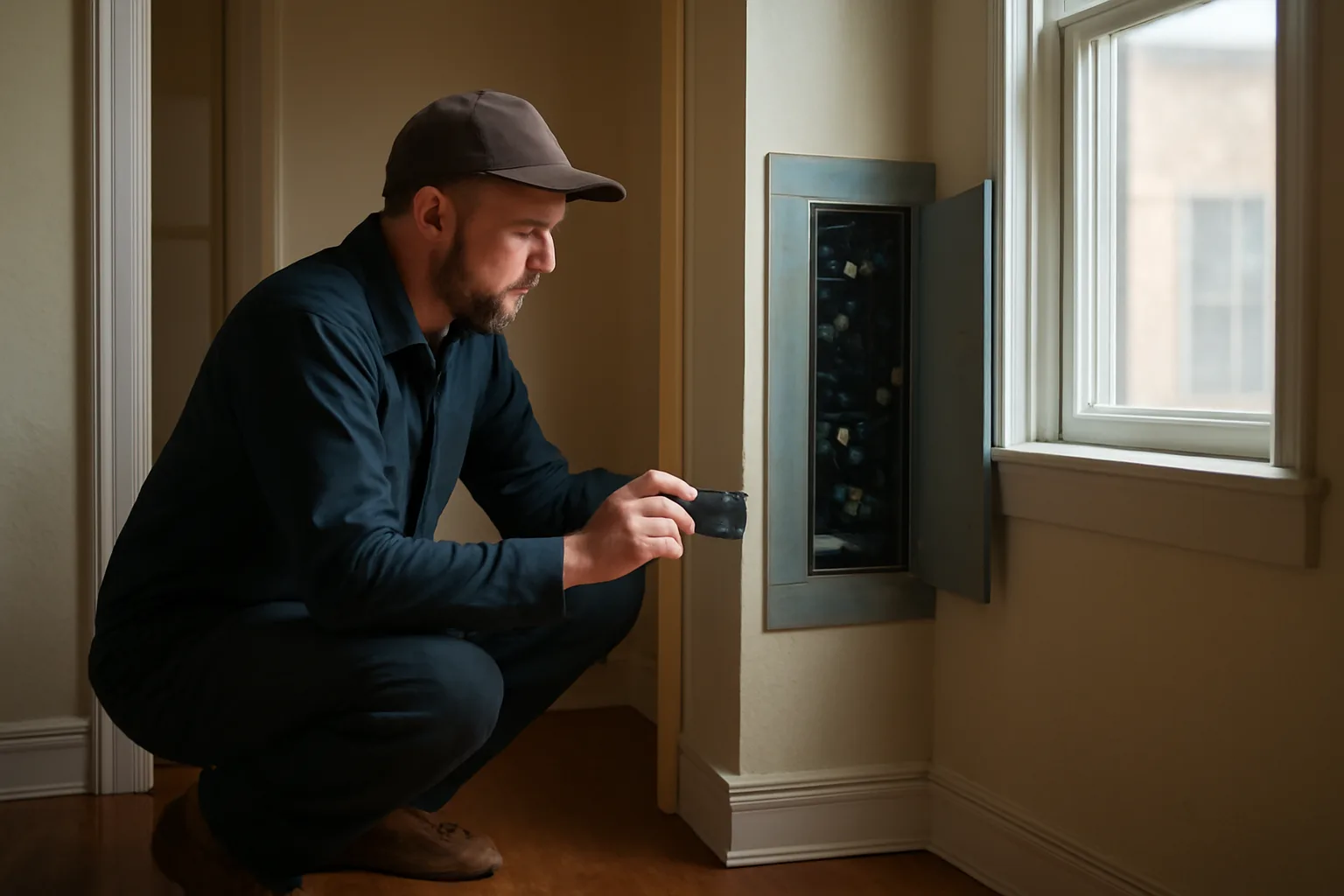
A rental inspection checks smoke and CO alarms, electrical and plumbing safety, heat, exits, pest and mold signs, and general structural condition. Most cities require 24 to 48 hours notice before entry. Landlords should walk every room, test every alarm, and photograph everything before the official inspector shows up.
What can a landlord look at during an inspection?
| Life safety | Smoke alarms (every bedroom, hallway, each floor), CO detectors, fire extinguisher if required, clear exits |
|---|---|
| Electrical | No exposed wiring, GFCI outlets near water, no overloaded extension cords, working panel |
| Plumbing | No active leaks, working water heater with relief valve, adequate water pressure, no sewage smell |
| Structural | Stable stairs/railings, no rotted framing, windows that open and lock, roof not visibly failing |
| Pest/mold | No visible infestation, no active mold growth, no standing water |
| Heating | Functional primary heat source rated for the climate zone |
A landlord (or a city inspector working from a rental licensing ordinance) is checking for health and safety conditions, not judging your housekeeping. That means smoke alarms and carbon monoxide detectors in every required location, working locks on doors and windows, no exposed wiring or overloaded outlets, a working heat source rated for the local climate, and no active leaks, mold, or pest infestation. Inspectors also look at the structural basics: are stairs and railings solid, are windows that are supposed to open actually opening (this matters a lot for fire egress from bedrooms), is there a second means of exit from upper floors, and is the water heater properly vented and equipped with a temperature/pressure relief valve. Many city codes borrow their minimum standards from the International Property Maintenance Code (IPMC), which most U.S. jurisdictions adopt in some form [1]. What a landlord generally cannot do, even during a legitimate inspection, is go through a tenant's personal belongings, closets, or drawers looking for anything other than the maintenance issue at hand. The inspection is about the unit's condition, not a search of the tenant's stuff. Here's a realistic checklist broken down by category: | Category | What gets checked |
How much notice does a landlord have to give before an inspection?
Most states require 24 to 48 hours written or verbal notice before a landlord enters an occupied unit for a non-emergency reason, including a routine inspection. California's Civil Code sets this at 24 hours as the presumptively reasonable notice period, and it must state the date, approximate time, and purpose of entry [2]. Some states use a flat 24 hours, others say "reasonable notice" without a fixed number, which usually gets interpreted as 24 to 48 hours in practice. Emergencies are the exception. A burst pipe, a gas leak, or a fire hazard lets a landlord enter without notice, because the health and safety risk outweighs the tenant's privacy interest. City-mandated rental inspections (the kind tied to a rental license renewal) often have their own separate notice rule written into the local ordinance, sometimes longer than the state's general entry notice rule, sometimes the same. Always confirm the exact notice window and format (written vs. verbal, mailed vs. posted) with your city rental licensing office, because this is one of the most commonly cited violations when landlords get it wrong.
Who is responsible for a rental property walk-through inspection in California?
In California, the landlord is responsible for scheduling and conducting move-in and move-out walk-through inspections, but the tenant has a right to participate. California Civil Code Section 1950.5 gives tenants the right to request an initial move-out inspection before vacating, done at a reasonable time, with at least 48 hours advance written notice given to the tenant, so they can be present [3]. The purpose of that pre-move-out walk-through is specifically about the security deposit: it lets the tenant fix problems themselves (a hole in the wall, a stain on the carpet) before the landlord makes deductions. After the actual move-out, the landlord has 21 days to return the deposit or provide an itemized statement of deductions under the same statute [3]. Separately, a local rental inspection tied to a city license (San Francisco, Los Angeles, and dozens of other California cities run these) is usually conducted by a city code enforcement officer or a licensed private inspector the city approves, not by the landlord personally. The landlord's job there is to schedule it, be present or have a representative present, and fix anything flagged before the deadline.
What is landlording, and what does a landlord actually do?
Landlording is the day-to-day work of owning and managing rental property: collecting rent, screening tenants, handling repairs, complying with local housing codes, and managing the legal relationship defined by a lease. It's part business, part maintenance work, part paperwork. A landlord, by definition, is the owner (or an agent acting for the owner) who leases real property to a tenant in exchange for rent. That's it at the legal level. But functionally, in a small operation with 1 to 10 units, the same person is usually also the plumber's first call, the person who reads the local ordinance to figure out inspection requirements, and the one who has to decide whether a $150 repair now beats a $500 fine later. Most mandatory rental licensing programs exist because cities found that unlicensed, uninspected rental housing correlates with more code violations and worse conditions for tenants. That's the policy logic behind programs like Minneapolis's rental license requirement, which applies to any property with one or more dwelling units rented to someone other than the owner [4].
How to become a landlord: what's actually required
Becoming a landlord legally involves more than buying a property and putting up a listing. At minimum you need: legal ownership or authority to lease the unit, compliance with any local landlord registration or rental licensing ordinance, a lease that meets your state's requirements, and usually proof of adequate insurance. In a mandatory rental-licensing city, you'll also need to register the property with the city (sometimes annually, sometimes on a multi-year cycle), pay a licensing fee (commonly somewhere between $50 and $300 per unit depending on the city, though this varies enormously, so confirm with your city rental licensing office), and pass an initial inspection before the city issues or renews the license. A practical first-year checklist: 1. Confirm zoning allows rental use at that address. 2. Register with the city's rental licensing or housing department. 3. Get landlord liability insurance (a standard homeowner's policy usually excludes rental use). 4. Fix anything an inspector would flag before you schedule the inspection, not after. 5. Draft a lease compliant with your state's landlord-tenant statute. 6. Set up a legal process for security deposit handling, since most states cap the amount and set a return deadline. If you're just getting your paperwork and inspection prep in order for a specific city's licensing cycle, a City Rental License & Inspection Prep Packet can save you from re-researching each city's requirements from scratch. It's a one-time $79 packet, not a subscription, and it doesn't replace your city's actual inspection checklist, it just helps you organize for it.
How to be a landlord without getting blindsided by inspections
The landlords who get hit with the most violation fines are almost always the ones who treat the inspection as something that happens to them instead of something they prepare for. Do your own walk-through 30 days before the city's scheduled inspection, using the same categories the city inspector will use: alarms, egress, electrical, plumbing, pest, structural. Keep a simple maintenance log per unit. Not because any law requires it (some cities do require records, most don't), but because when an inspector asks "when was this water heater installed," a real answer builds credibility and sometimes avoids a re-inspection fee. Budget for the fix-before-fail approach. A $40 smoke alarm and a $200 GFCI outlet swap are nothing compared to a failed inspection that triggers a re-inspection fee (commonly $50 to $150 per re-visit in cities that charge one, confirm with your city) plus a delay on your license renewal.
Why do landlords require renters insurance?
Landlords require renters insurance mainly to shift liability for the tenant's personal property and personal liability away from the landlord's own policy. A landlord's property insurance covers the building itself, not the tenant's furniture, electronics, or clothing, and it generally doesn't cover a tenant's liability if the tenant's dog bites a visitor or the tenant accidentally causes a kitchen fire. Requiring renters insurance (commonly $10 to $20 a month for a basic policy) is legal in most states as a lease condition, and it protects the landlord from disputes where a tenant claims the landlord's insurance should cover their damaged belongings after a leak or fire. It's a cheap risk-transfer tool, and most landlord associations recommend it as standard lease language, though it isn't universally required by law outside of specific state or city programs.
What rights do tenants have without a lease?
A tenant without a written lease still has legal protections in every state; the absence of a signed lease does not mean the tenant has no rights. Most states treat an undocumented tenancy as a month-to-month tenancy at will, governed by the state's default landlord-tenant statute. That typically means the tenant still has the right to: habitable, safe housing (implied warranty of habitability, recognized in some form in nearly every state), advance notice before the landlord can enter (usually the same 24 to 48 hour standard as leased tenants), advance written notice before termination (commonly 30 days for month-to-month, sometimes longer depending on how long the tenant has lived there), and formal eviction through the courts rather than a lockout or utility shutoff. Self-help eviction, meaning changing the locks or shutting off utilities without a court order, is illegal in essentially every U.S. state regardless of whether a lease exists. For deeper reading on what tenants can and can't be asked to do, see tenant rights and renters rights.
What a landlord cannot do in Ohio
Ohio's landlord-tenant law, codified at Ohio Revised Code Chapter 5321, spells out several things a landlord cannot do. A landlord cannot enter the rental unit without giving reasonable notice, and Ohio courts have generally treated 24 hours as reasonable in practice, though the statute itself just says the landlord must give "reasonable notice" and enter only "at reasonable times" [5]. A landlord in Ohio cannot use self-help eviction: no changing the locks, removing the tenant's belongings, or shutting off utilities to force a tenant out, even if rent is unpaid. Only a court-ordered eviction (through a forcible entry and detainer action) can remove a tenant. Ohio Revised Code 5321.15 specifically prohibits a landlord from willfully diminishing services like heat, water, or electricity to force a tenant out [6]. A landlord also cannot retaliate against a tenant for reporting a code violation or joining a tenant organization. Ohio Revised Code 5321.02 protects tenants from a landlord raising rent, decreasing services, or threatening eviction specifically because the tenant complained to a housing authority .
Room-by-room: what an inspector actually checks
Walking through with an inspector's mindset room by room catches more problems than a generic checklist. Here's how that usually breaks down: Kitchen: working range/oven, no gas leak smell, GFCI outlets near the sink, functioning exhaust fan or window ventilation, no under-sink leaks, refrigerator running at safe temperature if landlord-supplied. Bathroom: working exhaust fan or window, no active leaks under the sink or around the tub, grout and caulk intact (mold risk), water heater accessible and vented correctly, GFCI protection on outlets. Bedrooms: a smoke alarm in every bedroom (this is close to universal in U.S. fire codes now), a window that actually opens and is large enough for emergency egress, no space heater as a primary heat source (many cities flag this specifically). Common areas/hallways: interconnected smoke alarms in multi-unit buildings where required, clear and lit exit paths, fire extinguisher if the local code requires one for the building type. Exterior: handrails secure on any stairs with more than a couple steps, no trip hazards on walkways, proper address numbers visible (fire departments need this), roof and gutters not actively failing. Basement/utility: water heater relief valve present and piped down, furnace filter not caked with dust, no standing water, electrical panel labeled and accessible (not blocked by storage).
What happens if a rental property fails inspection?
A failed inspection usually triggers a written notice of violation with a correction deadline, commonly 10 to 30 days depending on the severity and the city's ordinance, confirm the exact window with your city rental licensing office since it varies widely by jurisdiction and by violation type. Life safety issues (no smoke alarm, exposed wiring, blocked egress) tend to get shorter deadlines than cosmetic issues. Most cities allow a re-inspection once you've made the fix, sometimes for a fee (commonly $50 to $150 where a fee applies), sometimes included in the original license fee. If you miss the correction deadline, the next step is usually a formal fine, and repeated failures can lead to license suspension, meaning you legally cannot rent that unit until it's resolved. The fastest way through this is to treat the first inspection notice as the deadline, not the actual inspection date, and start fixing things immediately rather than waiting to see what the inspector flags.
Frequently asked questions
How to become a landlord in a city that requires rental licensing?
Register the property with your city's rental licensing or housing department, pay the required fee, pass the initial inspection, and get a lease compliant with your state's landlord-tenant law. Requirements and fees vary enormously by city, so confirm the exact process with your city rental licensing office before you list the unit.
Who is responsible for a rental property walk-through inspection in California?
The landlord schedules and conducts the walk-through, but under California Civil Code 1950.5 the tenant has the right to request a pre-move-out inspection with at least 48 hours notice, so they can fix issues before deposit deductions happen. City-license inspections are usually done by a code officer, not the landlord.
What is landlording?
Landlording is the ongoing work of owning and managing rental property: collecting rent, screening tenants, handling repairs, staying compliant with local rental codes, and managing the legal lease relationship. It combines property management, light maintenance, and regulatory paperwork, especially in cities with mandatory rental licensing.
What is a landlord, legally speaking?
A landlord is the owner of real property, or their authorized agent, who leases that property to a tenant in exchange for rent under a lease agreement. The term applies regardless of whether the owner manages the property personally or hires a property manager to do it.
What rights do tenants have without a signed lease?
A tenant without a written lease is generally treated as a month-to-month tenant under state default rules, with the same core protections: habitable housing, advance notice before entry, formal eviction through the courts rather than a lockout, and (in most states) notice before rent increases or termination.
How to be a landlord and avoid failing an inspection?
Do your own pre-inspection walk-through 30 days ahead using the inspector's own categories: smoke and CO alarms, electrical, plumbing, heat, pest signs, and egress. Fix problems before the scheduled visit instead of after. Most failed inspections come from a handful of predictable issues, not surprises.
Why do landlords require renters insurance?
Renters insurance shifts liability for the tenant's personal belongings and personal liability claims away from the landlord's own policy, which typically covers only the building, not the tenant's stuff. It's a low-cost way (often $10 to $20 a month) to reduce dispute risk after a fire, leak, or injury.
How much notice does a landlord have to give before entering for an inspection?
Most states require 24 to 48 hours notice before non-emergency entry, including a routine inspection. California sets 24 hours as presumptively reasonable under Civil Code 1954. Some city rental-license inspections have their own separate notice rule, so check your local ordinance too.
What can a landlord look at during an inspection?
A landlord or city inspector checks the unit's physical condition: smoke and CO alarms, electrical safety, plumbing leaks, working heat, pest or mold signs, and structural soundness. They should not search a tenant's personal belongings or areas unrelated to the maintenance issue being inspected.
What a landlord cannot do in Ohio
Under Ohio Revised Code Chapter 5321, a landlord cannot enter without reasonable notice, cannot use self-help eviction (changing locks, shutting off utilities), and cannot retaliate against a tenant for reporting code violations. Only a court can order an eviction; the landlord can't force one out directly.
Can a landlord fail a rental inspection over minor cosmetic issues?
Usually no. Most rental inspection ordinances focus on health and safety items like alarms, electrical hazards, and structural soundness, not paint color or minor cosmetic wear. But some cities do include basic maintenance items (peeling exterior paint, broken screens) in their checklist, so confirm your city's specific standard.
How often do cities require rental property inspections?
It varies by city. Some require an inspection only at initial licensing, others require reinspection every 1 to 3 years on a rolling schedule, and a few inspect only when a complaint comes in. Confirm the specific cycle with your city rental licensing office, since there's no single national standard.
Sources
- International Code Council, International Property Maintenance Code: Most U.S. jurisdictions base local rental housing minimum standards on the IPMC
- California Legislative Information, Civil Code Section 1954: California requires 24 hours notice before non-emergency landlord entry
- California Legislative Information, Civil Code Section 1950.5: Tenants can request a pre-move-out inspection with 48 hours notice, and landlords have 21 days to return the security deposit
- Ohio Revised Code Section 5321.04: Ohio landlords must give reasonable notice and enter only at reasonable times
- Ohio Revised Code Section 5321.15: Ohio law prohibits a landlord from willfully diminishing services like heat, water, or electricity to force a tenant out
- Ohio Revised Code Section 5321.02: Ohio law protects tenants from retaliatory eviction or rent increases for reporting code violations