Last updated 2026-07-26
TL;DR
Rental inspectors mainly check life-safety items: working smoke and CO alarms, two exits from bedrooms, secure railings, no exposed wiring, functioning heat, hot water at a safe temperature, and no active pest or mold problems. Most failures are cheap fixes (a missing alarm, a loose railing) rather than structural issues, but you won't know your city's exact checklist until you request it.
what does a rental inspector actually look for?
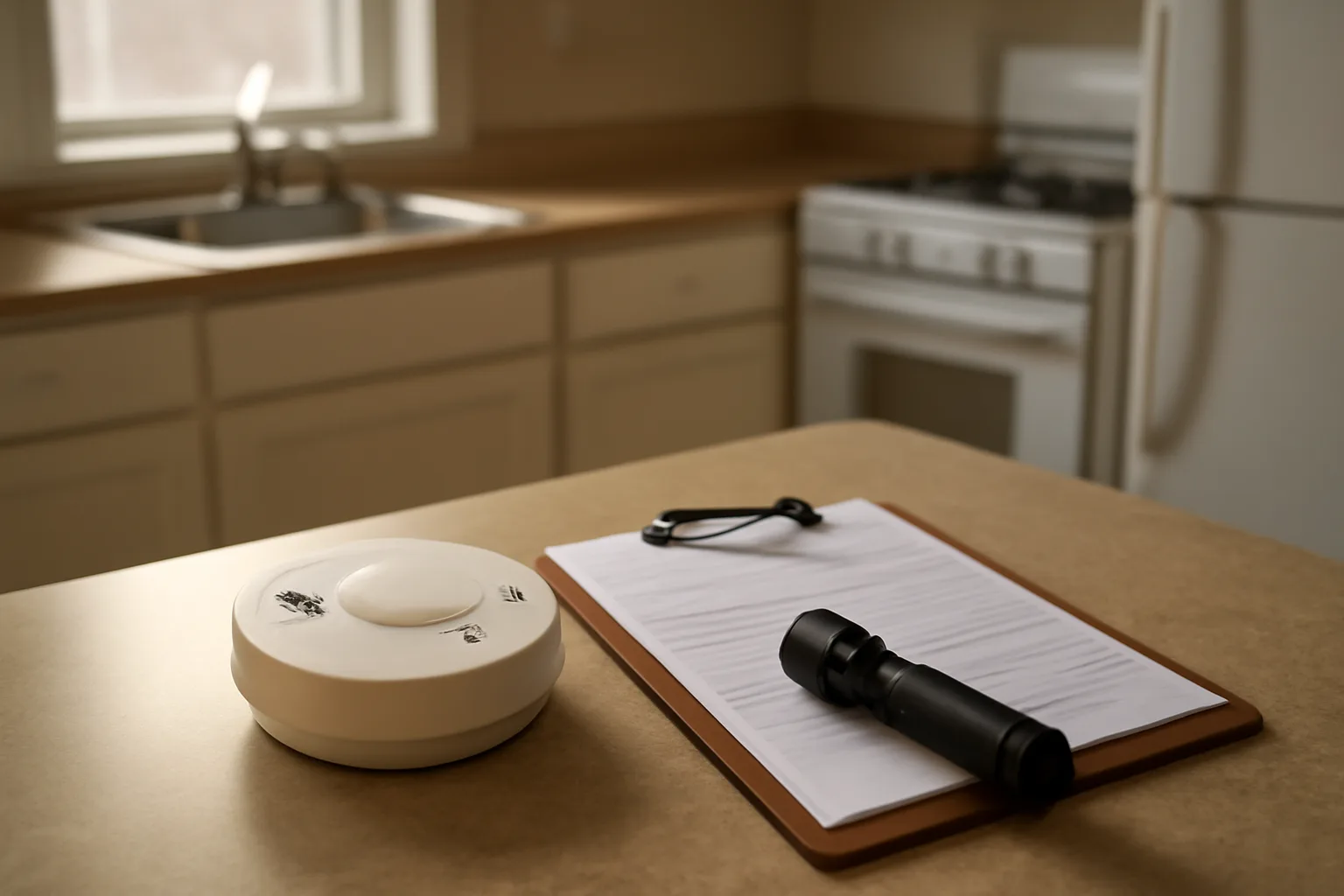
Every city runs its rental inspection program a little differently, but the core list is remarkably consistent because most of it traces back to the International Property Maintenance Code (IPMC), which a large share of U.S. cities adopt in whole or in part [1]. Inspectors are checking for conditions that could hurt or kill someone, not cosmetic stuff. At a minimum, expect the inspector to check: working smoke alarms in every bedroom and on every level, a carbon monoxide alarm if you have gas appliances or an attached garage, two ways out of every bedroom (a door and a window that opens, or a second door), secure handrails on any stairs with four or more risers, GFCI outlets near water sources, no exposed or frayed wiring, a furnace or heat source that actually works, hot water that isn't scalding, and no signs of active leaks, mold, or pest infestation. They're also looking at the exterior: peeling paint (especially in pre-1978 housing, because of lead paint rules), a roof that isn't visibly failing, windows that seal properly, and whether the yard has junk, standing water, or a rodent problem. None of this is a surprise checklist. Most cities that require rental inspections post the actual form online, and you should pull it before your first inspection instead of guessing.
what can a landlord look at during an inspection?
If you're asking this because you're the one doing a routine walk-through (not the city inspector), the rules are different and depend on your lease and state law. As a landlord, you generally have the right to inspect for safety hazards, unauthorized occupants, unauthorized pets, damage beyond normal wear and tear, and evidence of lease violations like illegal subletting. You do not have a blanket right to search personal belongings, go through drawers, or use the inspection as a pretext to harass a tenant or retaliate against one who filed a complaint. Many states, including California, require landlords to give reasonable written notice, typically 24 hours, before entering for a non-emergency inspection [2]. The safest approach: stick to what's on your inspection checklist (smoke alarms, filters, visible leaks, general condition) and don't linger or open closets and cabinets that aren't relevant to what you're checking. If a tenant refuses entry after proper notice, don't force your way in. That's a legal problem to solve through your state's notice-and-entry statute, not something to push through in the moment.
who is responsible for a rental property walk-through inspection in california?
In California, the landlord is generally responsible for arranging move-in and move-out walk-through inspections, but the tenant has real participation rights. Under California Civil Code Section 1950.5, a landlord must, on request, do an initial inspection before the tenant moves out and give the tenant an itemized list of deficiencies with an opportunity to fix them before move-out, so those items can't later be deducted from the security deposit without notice [2]. The statute is specific: the landlord must give the tenant "reasonable notice of no less than 48 hours" prior to the initial inspection, unless the tenant waives that notice in writing [2]. The tenant can choose to be present or not. If the tenant doesn't request the initial inspection, the landlord isn't required to offer that pre-move-out walkthrough, but the final security deposit itemization requirement still applies. For routine (not move-out) inspections during a tenancy, ordinary entry-notice rules apply. California law generally treats 24 hours as reasonable notice for entry to make repairs or show the unit, though "reasonable" is the actual legal standard and courts can look at circumstances [2]. This is separate from any city-level rental inspection program, which is run by a code enforcement office, not the landlord, and has its own notice rules.
how much notice does a landlord have to give before an inspection?
For a private landlord inspecting their own rental unit, most states require some form of advance notice, and 24 hours is the most common benchmark, though it's not universal. California's statute uses the phrase "reasonable notice," and describes 24 hours as presumptively reasonable in the absence of contrary evidence [2]. Other states set their own numbers by statute, and a few (some month-to-month leases without a formal state statute) rely mostly on lease language and general reasonableness. For a government rental inspection tied to a licensing program, notice requirements vary by city ordinance, not state landlord-tenant law. Some cities schedule inspections weeks in advance by mail and let the landlord and tenant coordinate a time. Others require the landlord to give tenants a set number of days' notice before the city inspector arrives. Since these deadlines carry fines if missed, confirm the specific notice window with your city rental licensing office rather than assuming a number. Emergency exceptions exist everywhere: if there's a burst pipe, gas leak, or fire, a landlord (or the fire department) can enter without advance notice. That's true under essentially every state's landlord-tenant framework and isn't something you need to look up city by city.
what fails most often in a rental inspection?
| Missing or expired smoke alarm | No working alarm in bedroom or hallway | $10 to $30 per alarm | |
|---|---|---|---|
| No CO alarm | Required with gas heat, gas water heater, or attached garage in many jurisdictions | $20 to $50 | |
| Blocked or missing second exit from bedroom | Window painted shut, security bars without release, or window too small | $50 to $400 depending on fix | |
| Loose or missing handrail | Stairs with 4+ risers need a graspable rail | $75 to $300 | |
| GFCI outlet missing near sink/bath | Required in wet locations under most electrical codes | $15 to $40 per outlet | |
| Peeling paint (pre-1978 units) | Lead paint hazard under federal rules | $200 to $2,000+ depending on scope | |
| Active pest evidence | Droppings, live insects, rodent entry points | Varies widely | The pattern is obvious once you see it: almost everything on this list is a $20 to $300 fix, not a major renovation. The landlords who get hit with re-inspection fees and fines are usually the ones who skip a pre-inspection walk-through entirely, not the ones who have a genuinely rundown building. |
There's no single national database tracking rental inspection failure rates across every city, so treat any specific percentage claim with some skepticism. But code enforcement officers and municipal housing departments consistently name a short list of repeat offenders, and it lines up with what the IPMC treats as priority hazards [1]: | Common failure | Why it fails | Typical fix cost |
what a landlord cannot do (using ohio as an example)
Landlord-tenant law is state-specific, so "what a landlord cannot do in Ohio" has a real answer under Ohio Revised Code Chapter 5321, and it's worth knowing because a lot of these restrictions are common across states even if the exact citation differs. Under Ohio Revised Code 5321.04, a landlord must, among other duties, keep the premises fit and habitable, maintain electrical, plumbing, and heating systems, and comply with building and housing codes that materially affect health and safety [3]. A landlord in Ohio cannot shut off utilities, change the locks, or remove a tenant's belongings to force them out; that's a "self-help eviction" and it's illegal everywhere in the state, since Ohio requires landlords to go through the court eviction process (forcible entry and detainer action) [3]. Ohio law (ORC 5321.05) also gives tenants specific duties (keep the unit clean, dispose of trash, use fixtures properly) and in return, ORC 5321.04's habitability duties can't be waived by lease language. A landlord also cannot retaliate against a tenant, under ORC 5321.02, for complaining to a housing authority or joining a tenants' union; retaliatory rent increases, eviction notices, or service cutoffs after a legitimate complaint are specifically restricted [3][4]. If you're inspecting a unit and find a tenant recently filed a code complaint, timing your next move carefully matters, both ethically and legally.
what rights do tenants have without a lease?
A tenant without a signed written lease still has real legal protections. In most states, an oral or implied agreement (you accept rent, they live there) creates a month-to-month tenancy under the same basic landlord-tenant statute that governs written leases. That means normal notice-to-vacate rules, habitability requirements, and entry-notice rules still apply. A tenant without a lease is generally entitled to: a habitable unit (working plumbing, heat, structural safety), advance written notice before the landlord can end the tenancy (commonly 30 days for month-to-month, though some states use different periods tied to how long the tenant has lived there), protection from retaliatory eviction, and, in security-deposit states, the same deposit return and itemization rules that apply to written leases. California's Civil Code 1946 sets a default 30-day or 60-day notice period for ending a month-to-month tenancy depending on how long the tenant has lived there, and that applies whether or not there's a written lease [5]. What a tenant without a lease usually does not get is a fixed term. Either side can generally end a month-to-month tenancy with proper notice, no "cause" required in most states outside just-cause eviction jurisdictions. If you're a tenant reading this because you got an inspection notice and you're not sure your unit is even legal, check whether the address shows up in your city's rental registration database. If it's not listed, you may have to report it to code enforcement or a local tenant rights group, since operating without a required license is the landlord's violation, not yours.
why do landlords require renters insurance?
Landlords require renters insurance mostly to shift liability risk, not to protect the tenant's stuff (though it does that too). If a tenant's negligence causes a fire, a burst aquarium, or a kitchen grease fire that damages the building, the landlord's own property insurance covers the structure, but it typically won't cover the tenant's belongings and can leave the landlord exposed to liability claims if the tenant is injured or their property is destroyed and there's a dispute over fault. A renters insurance policy usually costs between $15 and $30 a month nationally, according to insurance industry surveys, and typically includes personal liability coverage (often $100,000 or more) that protects both the tenant and, indirectly, the landlord if the tenant is found responsible for damage. Many landlords require proof of a policy that names the landlord as an "interested party" so they get notified if the policy lapses. There's no federal law requiring renters insurance, but landlords can generally require it as a lease condition in most states, the same way they can require a security deposit, as long as it doesn't function as a disguised way to discriminate against protected classes. If you require it, put the minimum liability coverage amount in the lease and ask for the policy declarations page annually, more than at move-in.
what is landlording and what is a landlord?
A landlord is the owner (or authorized agent of the owner) of a residential or commercial property who rents that property to another party, the tenant, in exchange for rent. Legally, a landlord takes on specific duties defined by state statute, things like habitability, repair obligations, deposit handling, and proper eviction procedure, in exchange for the right to collect rent and control access to the unit under lease terms. "Landlording" is the informal industry term for the actual work of running rental property day to day: screening tenants, collecting rent, handling maintenance requests, doing move-in and move-out inspections, keeping up with local licensing and inspection requirements, and managing the legal side of evictions or lease renewals when needed. It's part small business operations, part compliance work, and for most small landlords, it's a part-time job stacked on top of a full-time one. The compliance side is the part that trips people up first. A landlord with one or two units in a city with mandatory rental licensing has to track renewal deadlines, inspection scheduling, and fee payments the same way a landlord with fifty units does, just without a property manager to do it for them.
how to become a landlord (and how to actually be a good one)
Becoming a landlord legally requires buying or inheriting rental property, then meeting whatever registration, licensing, and tax requirements your city and state impose before you can legally rent it out. The steps are fairly consistent across the country: 1. Buy the property (or convert an owned property to a rental) and confirm zoning allows residential rental use. 2. Check whether your city requires a rental license or registration. Many mid-size and large U.S. cities do; the requirements, fees, and inspection cycles differ by city, so confirm with your city rental licensing office directly. 3. Get a rental inspection scheduled if your city requires one before you can rent the unit out. 4. Set up landlord-specific insurance (a standard homeowners policy usually won't cover a rented unit; you generally need a landlord or dwelling-fire policy). 5. Learn your state's security deposit limits, notice periods, and habitability statute. This is non-negotiable; ignorance of the law isn't a defense in a dispute. 6. Screen tenants consistently and in compliance with the Fair Housing Act, which prohibits discrimination based on race, color, national origin, religion, sex, familial status, or disability [6]. 7. Set up a system for rent collection, maintenance requests, and record-keeping before you have your first tenant, not after. "How to be a landlord" well, day to day, mostly comes down to responsiveness and documentation. Respond to repair requests quickly (many states set legal deadlines, often 24 to 48 hours for things like no heat or no water), keep written records of every notice and inspection, and don't cut corners on the safety items that inspectors check, because those are the same items that create liability if something goes wrong. If you're prepping for a city inspection for the first time, working from your city's actual checklist (not a generic one) is the difference between passing on the first try and paying a re-inspection fee. Our $79 rental packet builder pulls together a jurisdiction-specific prep checklist and document tracker if you'd rather not build the tracking system from scratch.
how does a city rental inspection differ from a landlord's own walk-through?
A city rental inspection is a code compliance check tied to your rental license or registration; a landlord's own walk-through is a private property management task. They look similar on the surface (both involve someone walking through checking things) but the legal stakes and scope are different. A city inspector is checking compliance with the local housing or property maintenance code, and failing items can result in a re-inspection fee, a fine, or in serious cases, an order that the unit can't be legally occupied until repairs are made. City inspectors generally have authority to enter with proper notice under the ordinance, and refusing entry can itself be a violation or can escalate to an administrative warrant in some cities. A landlord's own walk-through, by contrast, is about protecting the property and enforcing the lease. It's governed by your state's landlord-tenant entry statute, not a housing code, and the scope is narrower: you're checking for damage, unauthorized occupants, and general condition, not fire code compliance. It's smart to align your own periodic walk-throughs with your city's inspection cycle, since fixing a loose railing or replacing a smoke alarm battery three months before your scheduled city inspection is a lot cheaper than a failed inspection and a re-inspection fee. If you're not sure which category applies to a notice you just received, check the letterhead: a housing or code enforcement department means it's regulatory; a note from your landlord or property manager means it's the private kind.
Frequently asked questions
What do rental inspectors check inside the unit?
Inside the unit, inspectors typically check smoke and CO alarms, egress windows in bedrooms, electrical outlets and panel condition, plumbing for leaks, water heater temperature and pressure-relief valve, heating system function, and signs of mold, pests, or structural damage. Exact checklists vary by city, so requesting your city's actual rental inspection form before the visit is the most reliable way to prep.
How much notice does a landlord have to give before an inspection?
Most states require 24 to 48 hours' notice for a private landlord inspecting an occupied unit, though the exact standard depends on state law; California's statute treats 24 hours as presumptively reasonable [2]. Government rental license inspections follow the city's own ordinance schedule, which can differ, so confirm the specific window with your city rental licensing office.
Who is responsible for a rental property walk-through inspection in California?
The landlord arranges the walk-through, but California Civil Code 1950.5 gives tenants the right to request an initial move-out inspection with at least 48 hours' notice, plus an itemized list of deficiencies they can fix before move-out to avoid deposit deductions [2]. Routine mid-tenancy inspections follow the standard entry-notice rules instead.
What can a landlord look at during an inspection?
A landlord can check for safety hazards, damage beyond normal wear, unauthorized occupants or pets, and general lease compliance. A landlord generally cannot search personal belongings, drawers, or closets unrelated to the inspection's purpose, and cannot use the visit to harass or retaliate against a tenant.
What is landlording?
Landlording is the day-to-day work of owning and renting out residential property: screening tenants, collecting rent, handling repairs, doing inspections, and keeping up with local licensing rules. It combines small business operations with legal compliance, and for landlords with a handful of units, it's usually done alongside another job.
What is a landlord?
A landlord is the property owner (or their authorized agent) who rents residential or commercial space to a tenant in exchange for rent. State landlord-tenant law defines the landlord's specific legal duties, including habitability, repairs, deposit handling, and following proper eviction procedure.
What rights do tenants have without a lease?
A tenant without a written lease usually has a month-to-month tenancy with the same core protections as a leased tenant: a habitable unit, advance written notice before eviction (commonly 30 days, longer in some states based on tenancy length), and protection from retaliatory eviction. What they don't get is a fixed term; either side can generally end the tenancy with proper notice.
Why do landlords require renters insurance?
Landlords require renters insurance mainly to cover the tenant's belongings and personal liability, which the landlord's own property policy doesn't include. It reduces the landlord's liability exposure if the tenant causes damage or is injured, and policies typically run $15 to $30 a month with liability coverage often starting around $100,000.
What can't a landlord do in Ohio?
Under Ohio Revised Code 5321.04, a landlord can't ignore habitability duties like keeping electrical, plumbing, and heating systems functional [3]. Ohio law also bars self-help evictions (changing locks, shutting off utilities) and retaliation against tenants who file legitimate code complaints, under ORC 5321.02 [3][4].
How do I become a landlord?
Buy or convert a property to rental use, confirm zoning allows it, check whether your city requires rental registration or licensing, get any required inspection scheduled, secure landlord-specific insurance, and learn your state's security deposit and habitability rules before signing your first lease.
What fails most often in a rental inspection?
Missing smoke or CO alarms, blocked bedroom egress windows, loose handrails, missing GFCI outlets near water, and peeling paint in pre-1978 units are the most common failures nationally. Most of these cost under $300 to fix, according to typical hardware and contractor pricing, which is why a pre-inspection walk-through catches most problems cheaply.
Do I need a rental license to rent out one unit?
It depends entirely on your city. Many municipalities require rental registration or licensing regardless of how many units you own, sometimes even for a single room rental, while others exempt owner-occupied duplexes or small buildings. Confirm directly with your city rental licensing office since there's no national rule.
Can a landlord enter without notice for an emergency?
Yes. Every state's landlord-tenant framework recognizes an emergency exception, things like a burst pipe, gas leak, or fire, that allows entry without advance notice. This is separate from routine inspection notice requirements and applies even in states with strict 24-to-48-hour notice rules for non-emergency entry.
Sources
- International Code Council, International Property Maintenance Code: Most U.S. cities' rental inspection standards derive from the International Property Maintenance Code
- California Civil Code Section 1950.5: California landlords must give at least 48 hours notice for an initial move-out inspection and provide an itemized deficiency list
- Ohio Revised Code Section 5321.04: Ohio landlords must maintain habitability and comply with housing codes, and cannot use self-help eviction
- Ohio Revised Code Section 5321.02: Ohio law prohibits landlord retaliation against tenants who file legitimate complaints
- California Civil Code Section 1946.1: California sets 30 or 60 day notice periods to end a month-to-month tenancy depending on length of occupancy
- U.S. Department of Housing and Urban Development, Fair Housing Act overview: The Fair Housing Act prohibits rental discrimination based on race, color, national origin, religion, sex, familial status, or disability