Last updated 2026-07-26
TL;DR
A rental license is a permit your city issues before you can legally rent out a unit. Most programs require an application, a fee (often $50 to $300 per unit, per year), and a habitability inspection. Renting without one can trigger fines, an unpaid-rent defense for tenants in some states, or a stop-rent order.
What is a rental license, exactly?
A rental license is a permit issued by a city or county government that gives a property owner legal permission to rent out a residential unit. It's separate from your property deed and separate from a business license, though some cities fold them together. The license usually gets renewed on a set schedule (annually or every two to three years, depending on the city) and often requires the unit to pass a habitability inspection before the license gets approved. Think of it as a permission slip, not a formality. Cities that run these programs treat an unlicensed rental as an active violation, not a paperwork gap. Chicago, for example, requires registration of rental units through its Building Registration program tied to the Municipal Code, and cities like Los Angeles run a Rent Escrow Account Program (REAP) and Systematic Code Enforcement Program (SCEP) inspection cycle for most rentals [1]. The exact name changes by city (rental registration, certificate of occupancy for rental use, rental dwelling license), but the function is the same: the government wants a record of who owns the unit, who to contact, and proof it's safe to live in. Not every city has this. Rental licensing is a local ordinance, not a state or federal requirement in most places. That means your obligations depend entirely on which city or county the property sits in, and neighboring towns can have completely different rules, fees, and inspection cycles.
Which cities require a rental license?
There's no single national list, because this is a local government function, not a federal or usually even a state one. Hundreds of U.S. cities and some counties run mandatory rental registration or licensing programs, concentrated heavily in the Midwest and Northeast (Ohio, Pennsylvania, New Jersey, Illinois, Michigan) plus large cities on both coasts. Some states do set a floor. New Jersey's Hotel and Multiple Dwelling Law requires registration of certain multi-unit rental properties with the state Department of Community Affairs, on top of whatever the local municipality requires [2]. Most states, though, leave it entirely to the city, so a landlord in a licensed city ten minutes from an unlicensed one can have very different compliance work. The honest answer for your specific address: confirm with your city rental licensing office or your county's code enforcement department. Search your city's site for terms like "rental registration," "rental dwelling license," or "certificate of occupancy, rental." If the property is in an unincorporated part of a county, check the county's code enforcement page too, since some counties license unincorporated rentals directly.
How much does a rental license cost and how often do you renew it?
Fees vary enormously by city and by number of units, so there's no honest single number to give you. As a general range across mandatory-licensing cities, annual or biennial per-unit fees commonly run somewhere between $30 and $300, with some large multi-unit buildings paying more in aggregate and some cities charging a flat per-building fee instead of per-unit [3]. Renewal cycles are typically annual, every two years, or every three years. On top of the base fee, many cities charge separately for the inspection itself, and some charge a reinspection fee if the unit fails the first time. Late renewal often triggers a penalty on top of the base fee, sometimes doubling or tripling the cost if you miss the deadline by more than a set number of days. Because every city sets its own fee schedule and renewal window, confirm the current amount with your city rental licensing office before budgeting. Don't rely on a number you saw in a forum thread from two years ago; fee schedules get updated by city council vote and change more often than landlords expect.
How to become a landlord (the practical steps)
Becoming a landlord isn't a licensing exam or a certification you earn once. It's a sequence of legal and financial steps you take before you hand someone keys. First, confirm the property is legally allowed to be rented. That means checking zoning, checking whether the city requires a rental license or registration before occupancy, and checking your mortgage or HOA documents for any owner-occupancy restrictions. Second, get the unit inspection-ready: working smoke and carbon monoxide detectors, functioning heat, no obvious code violations like exposed wiring or missing handrails. Third, set your lease terms and screening criteria in writing, consistently applied to every applicant, since inconsistent screening is a common source of fair housing complaints under the Fair Housing Act [4]. Fourth, get landlord insurance (a standard homeowner's policy typically excludes rental use) and decide your renters insurance requirement. Fifth, if your city requires a rental license, apply before you advertise the unit, not after you sign a lease. Some cities won't let you legally collect rent until the license is issued and the inspection is passed. Many new landlords skip step five and find out about the license requirement only after a tenant complaint or a city mailer arrives. If that's you right now, the City Rental License & Inspection Prep Packet walks through the application and inspection prep checklist for a flat $79, which is usually a lot cheaper than a first-inspection failure and reinspection fee.
What is landlording and what does a landlord actually do?
Landlording is the ongoing work of owning and managing a rental property for income: screening tenants, collecting rent, handling maintenance, keeping the unit compliant with local codes, and managing the legal relationship defined by the lease and by state landlord-tenant law. A landlord, legally, is the owner (or an authorized agent of the owner) who leases residential or commercial property to a tenant in exchange for rent. The role carries obligations that go beyond just owning the building: most states require landlords to maintain the unit in habitable condition, a duty often called the "implied warranty of habitability." California's Civil Code, for instance, lists specific conditions a landlord must maintain, including effective waterproofing, working plumbing, gas facilities, heating, and smoke detectors [5]. Day to day, landlording means responding to repair requests within a reasonable time, giving proper notice before entering the unit, returning security deposits according to your state's deadline and itemization rules, and keeping the property licensed and inspected if your city requires it. It's part property manager, part bookkeeper, part first responder for a burst pipe at 11pm. People who do it well tend to treat the license and inspection cycle as a recurring calendar item, not a surprise.
Who is responsible for a rental property walk-through inspection in California?
In California, the landlord is responsible for scheduling and coordinating the move-in and move-out walk-through inspections, but the tenant has a right to participate. California Civil Code Section 1950.5 gives tenants the right to request an initial inspection before move-out, which lets them fix any deductible issues themselves before the landlord assesses damage against the security deposit [6]. Here's how it actually works: if the tenant requests the pre-move-out inspection (landlords must notify tenants of this right within a reasonable time before the tenancy ends), the landlord must give at least 48 hours' written notice of the date and time, unless the tenant waives that notice in writing. After the inspection, the landlord gives the tenant an itemized statement of anything that needs fixing or cleaning to avoid a deposit deduction. The tenant then has the chance to address those items before the final move-out inspection. Separately from the security deposit walk-through, some California cities also require a rental unit inspection tied to the local rental license or certificate of occupancy. That inspection is scheduled and paid for by the landlord (sometimes with the city's code enforcement inspector doing the walk-through), and it's about code compliance, not deposit deductions. Confirm with your city's rental licensing office whether that separate inspection applies to your address.
What can a landlord look at during an inspection?
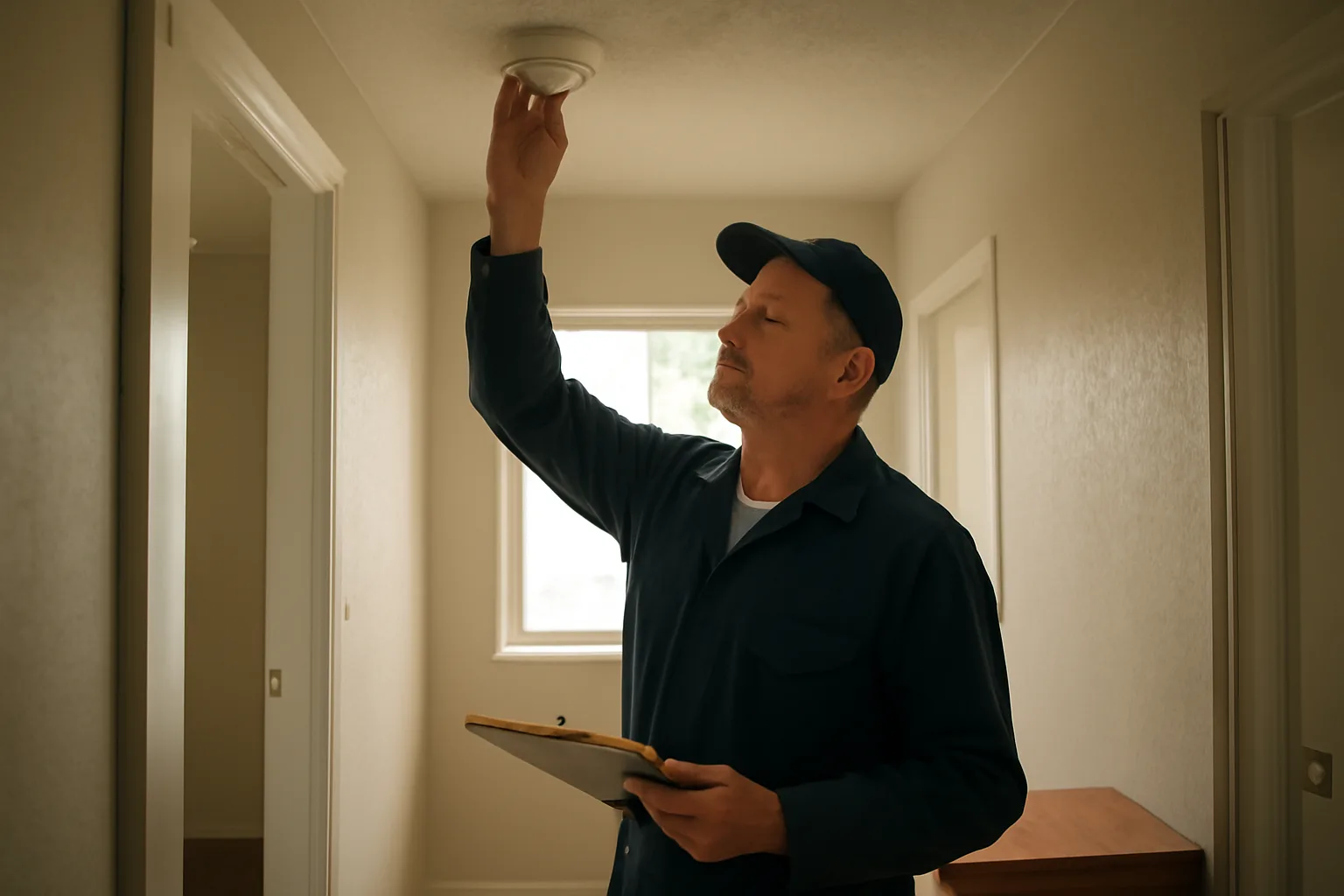
During a routine or license-renewal inspection, a landlord or city inspector can generally check anything related to habitability and code compliance: smoke and carbon monoxide detector function, plumbing and water heater condition, electrical panels and outlets, heating system operation, window and door locks, handrails and stair conditions, pest evidence, and mold or moisture damage. What they generally can't do, even during a legitimate inspection, is search through your personal belongings, closets, or drawers beyond what's needed to check the condition of fixtures and systems. An inspection is about the condition of the unit, not an excuse to go through your things. Most state landlord-tenant statutes and city inspection ordinances limit the inspector's scope to visible conditions and systems, not personal property searches. For city-run licensing inspections specifically, the inspector is usually checking against a written code checklist: egress windows, functioning smoke alarms in every bedroom, GFCI outlets near water sources, no exposed wiring, adequate heat source, and structural safety items like handrail height and step conditions. Ask your city's rental licensing office for the actual inspection checklist ahead of time; most publish one, and walking in blind is how avoidable items turn into a failed inspection and a reinspection fee.
How much notice does a landlord have to give before entering a unit or ending a tenancy?
Notice requirements split into two very different categories: notice to enter for a routine visit or inspection, and notice to end a tenancy. Both are set by state law, and both vary meaningfully by state, so treat any single number here as a starting point, not your state's actual rule. For entry notice, many states set 24 hours as the standard for non-emergency entry (repairs, showings, inspections), though the exact number and the required delivery method (written, posted, verbal) differ by state. California requires "reasonable notice," which the same Civil Code section presumes to be 24 hours in writing for most non-emergency purposes [6]. Some states specify 48 hours instead. Emergencies (fire, flooding, gas leak) generally allow entry without advance notice in every state. For ending a tenancy, notice periods depend on the tenancy type and the reason. Month-to-month tenancies commonly require 30 days' notice to terminate without cause, though many states bump that to 60 or 90 days once a tenant has lived there past a certain length (often one year), and some cities layer additional "just cause" eviction protections on top of the state minimum. Nonpayment of rent notices are usually shorter, often 3 to 14 days depending on the state, before a landlord can file for eviction. Because these numbers vary this much, check your specific state's landlord-tenant statute (usually titled something like "Residential Landlord and Tenant Act") rather than relying on a generic rule of thumb.
Why do landlords require renters insurance?
Landlords require renters insurance mainly to shift liability and personal property risk away from the landlord's own policy. A landlord's insurance covers the building structure and the landlord's liability; it typically doesn't cover a tenant's personal belongings if there's a fire, theft, or water damage, and it usually doesn't cover a tenant's guest getting hurt inside the unit due to the tenant's own negligence. Renters insurance closes that gap. It's also cheap relative to the protection it gives: national estimates commonly put average renters insurance premiums in the range of $15 to $30 per month depending on coverage limits and location, though your local market may run higher or lower [5]. For a landlord, requiring it as a lease condition means a tenant's water damage claim, a dog bite claim, or a stovetop fire is far less likely to become the landlord's financial problem or a lawsuit naming the landlord directly. Many landlords also like that renters insurance policies include liability coverage that protects the landlord if the tenant is at fault for damage to the unit itself, like an unattended candle fire. It's a low-cost requirement that meaningfully reduces the landlord's exposure, which is why it shows up as a standard lease clause in a large share of rental markets, though it isn't legally mandatory in most states unless the local lease or program requires it.
What rights do tenants have without a lease?
A tenant without a signed lease still has legal rights. If someone is paying rent and living in a unit with the landlord's knowledge, most states classify that as a month-to-month tenancy at will, governed by the same state landlord-tenant statute that governs written leases, just without the specific terms a written lease would otherwise lock in. That means the tenant still has a right to habitable housing, still has a right to proper notice before the landlord enters, and still has a right to proper notice before the tenancy ends (usually 30 days for month-to-month, though state and local rules vary as covered above). The tenant is also still entitled to a return of any security deposit under the state's deposit rules, and the landlord still can't shut off utilities or change locks to force someone out without going through the formal eviction process, in every state that has "self-help eviction" bans (which is most of them). What a tenant without a lease loses is the certainty a written lease provides: locked-in rent for a fixed term, specific rules about subletting, specific maintenance responsibilities, and a defined end date. Without those terms in writing, the relationship defaults to whatever the state's baseline landlord-tenant law says, and disputes about "what was agreed" become harder to prove. If you're a landlord letting someone move in without paperwork, that ambiguity cuts both ways and it's genuinely not worth the savings of skipping a lease.
What a landlord cannot do in Ohio
Ohio's landlord-tenant law is codified in Ohio Revised Code Chapter 5321. Under it, an Ohio landlord cannot enter the rental unit without giving the tenant reasonable notice of intent to enter and entering only at reasonable times, except in an emergency . Ohio courts and the statute generally treat 24 hours as reasonable notice, though the code itself uses the "reasonable" standard rather than a fixed number. An Ohio landlord also cannot engage in retaliatory conduct against a tenant for exercising a legal right, such as reporting a code violation. Ohio Revised Code 5321.02 specifically bars a landlord from increasing rent, decreasing services, or bringing eviction action against a tenant because that tenant complained to a governmental agency about a building, housing, or health code violation . An Ohio landlord cannot shut off utilities, remove doors or windows, or seize a tenant's belongings to force them out, self-help eviction methods that are illegal statewide; the landlord has to go through the formal eviction (forcible entry and detainer) process in municipal or county court. Ohio landlords also can't ignore their own maintenance duties under ORC 5321.04, which requires keeping the premises in a fit and habitable condition, complying with applicable building and housing codes, and keeping common areas safe . If your Ohio property is also in a city with its own rental licensing ordinance (Columbus, Cincinnati, and several other Ohio cities run local registration or inspection programs), that adds a separate layer of city-level requirements on top of the state code.
What happens if you rent without a required license?
Consequences vary by city, but they tend to fall into three buckets: fines, a rent-collection problem, and inspection escalation. Fines are the most common first step. Cities typically issue a notice of violation with a deadline to apply, followed by escalating fines (sometimes per day) if the landlord doesn't comply. Some cities' fine schedules run into the hundreds of dollars per violation, and repeat or willful noncompliance can escalate further. The rent-collection problem is less obvious but often more painful. Some cities and some state courts have held that a landlord operating an unlicensed rental cannot legally collect rent, or that a tenant can raise the lack of license as a defense in an eviction action. This isn't universal and depends heavily on your specific city's ordinance language, but it's a real risk in places like Los Angeles under REAP, where unresolved habitability violations tied to unregistered units can restrict a landlord's ability to collect full rent [1]. Inspection escalation means a city can flag the property for more frequent inspection, place a hold on future permits (like a certificate of occupancy for a sale), or in serious cases refer the property to a housing court. None of this is guaranteed to happen fast, and enforcement intensity varies a lot by city budget and staffing, but the risk compounds the longer a rental stays unlicensed after the city sends a notice.
How do I find and apply for my city's rental license?
Start with your city's website and search for "rental registration," "rental license," or "certificate of occupancy, rental unit." Most cities host this under a Building Department, Code Enforcement Department, or Department of Neighborhood Services. If you can't find it online, call city hall and ask directly whether residential rentals require registration or licensing. Once you find the right office, the application typically asks for the owner's name and mailing address (a real one, not a PO box, in most ordinances), the property address and unit count, and the name of a local contact person if the owner lives out of state or out of the city. Many cities require this local agent specifically so code enforcement has someone to reach quickly for emergencies. After the application, expect a scheduled inspection (sometimes immediate, sometimes weeks out depending on inspector availability) before the license is issued. Getting the unit ready ahead of that visit, fixing the obvious stuff like dead smoke detectors and missing GFCI outlets before the inspector shows up, is the single biggest lever you have over whether you pass on the first try. If you want a structured way to walk through that prep without guessing at your specific city's checklist, the City Rental License & Inspection Prep Packet is built for exactly that first-time application and inspection process, for a flat $79.
Frequently asked questions
What is a rental license in simple terms?
A rental license is a permit from your city government that legally allows you to rent out a residential unit. It usually requires an application, a fee, and often a habitability inspection before it's issued, and it typically needs to be renewed on a set schedule set by your city.
How to become a landlord if I've never rented a property before?
Confirm the property can legally be rented (zoning, HOA, mortgage terms), get the unit inspection-ready, set consistent written screening criteria, get landlord insurance, and apply for any required city rental license before advertising or signing a lease. Skipping the license step until after tenants move in is the most common early mistake.
Who is responsible for a rental property walk-through inspection in California?
The landlord schedules and coordinates the walk-through inspections, but California Civil Code Section 1950.5 gives tenants the right to request a pre-move-out inspection with at least 48 hours' written notice, so they can fix deductible items before the final assessment against their security deposit.
What is landlording?
Landlording is the ongoing work of owning and managing rental property for income: screening tenants, collecting rent, handling repairs, keeping the unit up to code, and following state landlord-tenant law on notice, entry, and security deposits. It's the day-to-day operation, not the one-time act of buying a property.
What is a landlord, legally?
A landlord is the property owner, or an authorized agent of the owner, who leases residential or commercial space to a tenant for rent. The role carries legal duties, including maintaining habitable conditions under most states' implied warranty of habitability, like California Civil Code Section 1941.1.
What rights do tenants have without a signed lease?
A tenant paying rent with the landlord's knowledge, even without a written lease, is usually treated as a month-to-month tenant under state law. They still get habitability protections, entry notice rights, standard termination notice (often 30 days), and security deposit return rights.
How to be a landlord who stays compliant with rental licensing rules?
Track your city's renewal date on a calendar, keep the unit's smoke detectors and safety systems in working order year-round, respond to code complaints quickly, and check your city's rental licensing office page annually since fee schedules and inspection rules change.
Why do landlords require renters insurance?
Renters insurance protects a tenant's personal belongings and covers tenant liability for accidents or damage they cause, none of which the landlord's own building policy covers. Requiring it, at a typical cost of roughly $15 to $30 a month, reduces the landlord's own financial exposure at very little cost to the tenant.
How much notice does a landlord have to give before entering a rental unit?
Most states require some form of advance notice for non-emergency entry, commonly presumed to be 24 hours in writing (California's standard), though some states set 48 hours. Emergencies like fire or flooding don't require advance notice. Check your specific state's landlord-tenant statute for the exact rule.
What can a landlord look at during a rental inspection?
An inspector or landlord can check smoke and carbon monoxide detectors, plumbing, electrical systems, heating, window and door locks, stairs and handrails, and signs of pests or moisture damage. They generally can't search personal belongings or areas unrelated to the unit's physical condition and code compliance.
What a landlord cannot do in Ohio specifically?
Under Ohio Revised Code Chapter 5321, an Ohio landlord can't enter without reasonable notice, can't retaliate against a tenant for reporting code violations (ORC 5321.02), can't shut off utilities or change locks to force a tenant out, and can't ignore the duty to keep the unit fit and habitable under ORC 5321.04.
Do all cities require a rental license?
No. Rental licensing is set by local ordinance, not federal or usually state law, so requirements exist only in cities and counties that have adopted them. Hundreds of U.S. cities do, concentrated in the Midwest and Northeast, but neighboring towns can have entirely different rules. Confirm with your specific city's licensing office.
What happens if I rent out a unit without the required license?
Expect an escalating fine schedule after a violation notice, and in some cities a restriction on your ability to legally collect rent until you're licensed. Some cities also allow tenants to raise the missing license as a defense in an eviction case. Rules and severity vary a lot by city.
Sources
- Los Angeles Housing Department, Rent Escrow Account Program (REAP) and Systematic Code Enforcement Program: Los Angeles runs REAP and SCEP inspection programs that can restrict rent collection on non-compliant rentals
- U.S. Department of Housing and Urban Development, Fair Housing Act overview: Consistent tenant screening criteria is required to comply with the federal Fair Housing Act
- California Legislative Information, Civil Code Section 1941.1: California law lists specific habitability conditions a landlord must maintain, including plumbing, heating, and smoke detectors
- California Legislative Information, Civil Code Section 1950.5: Tenants can request a pre-move-out inspection with at least 48 hours written notice, and 24-hour notice is presumed reasonable for entry
- Ohio Revised Code Section 5321.04, Landlord obligations: Ohio landlords must give reasonable notice before entry except in emergencies, and must keep premises fit and habitable
- Ohio Revised Code Section 5321.02, Retaliatory conduct prohibited: Ohio landlords cannot retaliate against tenants who report code violations to a government agency