Last updated 2026-07-26
TL;DR
Fix working smoke and CO alarms, clear egress paths, test every outlet and fixture, and document existing damage before the inspector arrives. Most cities give tenants and owners written notice (often 24 to 48 hours, check your local ordinance), and inspectors generally look at life-safety systems, structural condition, and code compliance, not your tenant's housekeeping.
What does a rental inspector actually check?
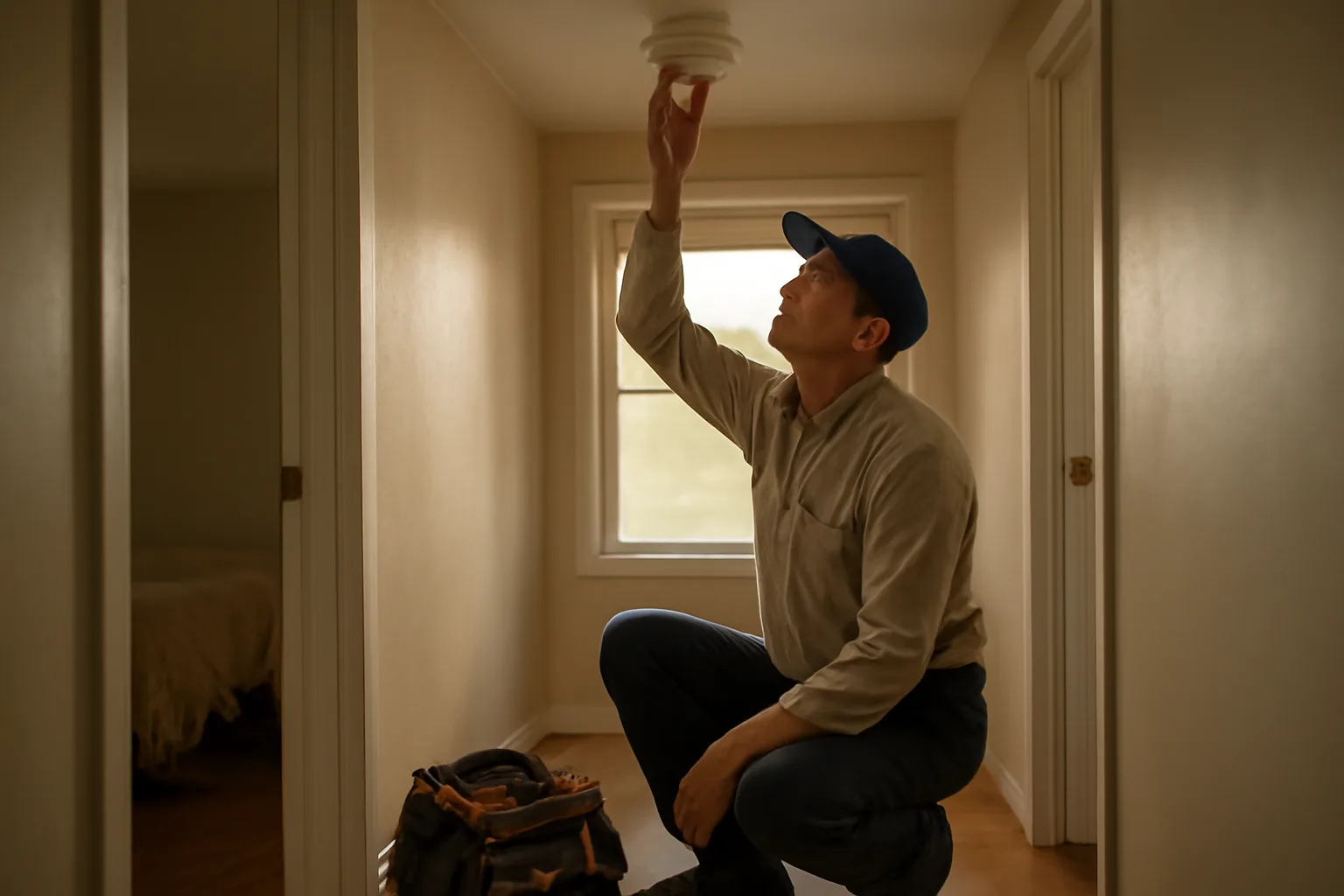
A rental inspector is looking for life-safety hazards first, then general code compliance. That means working smoke alarms and carbon monoxide detectors, clear exits, functioning heat, no exposed wiring, no active leaks, and a structure that isn't falling apart. Most municipal rental inspection checklists follow some version of the International Property Maintenance Code (IPMC), which many cities adopt directly or adapt into local ordinance. Expect the inspector to test smoke detectors by pressing the button (not always by triggering smoke), check GFCI outlets in kitchens and bathrooms, run water in every sink and tub, flush toilets, open and close windows to confirm they lock and aren't painted shut, and look at the water heater for a temperature/pressure relief valve and proper venting. They'll usually check the electrical panel for double-tapped breakers or obvious DIY wiring, look at handrails on stairs with more than a few steps, and check for peeling paint if the building was built before 1978 (a lead paint concern under federal law, see HUD's lead-based paint disclosure rule) [1]. They are not grading your tenant's cleaning habits. A pile of dishes in the sink isn't a violation. A missing smoke detector is. If you're not sure what your specific city checks, call the rental licensing or code enforcement office directly and ask for the inspection checklist in writing. Many cities publish theirs; if yours doesn't, confirm with your city rental licensing office before the appointment.
What can a landlord look at during an inspection?
During a landlord's own walkthrough (separate from a municipal inspection), you can generally check anything related to the condition of the unit: appliances, plumbing, HVAC, walls, floors, windows, smoke detectors, and signs of unauthorized pets, unreported occupants, or unreported damage. You are not entitled to search through a tenant's personal belongings, drawers, or closets under the guise of a maintenance check. The legal boundary is usually "reasonable purpose." California's Civil Code section 1954, for example, lists the specific reasons a landlord may enter: to make repairs, show the unit to prospective tenants or buyers, in an emergency, or when the tenant has abandoned the property [2]. Most states have a similar list, though the exact wording and notice period varies. If you're prepping for a city inspection, do your own walkthrough first. Look at what the municipal inspector will look at: alarms, outlets, egress windows, handrails, and the water heater. Fixing these yourself before the city shows up is almost always cheaper than a violation notice and a re-inspection fee.
Who is responsible for a rental property walkthrough inspection in California?
In California, the landlord is responsible for arranging entry and for giving proper notice, and the tenant has a right to be present. Under Civil Code section 1954, a landlord must give "reasonable notice in writing," and 24 hours is presumed reasonable absent circumstances suggesting otherwise [2]. The statute also requires landlords to enter only during normal business hours unless the tenant agrees otherwise. For move-in and move-out condition walkthroughs specifically, California Civil Code section 1950.5(f) gives tenants the right to request an initial inspection before move-out, with the landlord required to give at least 48 hours' written notice of that inspection and to provide an itemized list of deficiencies afterward [3]. This is separate from a city-mandated rental inspection program; some California cities (Los Angeles has its Systematic Code Enforcement Program, for instance) run their own periodic inspection cycles with their own notice rules, so confirm with your specific city rental licensing office for program-specific timing.
How much notice does a landlord have to give before an inspection?
| California (state law) | 24 hours (presumed reasonable) | Civil Code 1954 [2] |
|---|---|---|
| Move-out pre-inspection (CA) | 48 hours | Civil Code 1950.5(f) [3] |
| Florida (state law) | Reasonable notice, no fixed hours specified | Fla. Stat. ch. 83 [4] |
| Many municipal rental inspection programs | 24 to 72 hours (varies by city) | Confirm with your city rental licensing office |
Most states require some form of written notice, and 24 hours is the most common baseline, though it ranges from no statutory requirement at all to 48 hours in a handful of jurisdictions. California presumes 24 hours' notice is reasonable under Civil Code 1954 [2]. Florida's landlord-tenant statute (Chapter 83) doesn't set a specific number of hours but requires the landlord to give reasonable notice, which courts have generally treated as at least 12 hours [4]. Some cities layer their own inspection-specific notice rules on top of state landlord-tenant law, so a municipal rental license inspection might require 48 or even 72 hours' notice to the tenant even if state law would allow less. Here's the honest complication: state landlord-tenant law governs routine entry for repairs or showings, but a city's mandatory rental inspection program is a separate legal track with its own notice requirements, sometimes written into the municipal code rather than state statute. Don't assume your state's 24-hour rule covers a city inspection. Check the actual ordinance or call the rental licensing office and ask them directly: "what notice period applies to this specific inspection?" A rough comparison of common notice periods: | Jurisdiction type | Typical notice for routine entry | Notes |
How do I prepare each room for a rental inspection?
Go room by room, days before the appointment, not the morning of. Kitchen: test every burner and the oven, run the garbage disposal, check under the sink for leaks or mold, confirm the GFCI outlet trips and resets, and make sure the fire extinguisher (if required by your city) is charged and not expired. Bathrooms: check for slow drains, running toilets, caulking gaps around the tub, and exhaust fan function. A bathroom without a working exhaust fan or operable window is a common violation in cities that require mechanical ventilation. Bedrooms: confirm every bedroom has a compliant egress window (most codes require a minimum opening size and a sill height no more than 44 inches from the floor, per the International Residential Code's egress requirements) [5], and that smoke detectors are installed per local code, often inside each bedroom and outside each sleeping area. Common areas and exterior: check handrails on any stairway with three or more risers, look at exterior paint condition, clear egress paths of any stored items, and make sure house numbers are visible from the street, a surprisingly common cited violation. Utility spaces: the water heater needs a temperature and pressure relief (TPR) valve with a discharge pipe extending to within 6 inches of the floor, and the furnace or boiler needs clear combustion air space and no visible rust or soot around the flue.
How to become a landlord (the basics before you take on tenants)
Becoming a landlord is mostly administrative before it's anything else. You buy or convert a property, you check your local zoning and rental licensing requirements, you get the unit up to code, and you register or license it if your city requires that (many do; some don't require anything beyond a business license). The practical steps: confirm the property is zoned for rental use, check whether your city or county requires a rental license or registration (search "[your city] rental registration" or call code enforcement directly), get a landlord-friendly insurance policy (a standard homeowner's policy usually doesn't cover a rental, you need a landlord or dwelling policy, sometimes called a DP-3), screen tenants under the Fair Housing Act's protected classes (race, color, national origin, religion, sex, familial status, and disability, per 42 U.S.C. 3604) [6], and use a written lease. Most new landlords underestimate the paperwork side: rental license applications, lead paint disclosures for pre-1978 buildings [1], security deposit handling rules (which vary hugely by state, some cap the deposit at one or two months' rent, some require interest-bearing accounts), and habitability standards you're on the hook for regardless of what the lease says.
What is landlording and what is a landlord?
A landlord is the owner (or an authorized agent of the owner) of a residential property who rents it to a tenant in exchange for payment, usually under a lease or rental agreement. "Landlording" is the informal term for the ongoing work of managing that relationship: collecting rent, maintaining the property, handling repairs, following notice and entry rules, and staying compliant with local and state law. It's not passive income in the way people sometimes imagine it. You're the one who fields the 11pm no-heat call, the one who has to know whether your city requires a rental license renewal every year or every three years, and the one legally responsible for habitability even if you've handed day-to-day management to a property manager. HUD's landlord and tenant resource page frames the core obligation simply: providing and maintaining a safe, decent, sanitary home [7]. If you own even one rental unit in a city with a licensing or registration ordinance, you're a landlord under that ordinance whether or not you think of yourself as "in the rental business."
What rights do tenants have without a lease?
A tenant without a written lease still has legal rights. In most states, a tenant paying rent without a signed lease becomes a "tenant at will" or a month-to-month tenant by operation of law, and state landlord-tenant statutes still apply in full. That means the right to a habitable unit, protection from illegal lockouts or utility shutoffs, the right to proper notice before eviction, and (in states with rent control or just-cause eviction ordinances) the same protections a leased tenant would have. The absence of a written lease mostly affects notice periods for ending the tenancy. Without a lease specifying a term, most states require 30 days' written notice to terminate a month-to-month tenancy, though some require less for short tenancies and some cities with just-cause eviction laws require a stated legal reason regardless of lease status. Verbal agreements to pay rent are still enforceable contracts in most states, just harder to prove in a dispute. A landlord who wants clear terms should always use a written lease. But "no lease" never means "no rights." It's one of the more common misunderstandings new landlords have, and it can get expensive if you act on the wrong assumption.
Why do landlords require renters insurance?
Landlords require renters insurance mainly to shift liability and cover the tenant's own belongings, since a landlord's property insurance policy almost never covers a tenant's personal property or a tenant-caused injury to a third party. If a tenant's negligence causes a kitchen fire, or their dog bites a visitor, renters insurance (typically $15 to $30 a month for a modest policy, though this varies by coverage amount and region) is what pays that claim instead of the landlord's policy or the landlord's own pocket. It also protects the landlord indirectly: a tenant with renters insurance is less likely to sue the landlord for lost belongings after a covered event like a burst pipe or fire, because their own policy pays out first. Many landlords require proof of a policy with a minimum liability limit (commonly $100,000) as a lease condition, and some require the landlord to be listed as an "interested party" on the policy so they're notified if it lapses. This isn't a rule tied to any single statute; it's a lease requirement a landlord chooses to impose, and it's legal in nearly every state as long as it's applied consistently and disclosed in the lease.
What can a landlord not do in Ohio?
Ohio's landlord-tenant law (Ohio Revised Code Chapter 5321) spells out specific things a landlord cannot do. A landlord cannot enter the rental unit without giving "reasonable notice" (Ohio courts and the statute generally treat 24 hours as reasonable) except in an emergency, per ORC 5321.04(A)(8) [8]. A landlord cannot shut off utilities, change the locks, or remove a tenant's belongings to force them out; this is illegal "self-help eviction," and Ohio requires landlords to go through the courts (ORC 5321.15) [9]. A landlord also cannot retaliate against a tenant for reporting a code violation or asserting a legal right; ORC 5321.02 specifically prohibits retaliatory conduct like raising rent, decreasing services, or filing eviction within a certain period after the tenant's complaint . And a landlord cannot ignore habitability duties: ORC 5321.04(A) requires landlords to comply with building and housing codes, keep common areas safe, and maintain plumbing, heating, and other essential services in good working order [8]. Ohio also caps how a security deposit can be handled: if a landlord withholds any part of a deposit, ORC 5321.16 requires an itemized, written notice of deductions within 30 days of the tenant vacating, and failure to do so can expose the landlord to damages .
What happens if I fail a rental inspection?
Failing a rental inspection almost never means immediate license revocation. It usually triggers a written notice of violation with a correction deadline, typically 30 to 90 days depending on the severity and your city's ordinance, followed by a re-inspection (often for an additional fee, confirm the amount with your city rental licensing office). Life-safety violations (no smoke detector, blocked egress, exposed wiring, no heat) tend to get shorter correction windows, sometimes as little as 5 to 10 days, because they're treated as immediate hazards. Cosmetic or lower-severity code issues (a cracked window screen, minor paint issues) usually get the longer window. Repeated failures or ignored notices are what actually escalate things: municipal fines that accrue daily, referral to a housing court, or in rare cases suspension of the rental license, which can make it illegal to collect rent from the unit until it's resolved. The single best move after a failed inspection is to call the inspector or the code office the same week, ask exactly what needs fixing and by when, and get the re-inspection scheduled before the deadline instead of after it.
How to be a landlord day to day (staying inspection-ready year-round)
The landlords who never sweat an inspection notice are the ones who treat code compliance as ongoing maintenance, not a fire drill. Test smoke and CO detector batteries at every tenant turnover. Walk the exterior twice a year and note anything that's degrading, like peeling paint or a loose handrail, before it becomes a violation. Keep a simple maintenance log with dates, because inspectors and courts both respond well to documentation showing you acted promptly on repair requests. Renew your rental license or registration on time; a lapsed license is one of the most common and easily avoidable violations cities cite, and late renewal fees add up fast in cities that charge penalty percentages per month overdue. Keep copies of every inspection report, lease, and disclosure in one place, because when a city sends an ordinance notice or a violation letter, you want to be able to answer with dates and documents, not memory. If you manage rentals across multiple cities, each with its own licensing cycle, fee schedule, and inspection checklist, the paperwork side gets genuinely hard to track by hand. That's the specific gap the Rental Permit Path $79 City Rental License & Inspection Prep Packet is built for: a one-time packet that pulls together your city's checklist, renewal timing, and required disclosures so you're not reconstructing it from scratch every renewal cycle.
Frequently asked questions
How much notice does a landlord have to give before an inspection?
Most states require written notice, commonly 24 hours, though some require none and a few require up to 48 hours. California presumes 24 hours reasonable under Civil Code 1954. City-run rental inspection programs often have their own notice rules layered on top of state law, sometimes 48 to 72 hours, so confirm with your specific city rental licensing office.
What can a landlord look at during an inspection?
A landlord can inspect the general condition of the unit: appliances, plumbing, electrical, smoke detectors, signs of damage, and unauthorized pets or occupants. A landlord cannot search personal belongings or use an inspection as a pretext to harass a tenant. Entry must be for a legitimate purpose and with proper notice under state law.
Who is responsible for a rental property walkthrough inspection in California?
The landlord is responsible for scheduling the walkthrough and giving proper written notice, generally 24 hours for routine entry under Civil Code 1954, or 48 hours for a pre-move-out inspection under Civil Code 1950.5(f). The tenant has the right to be present. Municipal inspection programs may have separate, city-specific notice requirements.
What is landlording?
Landlording is the ongoing work of owning and managing a rental property: collecting rent, handling repairs, keeping the unit habitable, following entry and notice rules, and staying compliant with local licensing or inspection requirements. It's an active legal and financial responsibility, not passive income, even if you hire a property manager.
What is a landlord?
A landlord is the owner, or an authorized agent of the owner, of a residential property who rents it to a tenant under a lease or rental agreement in exchange for payment. Landlords carry legal duties around habitability, notice for entry, security deposit handling, and, in many cities, rental licensing or registration.
What rights do tenants have without a lease?
A tenant without a written lease still has full legal protections under state landlord-tenant law, usually as a month-to-month or at-will tenant. That includes the right to a habitable unit, protection from illegal lockouts, and required notice (commonly 30 days) before the tenancy can be ended.
Why do landlords require renters insurance?
Renters insurance covers the tenant's belongings and liability for damage or injury they cause, which a landlord's property policy doesn't cover. It reduces the chance a tenant sues the landlord after a fire or leak, and it's a common lease requirement, often with a minimum liability limit around $100,000.
What can a landlord not do in Ohio?
Under Ohio Revised Code Chapter 5321, a landlord cannot enter without reasonable notice except in an emergency, cannot shut off utilities or change locks to force a tenant out, cannot retaliate against a tenant for reporting a code violation, and must keep the unit compliant with building and housing codes.
How do I become a landlord?
Confirm your property is zoned for rental use, check whether your city requires rental registration or licensing, get a landlord insurance policy, screen tenants under Fair Housing Act protected classes, and use a written lease. Many first-time landlords underestimate the licensing and disclosure paperwork required before the first tenant moves in.
What happens if my rental fails inspection?
You typically get a written violation notice with a correction deadline, often 30 to 90 days for standard issues and as little as 5 to 10 days for life-safety hazards like a missing smoke detector. A re-inspection follows, sometimes for a fee. Ignoring the notice is what leads to escalating fines or license suspension.
Do I need to be present for a rental inspection?
Usually the property owner or a designated agent should be present, though requirements vary by city. Some municipal programs require the owner or manager to attend; others allow the tenant to grant access alone. Check your city's rental inspection notice for specific attendance requirements.
What's the difference between a landlord's own walkthrough and a city rental inspection?
A landlord's walkthrough is a private check of unit condition, governed by state landlord-tenant entry law. A city rental inspection is a government compliance check tied to a rental license or registration, governed by municipal ordinance, and can result in official violations, fines, or license action if it fails.
Sources
- California Legislative Information, Civil Code Section 1954: California landlord entry notice requirements and 24-hour reasonable notice presumption
- California Legislative Information, Civil Code Section 1950.5: Tenant right to request pre-move-out inspection with 48 hours' written notice
- Florida Legislature, Statutes Chapter 83: Florida landlord-tenant law requiring reasonable notice for entry
- International Code Council, International Residential Code, Section R310 (Emergency Escape and Rescue Openings): Egress window minimum size and sill height requirements for bedrooms
- HUD, Tenant Rights, Laws and Protections: Landlord obligation to provide a safe, decent, sanitary home
- Ohio Revised Code Section 5321.04: Ohio landlord obligations including reasonable notice for entry and code compliance duties
- Ohio Revised Code Section 5321.15: Prohibition on self-help eviction methods like utility shutoff or lockout in Ohio
- Ohio Revised Code Section 5321.02: Ohio's prohibition on landlord retaliation against tenants who report code violations
- Ohio Revised Code Section 5321.16: Ohio security deposit itemized deduction notice requirement within 30 days